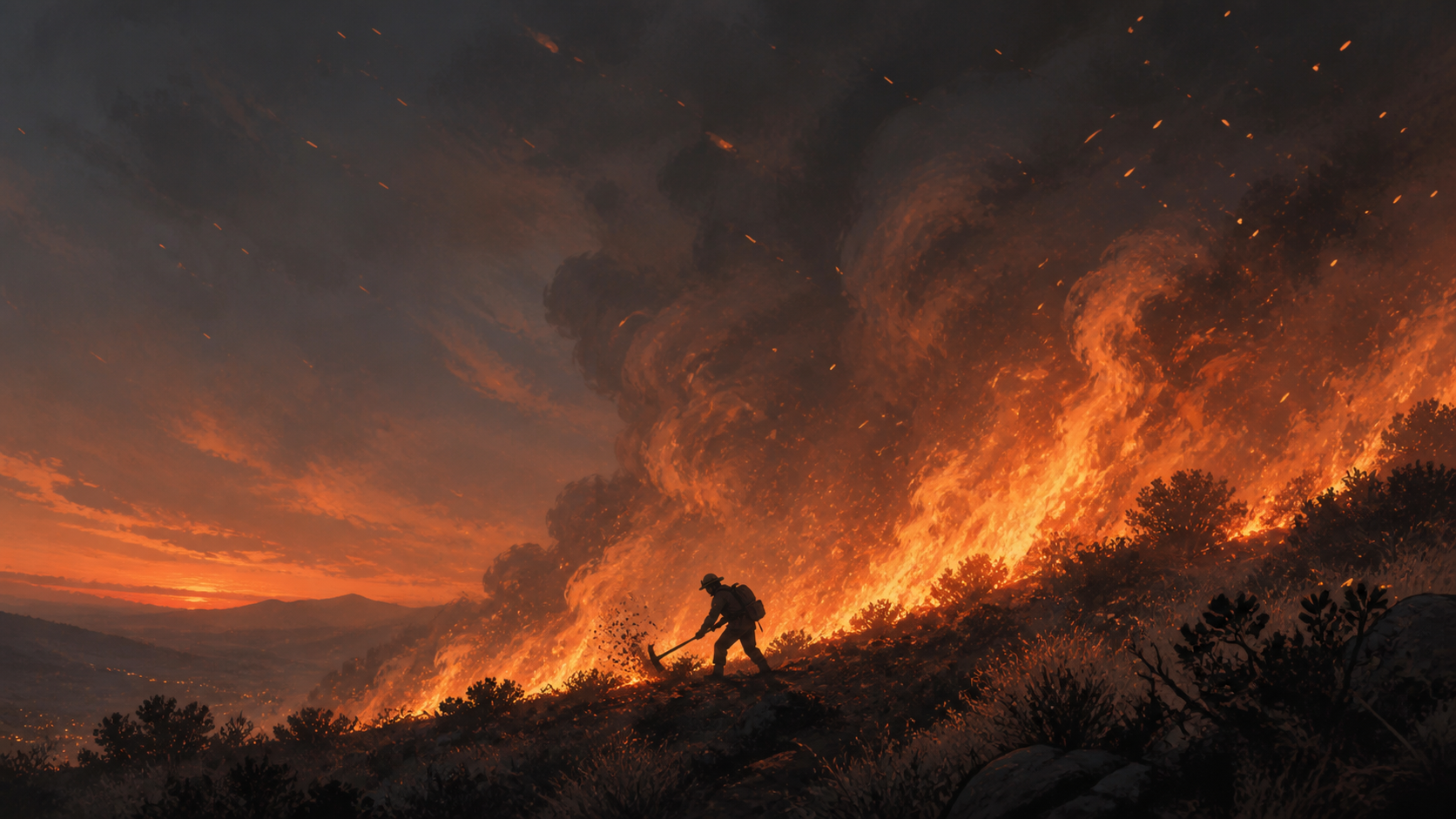
Fans of Into the Breach who want the same idea stretched into a full campaign: an enemy you can read, not a villain you can out-talk. They also want the squad stakes of Jagged Alliance 3, a crew they've named and worried about, without a war behind it. Grounded disaster-response fiction over fantasy conflict.
Contemporary American West-style fire country: dry ridgelines, chaparral draws, small towns built right up against wildland. Painterly, stylized illustration rather than photoreal disaster footage. No named real places, no real incidents referenced. The color language tracks the fight, from calm green-gray brush to ember-orange as containment slips.
Each of five crew members gets two actions: Move, Cut Line, Backburn, Carry a survivor, or Hydrate a teammate. Then the fire resolves — spreading by fuel type, wind, and slope, with embers that can spot across a line you thought was safe.
Deploy onto a hand-built fireground against a containment target and an imperfect wind forecast. Extract survivors, hold structures, contain the perimeter. Back at Fire Camp, spend Command Points on gear and pick tomorrow's incident from a board where ignored fires keep growing.
- Fire Spread Simulation — the entire opposing force is a per-tile cellular automaton driven by fuel, moisture, slope, and wind, always shown one turn ahead through the Fire Behavior overlay.
- Cut Line / Backburn Toolkit — a defense/offense verb pair built for the theme: cutting a line is slow and safe, backburning is fast but a wrong bet against the wind aims a second fire at your own crew.
- Wind Forecast — a probability track, not a guarantee, so every incident is planned against a likely shift rather than a scripted one.
- Rescue & Structure Triage — survivors, animals, and structures each run their own fire-tolerance clock; the campaign tracks what you couldn't reach in time instead of pretending everything gets saved.
- Regional Map That Doesn't Wait — unaddressed fires grow a ring of tiles every week you skip them and can merge into something much bigger, turning the meta-layer into real triage.
- Crew Dossiers & Burnout — injuries over permadeath, but a crew member pushed too far will refuse a dangerous order or quit the roster at season's end.
- The opposing force is a fire-behavior simulation, not an army: legible and deterministic, but it adapts to every tile you burn or clear, so no incident plays the same way twice.
- Cut Line and Backburn are a genuinely new tactical verb pair; getting the second one wrong is a self-inflicted second fire, not a missed attack roll.
- Objectives are triage, not elimination: losing some survivors, animals, or structures is a designed, tracked outcome rather than a fail state.
- A regional map where ignored problems compound on their own schedule, whether or not you're looking at them.
- Grounded, contemporary-adjacent stakes in a genre built almost entirely on fantasy and war.
Week 1 builds the fire spread simulation on its own. Week 2 adds crew actions and the Stamina economy. Week 3 layers in Heat Exposure, Carry, and the wind forecast. Week 4 introduces ember spotting and structure triage. Week 5 wires up Fire Camp and a two-incident regional week. Week 6 delivers a three-incident vertical slice for external playtesting, tuned against where runs actually fail.