PC Game Concept · Immersive Sim
Object
Permanence
You are dead, invisible, and stuck in one house — so you move people the only way left to you: by moving their things.
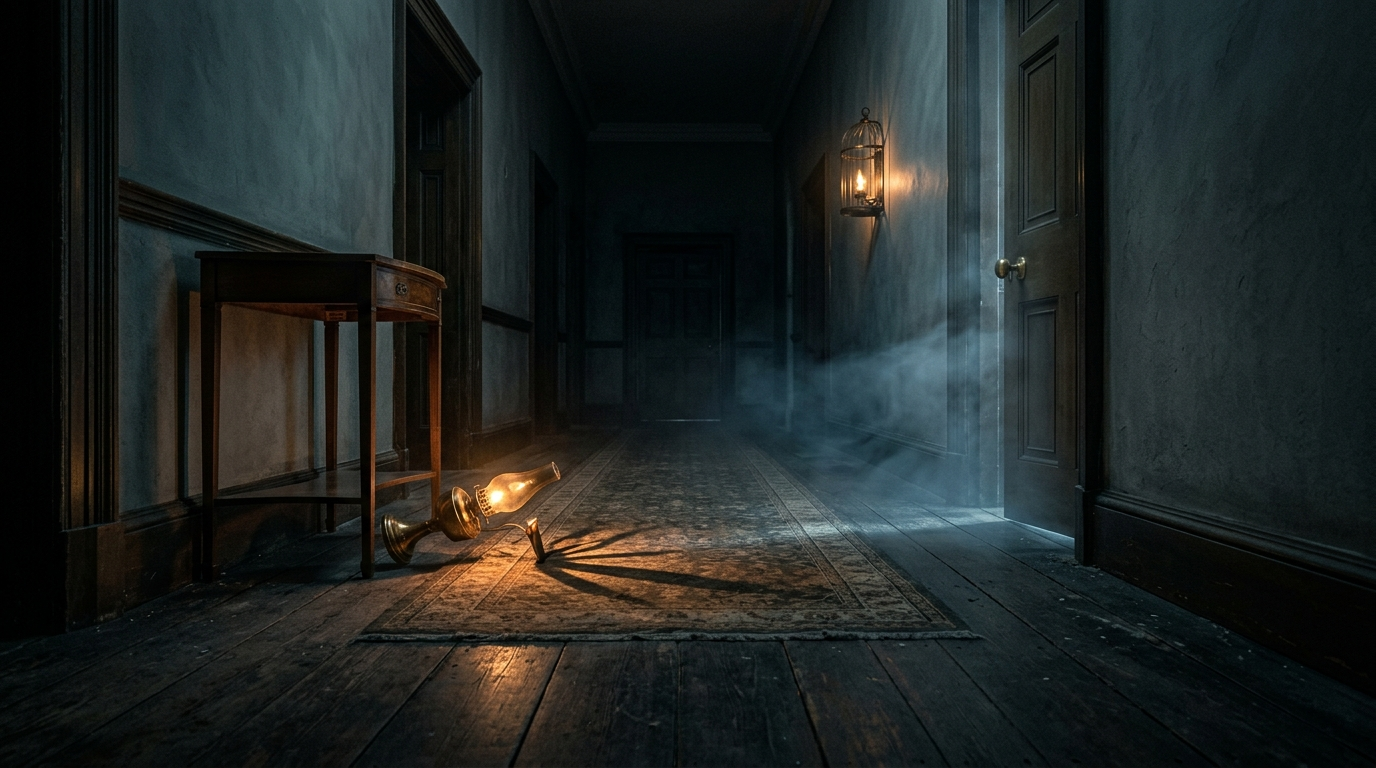
Every other imsim gives you a body. This one doesn't.
Dishonored gives you Blink. Prey gives you a GLOO cannon. Ctrl Alt Ego lets you hop between robot hosts. Object Permanence removes the host entirely — you're a presence in a convalescent home who can only possess objects: a lamp, a door, a kettle, a floorboard. You move people by staging incidents they interpret through their own psychology. No weapon. No dialogue wheel. No body, ever.
For the Shadows of Doubt three-time finisher
You've read Ctrl Alt Ego's pitch and wondered what happens if you take the body away for good. You don't need combat — a level is a machine you lean on until it surprises its own designer. You liked Obra Dinn for the deduction and Gone Home for the idea that a house can carry a plot on its own.
The Loop
30 seconds of possession, 30 minutes of consequence
30-Second Loop
- Possess a reachable object
- Spend Presence to act on it
- NPC notices or doesn't
- Belief shifts: Mundane or Uncanny
- Traverse to the next linked object
30-Minute Loop
- Pick a thread for the night
- Spend your Presence budget steering it
- The house runs its own routines regardless
- Dawn breaks; the loop resets
- The house remembers what you did
Systems
The house is a wiring diagram. The people are two counters and a personality curve.
Possession Graph
Every object sits on a node linked by a real physical medium — shared wiring, shared plumbing, shared air, mechanical linkage. You move only along real connections. The floor plan becomes something you learn by touch.
Belief, Not Health
Each NPC carries two independent counters — Mundane and Uncanny — that both rise from unexplained events. Whichever crosses its threshold first decides how they act. Same event, different character, different outcome.
Presence Economy
Every act costs Presence, regenerating slowly at anchors tied to your former life. Big theatrical acts risk a flare — a moment where sensitive NPCs can actually perceive your shape. For once, you're the one who gets caught.
Night-Loop Memory
The house keeps a diary you don't get to read. A maid who fled a flickering lamp on night two arrives on night four already carrying rowan. Your own competence becomes next night's obstacle.
Threads
Two or three situations run concurrently each night — a poisoning, a forced confinement, a theft. Solving one cleanly can make another harder: the witness you scared into hiding was the only one who could've stopped the other plot.
Anchors & Memory
Possessing objects from your former life triggers short, wordless vignettes piecing together how you died. Optional texture, never a gate — ignore it for a dozen nights and still finish every thread.
Key Features
What makes Object Permanence distinct in a genre built around embodiment
-
You are never a person, and the game never gives you one — no body to upgrade, no weapon to find, ever. Agency routes entirely through indirect object manipulation and other people's belief systems.
-
Persuasion is emergent, not authored — no dialogue wheel, no charisma stat. The same flickering lamp reads as faulty wiring to the skeptic and the dead walking to the superstitious kitchen girl.
-
Your own success is the difficulty curve — the house's cross-night memory means the elegant solution you found on night two gets specifically harder to repeat on night four.
-
Sensitive NPCs flip the jump scare — during a flare, a rare few characters can actually perceive your shape. For once, the invisible thing is the one at risk of being caught.
-
No single good ending — the campaign locks in a mosaic ending built from which threads you resolved, ignored, or botched across eight to ten nights, not a completion percentage.
Ashcombe House, early 1930s
A converted manor on the Scottish coast, serving as a convalescent home for shell-shocked officers, difficult wives, and guests whose families paid for discretion rather than treatment. No bleeding walls, no demons — the dread here is closer to cold morning fog than a scream.
A held breath, not a scream
Muted, overcast coastal light — sea-grey plaster, lamp-oil amber, damp charcoal shadow — closer to the restrained dread of The Innocents than any modern horror shooter. No blood, no combat animation. The tension is entirely in watching a domino chain land exactly where you meant it to, or not.
6-Week Prototype Plan
From one wired room to a playable night