Target Player
Fans of Disco Elysium's character depth and Her Story's intimacy who want investigation driven by psychological acuity — not item collection. They take notes while playing. They want to feel perceptive, not just systematic.
Core Loop
Read a witness's Performance State, choose when to push or hold back, resolve contradictions between testimonies, and reconstruct the prop room's staged "accident" — all inside a single theater building, over one pivotal night.
Setting
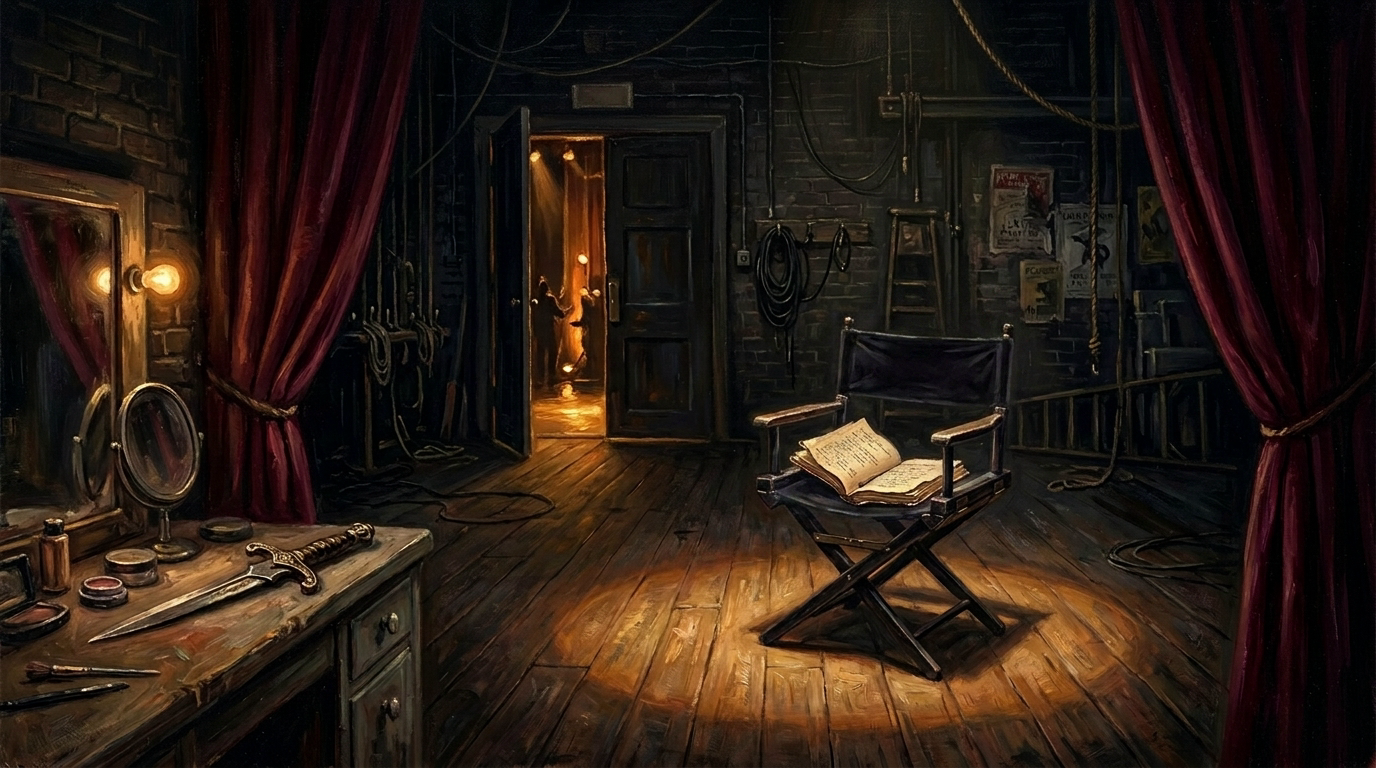
The Meridian Theatre, London, 1973. Edmund Hargreaves — 55, celebrated and feared — is found dead in the prop room the night before opening a play called The Inheritor, a drawing-room drama about a poisoning in an aristocratic family. The irony is not lost on anyone. Art direction: warm amber footlights against velvet black, the controlled glamour of the stage against the clutter and grime of the wings. Tone: the cool intelligence of a Highsmith novel, attentive to class, ambition, and the small violences people commit inside institutions they cannot leave.
Core Systems
- Performance Meter Every NPC exists on a three-state scale — In Character, Cracking, Raw. Read behavioral tells and time your interventions to access deeper conversation branches.
- Testimony Web Statements are tracked as nodes. Contradictions generate tension lines; resolving each one triggers cascading reveals that unlock new threads with other characters.
- Prop Room Reconstruction Spatially reassemble the staged crime scene — each correctly placed object unlocks a deduction that narrows the suspect pool.
- Script Marginalia Edmund's annotated rehearsal script is the primary artifact. His director's shorthand doubles as cryptic character assessments: the victim as posthumous detective.
- Reputation Economy Publish speculation too early and witnesses close off. Wait too long and the prop room is cleared. Managing when to act is as important as knowing what to do.
- Backstage Geography Shared walls, fly-system logistics, and sightlines from the wings make certain alibis physically impossible. The building itself is an alibi-checking tool.
Key Features
- Performance-as-Epistemology: every witness is a trained actor, making the usual "spot the liar" heuristic insufficient — the core mechanic is distinguishing authentic emotion from performed behavior
- Closed-room theatrical setting with no equivalent in the detective genre — a 1970s London repertory company where the milieu generates motive, alibi, and character in equal measure
- The Director as Posthumous Detective: Edmund's annotated rehearsal script as the primary evidence artifact, making the victim an active collaborator in solving his own murder
- Intimacy over width — 8–10 named characters, one building, one night; every NPC has a complete arc rather than a clue-delivery function
- Morally complex conclusion: the killer's motive is entangled with Edmund's own documented cruelties, denying clean catharsis and inviting the player to choose which truth to publish
- New Game Plus adds Edmund's own perspective — diary entries and observations from the fortnight before his death, retrofitted into scenes the player has already cleared
Differentiators
-
01Performance-as-Epistemology The Performance Meter is not a minigame — it is the investigative premise. Every witness is both a potential liar and a professionally trained performer, which means the usual "spot the liar" heuristic is insufficient. Players must distinguish performing for Constance from performing for themselves.
-
02Theatrical Milieu No detective game has been set backstage in a working theater company. The setting delivers a natural closed-room structure and an ensemble cast with legible, competing motives — without requiring elaborate worldbuilding.
-
03The Director as Posthumous Investigator Edmund's annotated script is a novel primary-evidence mechanic. Players collaborate with the dead man to solve his own murder — creating emotional stakes unusual for the genre.
-
04Depth over Width Eight to ten characters, one building, one evening. Against the genre trend toward sprawling case boards, The Understudy commits to character depth. Every NPC has a complete arc; no one exists only to deliver a clue.
-
05Moral Undercurrent The killer's motive is entangled with Edmund's own cruelties. The game does not exonerate the killer, but it does not permit clean catharsis either. Constance's final article can take multiple honest tones; the player chooses which truth to foreground.