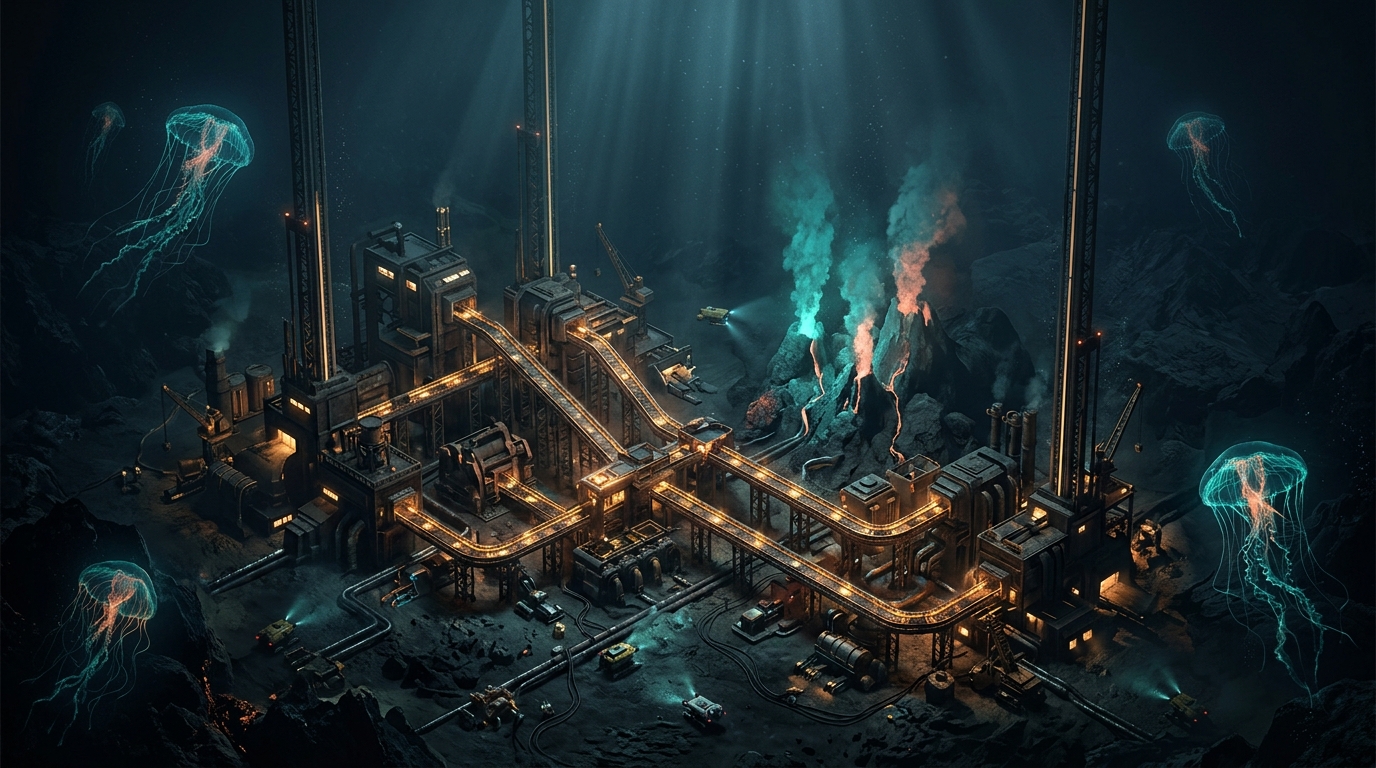
Pressure Lines key art — deep-sea automated factory
Automation / Factory Sim PC · Windows · Keyboard & Mouse Concept

Pressure Lines

You are the sole engineer of an autonomous deep-sea mining fleet — design the systems, route the conveyors, manage the pressure bands, and keep the abyss from swallowing what you built.

Factory sim veterans who've launched Factorio's rocket and finished Satisfactory's Phase 4 — and are tired of the same surface-world rocky biome with alien-bug combat. They're drawn to Subnautica-style discovery but frustrated that game never let them build the megafactory the setting deserved. They want environmental physics to matter: a setting where placement decisions carry physical consequences, not just throughput math.

Three pressure bands. Three design philosophies.

🌊
Photic Zone · 0–200 m
Low pressure · Tier 1 components · Belt-only logistics
Abundant but low-grade ore. Where every run begins. Forgiving enough to learn; thin enough to motivate going deeper.
🔵
Bathyal Zone · 200–3,000 m
Medium pressure · Tier 2 rated components · Slurry pipes unlock
Richer deposits. First Fauna Events. Phase Separators required to move ore as pressurized slurry — your whole belt logic must adapt.
🟠
Hadal Zone · 3,000 m+
Extreme pressure · Fully enclosed pipelines only · Exotic minerals
Dissolved-compound logistics replace conveyors entirely. Solids cannot survive at this depth. A complete redesign of your extraction philosophy.

The core loop

30-second loop
Place a component. Verify its Pressure Rating. Check flow-type consistency across adjacent connections — ore belts cannot feed slurry pipes without a Phase Separator. Confirm power coverage. Three simultaneous constraint axes, no time pressure, immediate visual feedback on every error.
30-minute loop
Deploy a survey drone → wait for seabed map → identify resource nodes → design extraction circuit → lay conveyors & pipelines → watch throughput climb → manage the Seismic Signature before megafauna emerge → scale to maximum sustainable yield → go deeper.
Full playthrough arc
From manual shelf mining to the Deep Hub milestone: a fully autonomous Bathyal station that manages its own repair Crawlers and reroutes around fauna without player input. You graduate from planner to strategist.

What drives the factory

〰️
Three-Phase Flow
Resources travel as Solids (belts), Slurries (pumped pipes with pressure-loss curves), or Dissolved Compounds (membrane separators). Phase transition points — where you convert between them — are the central logistics puzzle.
🌀
Current Grid
Directional ocean floor currents cycle every 30 in-game minutes. Belts running with the current gain 15 % speed; against it, they lose 15 %. The Current Overlay reveals the live vector field. Designing arteries along dominant currents is a measurable skill ceiling.
🔊
Seismic Signature & Fauna Events
Each extractor adds to the zone's Seismic Signature. Exceed the threshold and bioluminescent megafauna emerge and physically damage infrastructure. There is no combat — you manage acoustic footprint: vibration dampeners, throttled extractors, or rerouted conveyors.
📡
Autonomous Survey Drones
The map is blank until you survey it. Drones are built in-factory and return after a depth-dependent timer. Deep drones risk loss if sent into active Disruption zones — a risk/speed tension around every expansion decision.
⬆️
Surface Riser Network
All processed material must reach the surface through vertical risers with fixed bandwidth limits. Riser congestion creates factory-wide backpressure. Building more factory without adding riser capacity eventually stalls everything — a hard constraint that shapes every layout decision.
🔧
Maintenance Decay
Equipment degrades over time. You must produce Maintenance Kits within your own factory (alloy + polymer → assembly line → kits) and dispatch Repair Crawlers. A factory that doesn't supply its own maintenance eventually fragments — creating an internal demand loop that persists at every scale.

What's in the pitch

Why this stands apart

01
Pressure as a design constraint
Depth bands require genuinely different component sets — not tier upgrades. Going deeper means redesigning your pipeline philosophy from scratch.
02
Current-aware logistics
Directional ocean currents are live throughput modifiers. Routing arteries with the current instead of against it is a meaningful skill expression absent in every other factory sim.
03
No combat — noise management
Stealth-through-efficiency: manage your factory's seismic footprint to avoid disrupting megafauna. A mechanic vocabulary new to the genre.
04
Vertical bandwidth constraint
All output rises through finite riser slots. A hard chokepoint that shapes every layout decision — unlike the genre's usual "bigger is always better" ethos.
05
Scout before you build
The map is dark until surveyed. Survey drones can be lost. Incomplete information and exploration risk are first-class mechanics, not just flavor.

Opportunity snapshot

$24.99
Price point
EA
12-month early access
The deep-sea setting is unoccupied in factory automation — every major sim is surface-world. Aquatico and Surviving the Abyss prove the underwater niche has Steam appetite; neither is a factory automation game. Subnautica's ~4 M Steam owners are an adjacent, accessible conversion target.