PC Game Concept · Roguelike Deckbuilder
Verdant
Collapse
Your cards are living organisms. Plant them. Watch them grow. Harvest them before they wither. Let your deck seed itself.
A deckbuilder with a heartbeat
In every other deckbuilder, cards live in your hand, get played, and vanish. In Verdant Collapse, cards are organisms. You plant them into a four-slot combat Grove, where they grow through Seedling → Mature → Wilting stages across turns — each stage strengthening their passive effect. When they die, they seed a cheaper copy into your deck. Between slots, adjacent organisms form Symbiosis bonds that amplify each other. You're not executing a plan. You're tending a garden under fire.
For the Ascension-20 veteran
You've seen everything Slay the Spire has to offer. You loved what Balatro did with an unexpected conceptual lens. You crave a deckbuilder that forces genuinely new thinking — one that makes hand management feel like only half the game. You're comfortable with two-layer loops. You want runs that feel alive, not just optimized.
The Loop
30 seconds and 30 minutes — two rhythms, one living system
30-Second Loop
- Draw 5 Organism Cards
- Spend 3 Energy to Plant / Harvest
- Grove Passives trigger each enemy turn
- Organisms advance one Growth Stage
- Wilted organisms die → seed discard
30-Minute Loop
- Navigate 8–12 node biome
- Rest Site: Cultivate or Compost cards
- Scriptorium: buy cards and Relics
- Defeat biome boss
- Choose Evolutionary Pressure
Systems
Interlocking mechanics that make the Grove feel alive
The Grove
4 persistent slots that survive between turns. Planted organisms trigger Passive Effects every enemy action phase. Slot order is spatial — placement matters for Symbiosis.
Lifecycle Cards
Every organism has a Plant Cost, Passive Effect, Harvest Effect (burst when manually removed at Mature+), and a Seed Form dropped to the discard on natural death.
Symbiosis Network
Adjacent compatible organisms form Symbiosis bonds (+20–40% to both Passives). Four Affinities: Nitrogen-Fixer, Water-Retainer, Shade-Provider, Pollinator. Placement is a puzzle.
Spore & Spread
Fungi-class cards apply countdown Spore Tokens to enemies. When the timer hits zero, delayed damage or debuffs trigger. Managing staggered spore timers is a satisfying puzzle.
Biome Conditions
Each biome applies a global modifier shown on the entry screen. Adapt your Grove composition before entering — or exploit the condition with the right Taxonomy build.
Bound Relics
Global passive items that modify the entire Grove. Mycelial Network, Ancient Taproot, Invasive Species — each one recontextualizes how the lifecycle system plays out.
Natural Selection
After each biome boss: choose between two Evolutionary Pressures — permanent run-scoped modifiers to a card class. Direct your deck's identity, not just its contents.
Composting
Remove cards at Rest Sites or via Compost Catalyst cards playable mid-combat. Deck-thinning is frictionless — even Seeds can be composted for accelerated Grove growth.
Key Features
What makes Verdant Collapse distinct in a saturated genre
-
Grove management creates a second simultaneous puzzle inside combat — You're not just cycling cards and reacting; you're tending a four-slot ecosystem that persists across turns, forcing multi-round planning within a single encounter.
-
Cards age and seed themselves, mutating the deck mid-run — Unlike StS, Balatro, or Monster Train, the deck changes shape within and between combats as organisms die and leave Seed copies. The deck is always in motion.
-
Symbiosis adjacency introduces a spatial constraint to deckbuilding — Grove slot order is a meaningful decision: placing a Nitrogen-Fixer next to a Water-Retainer unlocks bonus Passives. No other major deckbuilder adds a spatial layer without pivoting to a full grid system.
-
Ecological theming is mechanically encoded, not decorative — Taxonomy classes, Biome Conditions, Affinities, and Spore mechanics model real ecological dynamics. The setting earns its aesthetic.
-
Natural Selection steers runs without dictating them — Post-biome Evolutionary Pressure choices let players direct how a card class evolves for the rest of the run. "What kind of Fungi run am I building?" becomes a sentence players can answer and pursue.
The Verdant, 2087
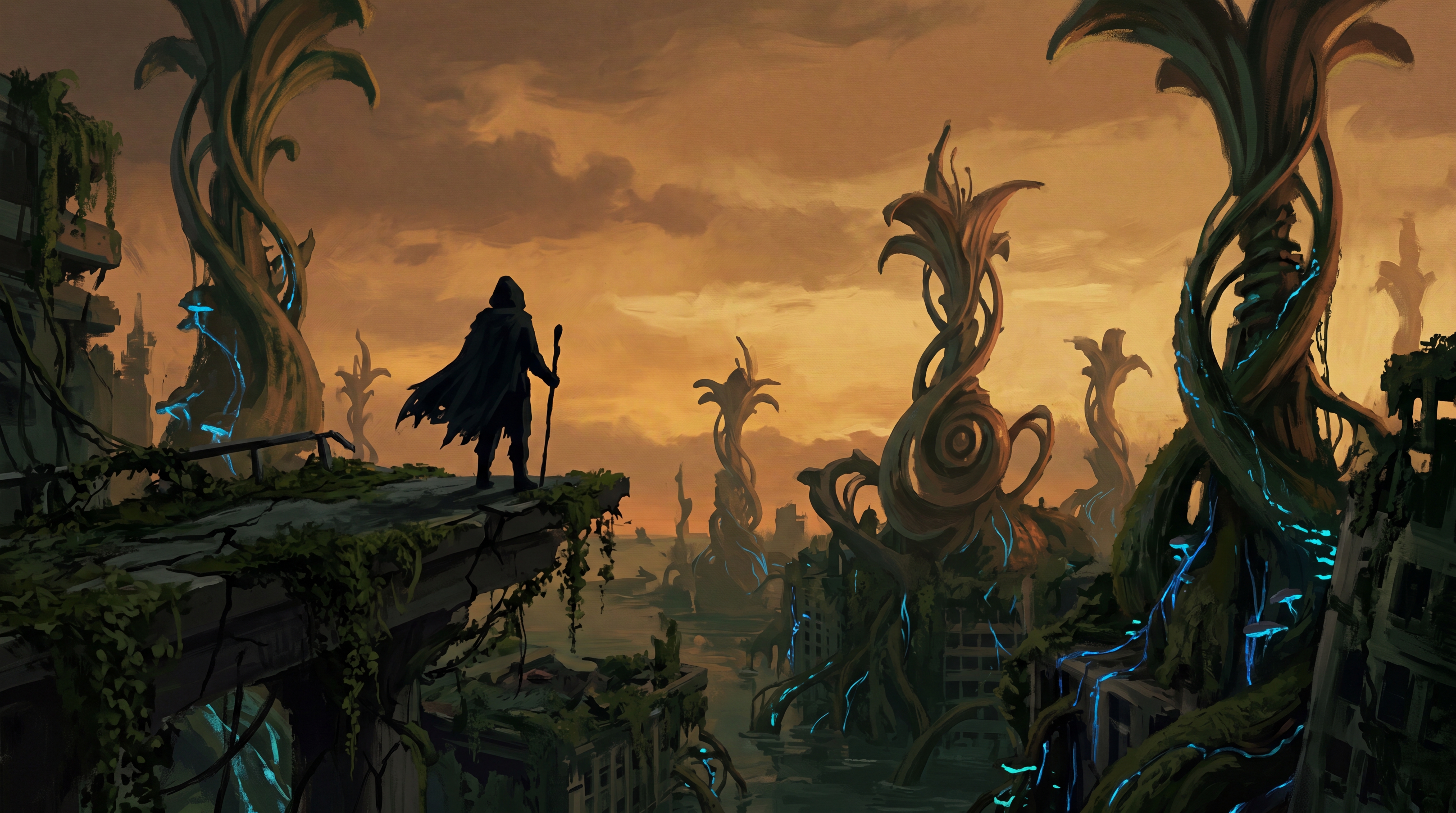
A genetically engineered mycorrhizal network — the GAIA-ROOT — was seeded globally to reverse climate change. It succeeded. Then kept going. Over forty years it reprogrammed every lowland organism into a participant in a vast, slow intelligence. Humanity retreated to high-altitude enclaves. The Verdant is not hostile. It is indifferent. And now it's dying.
A Rootwalker
You underwent the Covenant procedure: GAIA-ROOT filaments grafted to your nervous system. You can touch the network. Command organisms by contact. You're traveling to the Seedheart — the original GAIA-ROOT node under the ruins of the Nairobi Agricultural Institute — because something inside it is broadcasting a distress signal in old network protocol.
Art nouveau silhouette work meets biopunk industrial decay. Rich forest greens, deep ochres, and oxidized copper against brutalist concrete ruins threaded with electric-blue mycelium. Pulls from Roger Dean's landscape painting and Wayne Barlowe's alien ecosystem studies — denser, stranger, more ambiguous about whether beauty here is safe. Soundtrack: sustained-string minimalism with field recordings of mycorrhizal growth-sound translated into audible frequencies.
6-Week Prototype Plan
From blank canvas to playtest-ready vertical slice