The loop
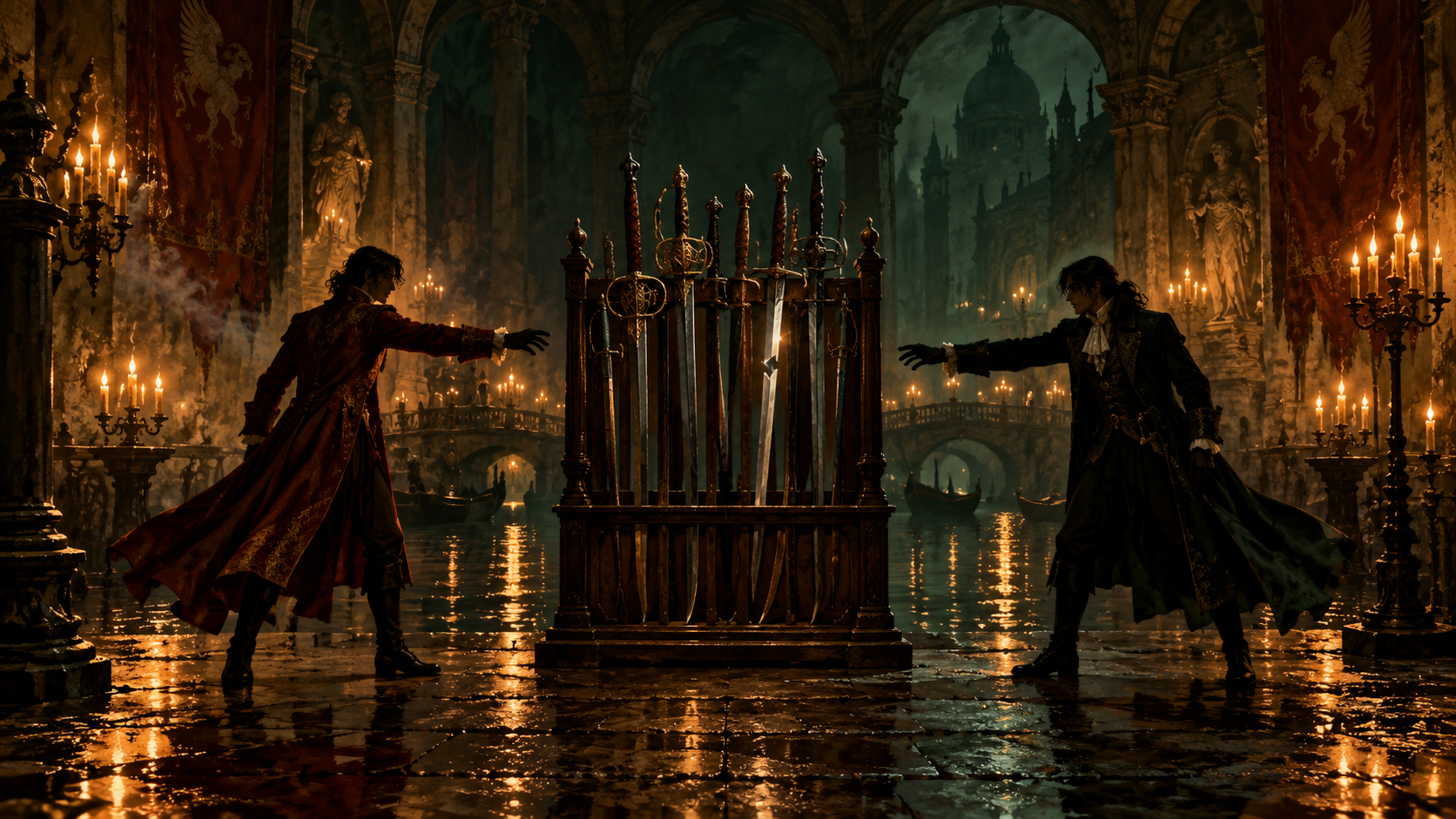
Strike with the blade in your hand or set it back on the shared rack where your opponent draws next, notching the blades you can't afford to hand over, while every blade you win joins the rack the next duelist draws from.
One turn, thirty seconds
- Draw the top card of the Rack, the single pile you share. Its top card, the peg, is always face-up.
- Spend 3 Breath on Cuts, Parries, Feints and Binds.
- Rack one card for free: on top to choose the opponent's next draw, or on the bottom to bury it.
- Cards you fed them stay face-up in their hand. Their intent shows exact damage for those and a range for the rest.
- A notched blade in their grip turns and does nothing. In yours it cracks; three cracks and it shatters.
Who it's for
Players with hundreds of hours in Slay the Spire who know the decisions by heart, Inscryption fans who liked having someone across the table, and draft players who know every pick is also a pick denied.
Standout systems
The shared Rack
Your deck is the draw pile for both duelists. Each opponent shuffles in a 2–4 card kit for the duel, and you can draw it too.
Racking
A free action once per turn that sets the opponent's next draw. It's the only tool that acts on their next hand.
Notches
Start with 3, earn about one every 2–3 duels. They make a blade fail for the enemy and crack it a little for you.
Read state
Every card in the opponent's hand is known or blind. Good players win with 3 of 4 known.
The ramp, one new pressure per step
| Step | Where | New pressure | Values |
|---|---|---|---|
| 0 | Act 1, duels 1–3 | None: learn racking | Guard 18–24, draw 1 from top |
| 1 | Act 1 elite | Variety: Cutpurse draws from bottom | Guard 34, kit 3 |
| 2 | Dockmaster | Density: 2 plays a turn | Guard 70, Breath 4 |
| 3 | Act 2 | Speed: opponents draw 2 | Notch income 1 per 3 duels |
| 4 | The Inspector | Cognitive: files your notches off | Guard 48 |
| 5 | Guildwarden | Compound: racks at you and draws 2 | Guard 110 |
| 6–7 | Act 3 · Magistrate | Precision: audit exiles 2 blades per duel | Guard 45–60 · 160 |
Differentiators
Every reward is two-sided
A blade you take after a fight is a blade the next opponent can draw. Neither Slay the Spire 2 nor Inscryption asks you to weigh that.
You choose their draw
Racking sets what the opponent gets next, and the cards you fed them stay visible, so reading their turn depends on what you gave them.
Sabotage wears your own steel
Notched blades fail for the enemy but crack in your hand, so the more you sabotage, the faster your rack falls apart.
Key features
- One draw pile shared by both duelists: every blade you add to your deck is one your next opponent can draw and use against you.
- Rack a card on top of the pile to decide your opponent's next draw, then watch it sit face-up in their hand.
- Notch a blade so it fails in enemy hands, but every time you swing it yourself it cracks, and three cracks shatter it.
- Steal a boss's signature blade off the peg mid-duel and keep it for the rest of the run.
- Three acts through the drowned salles of the Delta, where you fight as a hired proxy against bravos, inspectors and the magistrate who wrote the rules.
- Strictly turn-based with undo, no timers, shape-coded cards, and a known-card overlay that lists everything you know about the opponent's hand.
Six weeks to a slice
Weeks 1–2
Grey-box duel with the shared Rack, racking, known/blind hands, and a greedy AI. Testers log how many opponent cards they know when they win.
Weeks 3–4
Notches, cracks, the Statute of Twelve, then a full Act 1 map with the Dockmaster boss.
Weeks 5–6
Art and sound pass, the notch shader, then an 8-person playtest. Pass if 6 of 8 can explain racking unprompted.