News 2026-09-11
Science & Space Digest — Sep 11, 2026
OpenAI says its AI has made a major breakthrough on the Navier-Stokes problem, one of the seven Millennium Prize Problems—famous unsolved mathematics challenges with $1 million prizes.
Open report
Science & Space Digest — Sep 11, 2026
Week of: Sep 11, 2026
Discovery of the Week
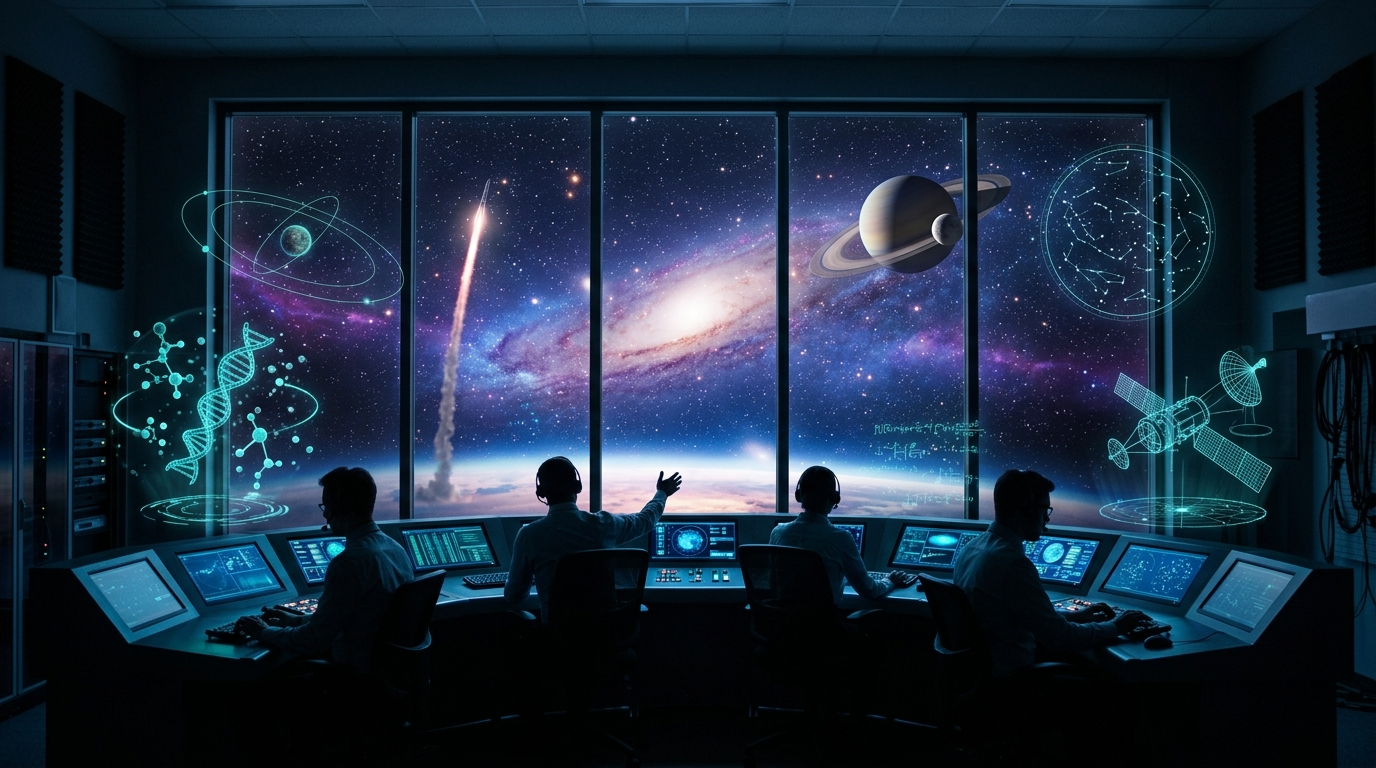
OpenAI says its AI has made a major breakthrough on the Navier-Stokes problem, one of the seven Millennium Prize Problems—famous unsolved mathematics challenges with $1 million prizes. Navier-Stokes equations describe how fluids (liquids and gases) flow, and proving their behavior rigorously is central to physics and engineering. Mathematicians are now urgently checking what the AI actually proved, and a controversy has erupted over who deserves credit. (Nature News; Science Magazine News)
Space Missions & Astronomy
- German company becomes first in Europe to launch fully commercial orbital rocket — A German firm sent a commercial rocket to orbit, a first for Europe. Significance: High. (Ars Technica Science)
- NASA moves to create first U.S. Space Academy — NASA is organizing the new academy to train the future aerospace workforce after an executive order. Significance: Medium. (NASA News)
- Webb sees dust and water in the Milky Way’s center — JWST’s mid-infrared view of the region around Sagittarius A* reveals oxygen-rich silicate dust and water signatures. Significance: Medium. (NASA News)
- Australian satellite firm expands in India — LatConnect 60 signed agreements to market its SWIRSAT Earth-observation satellite in India. Significance: Low. (SpaceNews)
Life Sciences & Medicine
- AI genome atlas charts all nine billion human mutations — DeepMind’s system predicts the effects of every possible single-letter DNA change, helping doctors interpret which mutations matter. Significance: High. (Nature News)
- Particles aim to breach the blood–brain barrier — Researchers are developing drug-delivering particles to cross the brain’s protective filter, which normally blocks most medicines. Significance: High. (Nature News)
- Farmed salmon may be less nutritious than it once was — A shift in salmon feed appears to lower the fish’s nutritional value and affect the environment. Significance: Medium. (Ars Technica Science)
- Tiny “microhabits” can boost wellbeing — Short mindfulness practices may work as well as long ones, making them easier to keep. Significance: Low. (New Scientist)
- Data leak shuts a top research biobank — A major store of biological samples and data was forced to close after a leak, and its recovery offers lessons. Significance: Medium. (Nature News)
Physics & Materials
- Quantum mechanics meets relativity in atom experiment — Physicists placed atoms in a superposition of trajectories—meaning each atom existed in multiple paths at once—to probe how quantum theory and relativity interact. Significance: High. (Ars Technica Science)
- Atomic collisions that create gas pressure detected — A new twist on a classic Brownian motion experiment—observing random particle jiggling—detects individual atomic collisions and could test quantum theory. Significance: Medium. (Science Magazine News)
- Eggshell-inspired armor for spacecraft — 3D-printed aluminum eggshell arrays filled with water were more effective at resisting impacts, suggesting a new way to shield spacecraft from space debris. Significance: Medium. (Ars Technica Science)
Climate & Earth Science
- Nepal disaster shows need to plan for compound climate risks — The disaster is a wake-up call to prepare for multiple climate hazards striking together, not just one at a time. Significance: High. (Nature News)
- El Niño goes viral, teaching scientists about climate communication — El Niño—a periodic Pacific warming that shifts weather worldwide—went viral, and researchers studied why to learn what makes people care about climate. Significance: Medium. (Nature News)
- Italian hunting bill would sideline science — Proposed legislation would loosen hunting rules and reduce the role of an environmental research body in wildlife decisions. Significance: Medium. (Science Magazine News)
Technology-Driven Science
- NASA and IBM launch AI model for lunar science — A new open-source AI foundation model—a large system trained on broad data and adaptable to many tasks—is built specifically to help analyze the Moon’s surface. Significance: Medium. (NASA News)
- New “challenge atlas” picks science problems for AI — Researchers identified four complex physics problems now within AI’s reach. Significance: Medium. (Science Magazine News)
Upcoming: Launches & Publication Dates
No major developments captured this week.
More from News
🌍 World & Geopolitics Briefing
2026-09-26

IAM & Security Weekly Briefing
2026-09-26
AI Model & Benchmark Watch — September 25, 2026
2026-09-25

AI Projects - September 25, 2026
2026-09-25

AI Tool Updates - September 25, 2026
2026-09-25

General AI News - September 25, 2026
2026-09-25

MCP Protocol News - September 25, 2026
2026-09-25
Science & Space Digest — Sep 25, 2026
2026-09-25
🏛️ Tech Policy & Regulation Watch
2026-09-24
🔬 Emerging Technology Watch
2026-09-24
⚡ Energy Industry Briefing
2026-09-23
🎬 Media & Creator Economy Watch
2026-09-22