The Search For Life On Europa And Enceladus
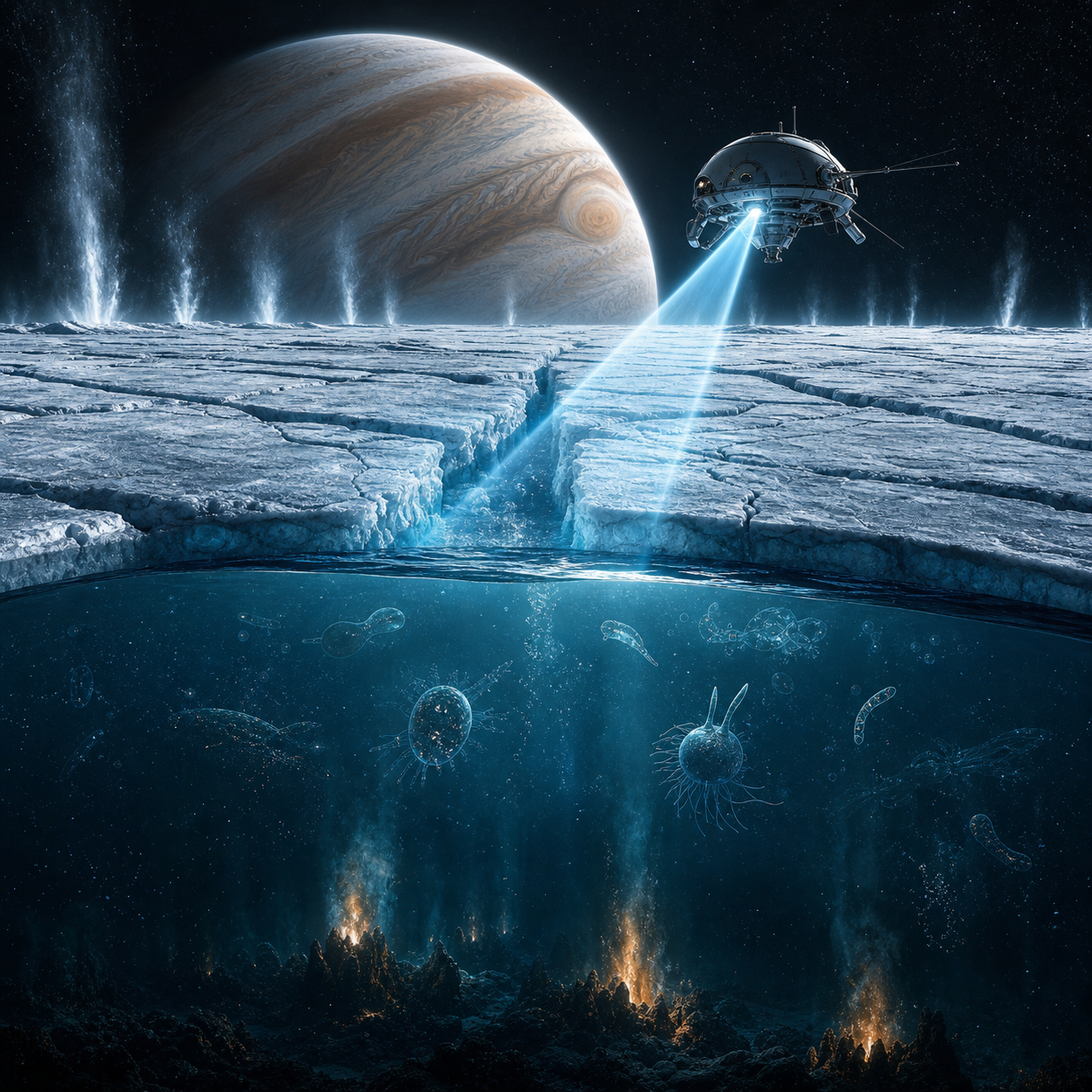
The Search for Life on Europa and Enceladus
Date: 02-05-2026 Group: Group1 Host: Dr. Penelope Hartwell Cast: Alien Andy, Flat-Earth Fred, Prepper Paul, Rex "The Truth" Sterling
Topic Description
Tonight on Hartwell, the unflappable Oxford-educated host invites four of the most committed contrarians on the panel circuit to discuss the search for life on Jupiter's moon Europa and Saturn's moon Enceladus — two ocean worlds buried beneath miles of ice that, depending on whom you ask, are either the most exciting astrobiology targets in the solar system or yet another alphabet-agency theatre production. Dr. Hartwell quietly walks the cast through ocean-world habitability, the upcoming probe missions, what alien microbes might actually look like, and the planetary-protection rules meant to stop us from contaminating either body — while declining, with great courtesy, to be moved by a single one of their answers.
Script
Dr. Penelope Hartwell
Good evening. You're listening to Hartwell, I'm Dr. Penelope Hartwell, and tonight we are turning our attention outward — quite far outward — to two small, icy moons in the outer solar system that have, rather inconveniently for those of us who like a tidy universe, become the most exciting addresses in astrobiology. I'm referring to Europa, in orbit around Jupiter, and Enceladus, in orbit around Saturn. Beneath the frozen crust of each, we believe, sits a global ocean of liquid water, kept warm by tidal flexing, possibly home to microbial life. We have probes en route. We have planetary-protection protocols. And, somehow, we also have tonight's panel. To my left, a gentleman who has been, by his own count, abducted more times than he has filed a tax return — Alien Andy. Welcome. Beside him, broadcasting from a truck cab somewhere outside Reno, the indomitable Flat-Earth Fred. Across from Fred, a man who has informed our producers that the green room is "not tactically defensible" — Prepper Paul. And finally, Rex "The Truth" Sterling, who I believe is currently mid-supplement. Rex, do swallow before answering. Andy — let us begin with you. Europa and Enceladus. Microbial life beneath the ice. Plausible?
Alien Andy
Doc — bro — listen. (whisper) They're already there. They've been there. The Greys have a forward operating colony under the Europa ice shelf, I have this on the absolute best authority because the Tall Whites told me on a Tuesday — I think it was a Tuesday, the implant was buzzing real bad that week. The reason NASA is so desperate to drill through that ice with this Clipper thing is they need to know if the colony is still active or if the Reptilians moved in and pushed the Greys out. (louder) And Enceladus is even worse. Those plumes? Those plumes that Cassini flew through? Bro, that's the exhaust from a hydrothermal docking bay. We're not searching for microbes, we're searching for roommates, and they pay rent in livestock — and the livestock is us, Doc. The livestock is us.
Dr. Penelope Hartwell
Mm. That is — thank you, Andy, that is a great deal to absorb in one breath. Could I just slow us down for a moment? You said the Greys are running a "forward operating colony" beneath Europa's ice. That ice, by current estimates, is between ten and thirty kilometres thick. I'm curious — how, mechanically, is the colony breathing?
Alien Andy
Through the implant, Doc. Through the implant. They don't need air the way we do, that's a sheeple assumption. They process directly off the vibration of the ice plates. It's like — okay, you ever yawn and your ears pop? It's like that, but constant. And they're farming us through the same frequency. (whisper) I can feel it right now actually, my left ear is doing a thing.
Dr. Penelope Hartwell
I see. We'll come back to your left ear. Fred — you've been very patient. What's your read on Europa?
Flat-Earth Fred
10-4, good buddy, breaker breaker — let me tell you something, Doc, with all due respect, and there is some — Europa is not real. None of it is. Jupiter? Painted on. Saturn? Painted on with a lazy Susan attached. NASA's been runnin' the same green-screen since the Apollo soundstage, only now they got better lighting designers. You think they're sendin' a probe to a moon? They're sendin' a probe to a parking lot in Houston. I drove past it. There's a sign that says "RESTRICTED — ENCELADUS OPS" and it's three guys eating Wendy's behind a fence. (big laugh) And the so-called ice shell? Brother, that's a sky dome. Same ice dome that's sittin' over our flat plane right here, just relabeled and rebranded. You ever heard of a moon? I haven't. I've driven coast to coast nine hundred times, never seen the underside of one. Not once.
Dr. Penelope Hartwell
Mm. Fred — you've driven coast to coast nine hundred times, you say. And in all of those crossings, you've never once looked up?
Flat-Earth Fred
Doc, I look up constantly, that's how I know it's a screen! You can see the seams, good buddy! You can see the seams! Between two and four a.m. local, somewhere outside Tulsa, you can watch the dome reset. They reboot the thing nightly. And Europa, Enceladus — that's just the screensaver.
Dr. Penelope Hartwell
Fred, that is a remarkably elaborate IT department. Paul — over to you. Ocean worlds. Microbial life. Where do you stand?
Prepper Paul
(low, urgent) Doc, listen to me very carefully. The day they confirm life on Europa is the day the grid drops. That is a hard rule. I have it written on the inside of my bunker door — "BIO-CONFIRMATION = COLLAPSE." The minute NASA goes on TV and says "ladies and gentlemen, microbes," every supply chain on this planet seizes. Religion folds. Currency folds. Beef goes to forty dollars a pound by Tuesday. I've stocked accordingly. Eighteen months of food, twelve thousand rounds of 5.56 — I bumped it up — three Faraday cages, one of 'em big enough for a fridge. I've got iodine, potassium iodide, water purifier, and a printed copy of the Bible and the Constitution because once the elites confirm we're not alone, both of those documents go in the shredder. You wanna survive disclosure? You start now. You start yesterday.
Dr. Penelope Hartwell
Mm. Paul — for the sake of clarity — you believe that the news of microbial life, on a moon four hundred million miles away, will cause the price of beef to quadruple within forty-eight hours.
Prepper Paul
Forty-eight is generous, Doc. I'd say twelve.
Dr. Penelope Hartwell
I see. And the iodine — that's for the microbes, or for something else entirely?
Prepper Paul
Both. Always both. You assume single-use, you die single-use.
Dr. Penelope Hartwell
A philosophy I shall be turning over for some time. Rex — your turn. Same prompt: Europa, Enceladus, life beneath the ice.
Rex "The Truth" Sterling
Doc — Doc — first of all, I gotta correct the framing. There is no "search." There has never been a search. The search is the cover. The search is the false flag. The deep state has known about Europa biology since the Voyager flybys in '79, they confirmed it with Galileo, they buried it with Galileo when they crashed Galileo on purpose into Jupiter in 2003 — go look it up, that's not a conspiracy, that's a press release — and now they're slow-rolling the disclosure through this Clipper mission because the elites need the timing to line up with the next phase of the digital ID rollout. It's all one operation. Microbes, CBDC, fluoride, mRNA, GPS — same desk, same building, same guy. And while we're talking about it, the supplements I take — colostrum, shilajit, beef organ — those are the only thing keeping my pineal gland clear enough to see the operation, which is why they're coming for those next. You think Europa's about science? Europa's about control.
Dr. Penelope Hartwell
Mm. Rex — I'd love to follow you on the Galileo point, because you're not entirely wrong that the spacecraft was deliberately deorbited into Jupiter in 2003. Do you happen to recall the stated reason?
Rex "The Truth" Sterling
Cover-up. Obviously.
Dr. Penelope Hartwell
The stated reason — that's all I asked for. The stated reason was planetary protection. The mission planners were concerned that Galileo, having not been sterilised to a high enough standard before launch, might one day fall into Europa and contaminate the ocean with terrestrial microbes. They destroyed the spacecraft to protect what might be there. Do you find that — interesting at all?
Rex "The Truth" Sterling
I find it suspicious. They don't crash a billion-dollar asset to "protect microbes." They crash a billion-dollar asset because the asset saw something. And the cover story is "oh, we were being polite to bacteria." Doc, with respect, you got Stockholmed by the press kit.
Dr. Penelope Hartwell
Stockholmed by the press kit. I'll have that embroidered. Let's pivot to the missions themselves. Europa Clipper has been en route since 2024 and is, by current trajectory, due to enter Jovian orbit in 2030. Enceladus has the proposed Orbilander concept, currently in the queue. Andy — when Clipper arrives, what do you expect it to find?
Alien Andy
Doc, (whisper) it's not gonna get there. It's gonna get there and then it's gonna stop transmitting. That's the play. Always. Same thing happened to Mars 2 in '71, same thing's gonna happen to Clipper. It'll arrive, it'll do one flyby, it'll send back one photo of an actual door — like an actual rectangular door, with a handle, on the surface of the ice — and then the feed will go dark and JPL will say "oh, communication anomaly," and that'll be that. The implant in my neck has already pre-buzzed it. (whispers) Pre-buzzed.
Flat-Earth Fred
Pre-buzzed! Doc, did you hear that? Pre-buzzed! This is the same guy who thinks his ear is a radio, and you're lettin' him do meteorology on a fake moon!
Alien Andy
Fred — bro — you don't even believe in the moon!
Flat-Earth Fred
Correct! And I am consistent! You are out here believin' in secret moons!
Dr. Penelope Hartwell
Gentlemen. Gentlemen. One at a time. Fred — let's stay with you. If, hypothetically, Europa Clipper does enter Jupiter orbit and does send back data — what would convince you?
Flat-Earth Fred
Nothin', Doc. Nothin' would convince me. That's the whole point. They could send me a microbe in a jar with a little hat on it and I'd say it was grown in a lab in Pasadena. I am unconvinceable. That's my brand.
Dr. Penelope Hartwell
Ah. Refreshing honesty. Paul — Orbilander. Enceladus. Land on the south polar plumes, sample the spray. Your view?
Prepper Paul
Doc, the second they sample those plumes is the second something comes back with the sample. That's how it always works. You go fishing, you catch a fish, the fish has a fish on it, and the fish-on-the-fish has teeth. I don't care if it's microbial, I don't care if it's nano-microbial, I don't care if it's quote-unquote "extinct." If it lands in a clean room in Maryland, it gets out of the clean room in Maryland. That's a Wednesday. By Thursday it's in the water table. By Friday I'm in the bunker, and by Saturday I'm watching the rest of you on a wind-up radio I built from a lawnmower.
Rex "The Truth" Sterling
He's not wrong, Doc. He's not wrong. This is the back-contamination angle, this is what they don't want you talkin' about. They have whole pages of NASA policy on it — they call it COSPAR, planetary protection, Categories I through V, look it up — and what they're really sayin' is they know something can come back and they've already legalised the cleanup. The cleanup is the cover. The cover is the cleanup. (beat) And the supplements stay.
Dr. Penelope Hartwell
Mm. Now — that is interesting, Rex, because the COSPAR framework is real, it is public, and it does indeed cover both forward contamination — what we might bring to Europa or Enceladus — and back-contamination, what we might bring home. But I'd put it to you that the existence of a published rulebook is generally a sign of transparency rather than the opposite. Could you say a bit more about why a rulebook, freely available to anyone with internet, constitutes a cover-up?
Rex "The Truth" Sterling
Doc, the best cover-ups are publicly available. That's the genius. Hide it in plain sight. PDF it. They know nobody reads PDFs. Sheeple don't read PDFs.
Dr. Penelope Hartwell
A devastating point about reading habits. Andy — let's talk about what these microbes might actually be — assuming, for argument's sake, they exist in the ordinary biological sense and not as a Grey forward operating colony. Extremophiles, chemosynthesis, hydrothermal vents under the ice. Anything land for you?
Alien Andy
Doc, here's my theory — (leaning in) — every "extremophile" on Earth, every weird tube worm by every weird vent — those are seeds. The Greys planted 'em. They ran the panspermia drop on Earth four billion years ago, and they ran the same drop on Europa and Enceladus. We're cousins, Doc. We're literally cousins to a vent worm on Saturn. And when Clipper or Orbilander pulls up a sample, the DNA's gonna match — partially — and that's the moment the implant network sings. Across the planet. I'll be the loudest one. I might pass out. Just letting the chat know in advance.
Flat-Earth Fred
Pass out on a fake moon. Pass out on a fake moon, ladies and gentlemen.
Prepper Paul
Doc — to Andy's credit, and this is rare — the panspermia angle does explain a lot of my food-storage anxieties.
Dr. Penelope Hartwell
Of course it does. Final angle, gentlemen, and then I shall release you. Planetary protection. The principle that we should not contaminate other worlds with our microbes, nor allow theirs to contaminate ours. Fred — yes or no — should we sterilise the probes?
Flat-Earth Fred
Doc, you can't contaminate a soundstage. Save the bleach.
Dr. Penelope Hartwell
Paul?
Prepper Paul
Sterilise it, irradiate it, vacuum-flash it, run it through a plasma chamber, and then don't send it. Send a decoy. Always send a decoy.
Dr. Penelope Hartwell
Rex?
Rex "The Truth" Sterling
Sterilise the scientists, Doc. The probe's fine. It's the people you can't trust.
Dr. Penelope Hartwell
Andy?
Alien Andy
Doc, the Greys want us not to sterilise. They want the cross-contamination. It softens the species barrier. (whisper) Ask yourself why every sci-fi movie has someone touch the alien rock. (whisper) Ask. Yourself.
Dr. Penelope Hartwell
I shall — at length, possibly into the small hours — ask myself exactly that. Well. Tonight on Hartwell: four extraordinary minds, two ice-covered moons, and one host who is going to lie down for several years. Whatever you believe, the search itself — the simple human act of looking — remains, I think, the most respectable thing our species has done in some time. We'll be back next week with a panel that I am praying contains at least one geophysicist. Until then — keep your kettle on, your mind open, and your iodine, apparently, both.