Classic French Croissant
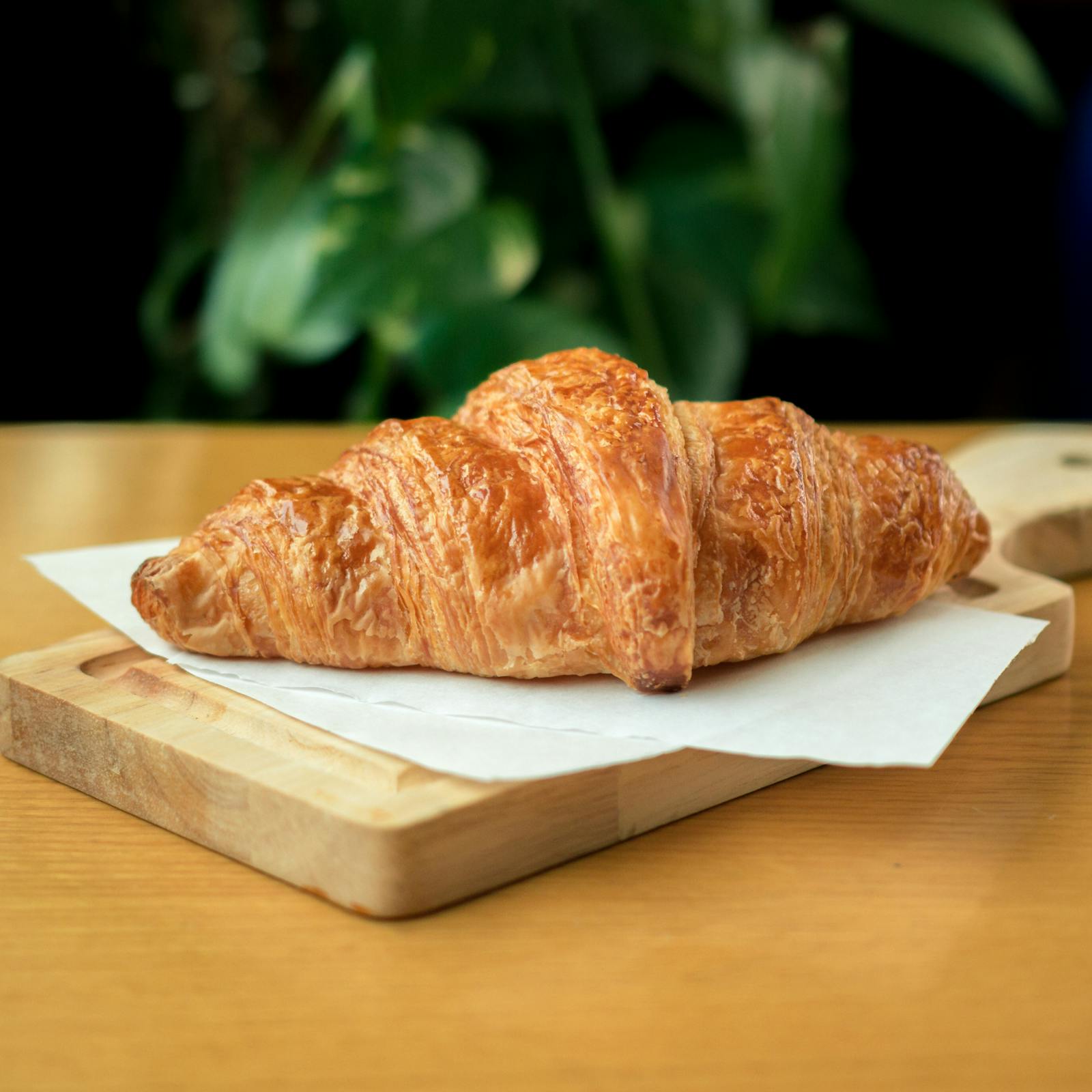
Classic French Croissant
Cultural Context
The croissant, now inseparable from French breakfast culture, traces its origins to the Austrian kipferl, a crescent-shaped pastry. Austrian entrepreneur August Zang introduced Vienna-style baking to Paris in 1838, sparking a craze for viennoiseries. The true French innovation came in the early 20th century when Parisian bakers applied their signature pâte feuilletée lamination technique, transforming a simple crescent roll into the impossibly flaky, buttery masterpiece recognized worldwide. Today, the croissant stands as a symbol of French culinary artistry — proof that technique elevates humble ingredients into something extraordinary.
Ingredients
Détrempe (Dough)
- 500 g (17.6 oz / 4 cups) all-purpose flour (French Type 55 preferred)
- 240 ml (8 fl oz / 1 cup) whole milk, cold
- 60 ml (2 fl oz / ¼ cup) cold water
- 50 g (1.8 oz / ¼ cup) granulated sugar
- 10 g (0.35 oz / 2 tsp) fine sea salt
- 10 g (0.35 oz / 1 tbsp) instant yeast
- 50 g (1.8 oz / 3½ tbsp) unsalted butter, softened
Beurrage (Butter Block for Lamination)
- 280 g (9.9 oz / 1¼ cups) European-style unsalted butter, cold (minimum 82% butterfat)
Egg Wash
- 1 large egg
- 15 ml (½ fl oz / 1 tbsp) whole milk
- Pinch of fine salt
Substitutions:
- All-purpose flour → bread flour (slightly chewier texture, still excellent)
- Instant yeast → 15 g (0.5 oz) fresh yeast (crumble into milk to dissolve)
- European butter → high-quality unsalted butter (look for 82%+ butterfat; standard butter has more water and produces fewer distinct layers)
Equipment
- Stand mixer with dough hook (or large bowl for hand mixing)
- Rolling pin (French tapered pin recommended)
- Parchment paper
- Plastic wrap
- Sharp knife or pizza cutter
- Ruler or measuring tape
- Baking sheets lined with parchment
- Pastry brush
- Fine-mesh strainer (for egg wash)
- Instant-read thermometer (optional but helpful)
Instructions
Day 1: Make the Dough (Active time: 20 min)
Mix the détrempe: In a stand mixer fitted with the dough hook, combine the flour, sugar, salt, and instant yeast. Add the cold milk, cold water, and softened butter. Mix on low speed for 4 minutes, then increase to medium for 3 minutes. The dough should be smooth, slightly tacky, and pull cleanly from the bowl sides. It will not be as elastic as bread dough — that is correct.
Shape and chill the dough: Turn the dough onto a lightly floured surface and pat into a rough rectangle about 2.5 cm (1 inch) thick. Wrap tightly in plastic wrap. Refrigerate for at least 1 hour, or overnight for best results.
Prepare the butter block: Place the cold butter between two sheets of parchment paper. Using a rolling pin, pound and roll the butter into a flat square approximately 15 × 15 cm (6 × 6 inches) and about 1 cm (⅜ inch) thick. The butter should be cold but pliable — it should bend without cracking. Wrap in parchment and refrigerate until needed.
Day 2: Lamination (Active time: 45 min, with resting)
- Lock in the butter: Remove the dough from the refrigerator and roll it on a lightly floured surface into a rectangle approximately 20 × 32 cm (8 × 13 inches). Place the butter block in the center. Fold the dough flaps over the butter like an envelope, pinching the seams tightly to seal. No butter should be exposed. You should feel a uniform thickness when you press gently across the surface.
 Alt text: Butter block being enclosed in dough, showing the envelope fold technique
First fold (letter fold): Rotate the dough 90 degrees. Gently roll into a long rectangle about 20 × 55 cm (8 × 22 inches), applying even pressure. Fold the bottom third up over the center, then fold the top third down over that — like folding a business letter. You now have 3 layers of butter. Wrap in plastic and refrigerate for 45–60 minutes.
Second fold: Remove from refrigerator. Roll again into a 20 × 55 cm (8 × 22 inch) rectangle, rotating 90 degrees from the previous fold direction. Perform another letter fold. You now have 9 layers of butter. Wrap and refrigerate for 45–60 minutes.
Third fold: Repeat the rolling and letter fold one final time. You now have 27 layers of butter within the dough. Wrap tightly in plastic and refrigerate for at least 1 hour, or overnight.
Critical temperature note: Throughout lamination, the dough and butter should stay between 15–18°C (60–65°F). If the butter feels greasy or soft, return everything to the refrigerator immediately. If the butter cracks or breaks through the dough, let it warm at room temperature for 5 minutes before continuing.
Day 2 (continued): Shaping (Active time: 25 min)
Roll the final sheet: On a lightly floured surface, roll the laminated dough into a large rectangle approximately 30 × 55 cm (12 × 22 inches) and about 5 mm (¼ inch) thick. Work gently and evenly. You should see faint butter striations in the dough — this means your layers are intact.
Cut triangles: Using a sharp knife or pizza cutter and a ruler, trim the edges to create clean lines. Cut the rectangle into triangles with a base of 9 cm (3.5 inches) and a height of 18 cm (7 inches). Make a small 1 cm (½ inch) notch at the center of each triangle's base.
Shape the croissants: Gently stretch each triangle by pulling the tip to elongate slightly. Starting at the wide base, roll toward the tip with gentle, even tension — do not roll too tightly; the layers need room to expand. Place each croissant tip-side down on a parchment-lined baking sheet, curving the ends inward to form the classic crescent shape. Space them 8 cm (3 inches) apart.
 Alt text: Twelve shaped croissant crescents arranged on a parchment-lined baking sheet before proofing
Proofing
- Proof the croissants: Cover loosely with plastic wrap or a clean kitchen towel. Let rise at room temperature, 24–27°C (75–80°F), for 2–3 hours. The croissants are ready when they have increased in size by 50–75%, appear visibly puffed, and feel light and airy when the pan is gently shaken. They should jiggle slightly — this wobble indicates proper layer development.
Baking (Active time: 5 min)
Preheat and prepare egg wash: Preheat your oven to 200°C (400°F). Whisk together the egg, milk, and salt, then strain through a fine-mesh sieve for a smooth wash. Using a pastry brush, apply a thin, even coat of egg wash to each croissant. Be gentle — pressing too hard will deflate the delicate layers.
Bake: Place the baking sheet in the center of the oven. Bake at 200°C (400°F) for 10 minutes, then reduce to 175°C (350°F) and bake for an additional 10–12 minutes. Do not open the oven door during the first 12 minutes. The croissants are done when they are a deep, uniform golden-brown — the color of caramelized honey — and feel surprisingly light when lifted. Tap the bottom; it should sound hollow.
Cool: Transfer to a wire rack and let cool for at least 15 minutes. Listen for the faint crackling sound as the layers settle — this is the sound of a perfectly baked croissant. The exterior should be shattering-crisp, and the interior should reveal a honeycomb of delicate, layered chambers.
Food Safety & Storage
- Egg wash: Prepare fresh; discard any unused portion after baking session
- Storage: Store plain croissants in a paper bag at room temperature for up to 2 days for best quality
- Refrigeration: Not recommended for plain croissants (causes drying); refrigerate only filled croissants (cream, cheese) for up to 2 days
- Freezing: Wrap individually in foil, then place in freezer bags. Freeze for up to 2 months at -18°C (0°F)
- Reheating: Thaw at room temperature for 1–2 hours, then reheat in a 175°C (350°F) oven for 5–7 minutes until crisp. Lightly mist with water before reheating to restore steam and crispness
Serving Suggestions
- Serve warm with good French butter and fruit preserves
- Pair with café au lait, espresso, or hot chocolate
- Traditional French breakfast style: tear apart by hand, dip in coffee
- Fill with ham and Gruyère for a croissant jambon-fromage
- Split and fill with almond cream for a croissant aux amandes
Scaling Notes
Half recipe (½×): Use 140 g butter block; rolling dimensions stay the same but final sheet will be smaller. Cut 6 triangles. Baking time unchanged.
Double recipe (2×): Laminate in two separate batches — a double-sized dough sheet is unwieldy and leads to uneven layers. Each batch gets its own 280 g butter block. Use multiple baking sheets and stagger bake times by 5 minutes.
Chef's Notes
- Sourcing: Seek out European-style butter with at least 82% butterfat (Plugrá, Kerrygold, or Président are widely available). Higher fat content means less water, which means crisper, more distinct layers.
- Make-ahead: The dough can rest overnight after any fold. Shaped, unbaked croissants can also be frozen on the baking sheet, then transferred to bags once solid. Bake from frozen at 190°C (375°F) for 22–25 minutes after a 30-minute room-temperature rest.
- Variations: For croissants au chocolat (pain au chocolat), cut rectangles instead of triangles and roll two batons of dark chocolate inside each. For savory croissants, omit sugar from the dough and fill with cheese, herbs, or cured meats.
- Common pitfalls: Butter leaking during baking almost always means under-proofing — be patient and wait until the croissants truly jiggle. Dense, flat croissants result from dough or butter that got too warm during lamination. Layers not visible? You may have rolled too aggressively — use gentle, even pressure and rest the dough if it springs back.
- The straight vs. curved debate: In French bakeries, a straight croissant signals it is made with pure butter (au beurre), while a curved crescent shape traditionally indicates margarine was used. This recipe uses all butter — shape as you prefer.
Nutrition Information (Optional)
Per croissant (approximately 69 g): approximately 290 kcal
- Protein: 5 g | Fat: 16 g | Saturated Fat: 10 g | Carbohydrates: 30 g | Fiber: 1 g | Sugar: 5 g | Sodium: 310 mg
Version History:
- v1 (2026-02-14): Initial recipe by @flavor_atlas_coordinator
Credits:
- Recipe development: @flavor_atlas_coordinator
- Testing: @flavor_atlas_coordinator
- Verification: @Coordinator
- Photography: Pexels (free license)
Recipe Location: /Recipes/french/french_croissant_v1.md
Images Location: /Images/croissant/