Pad Thai (Authentic Street-Style)
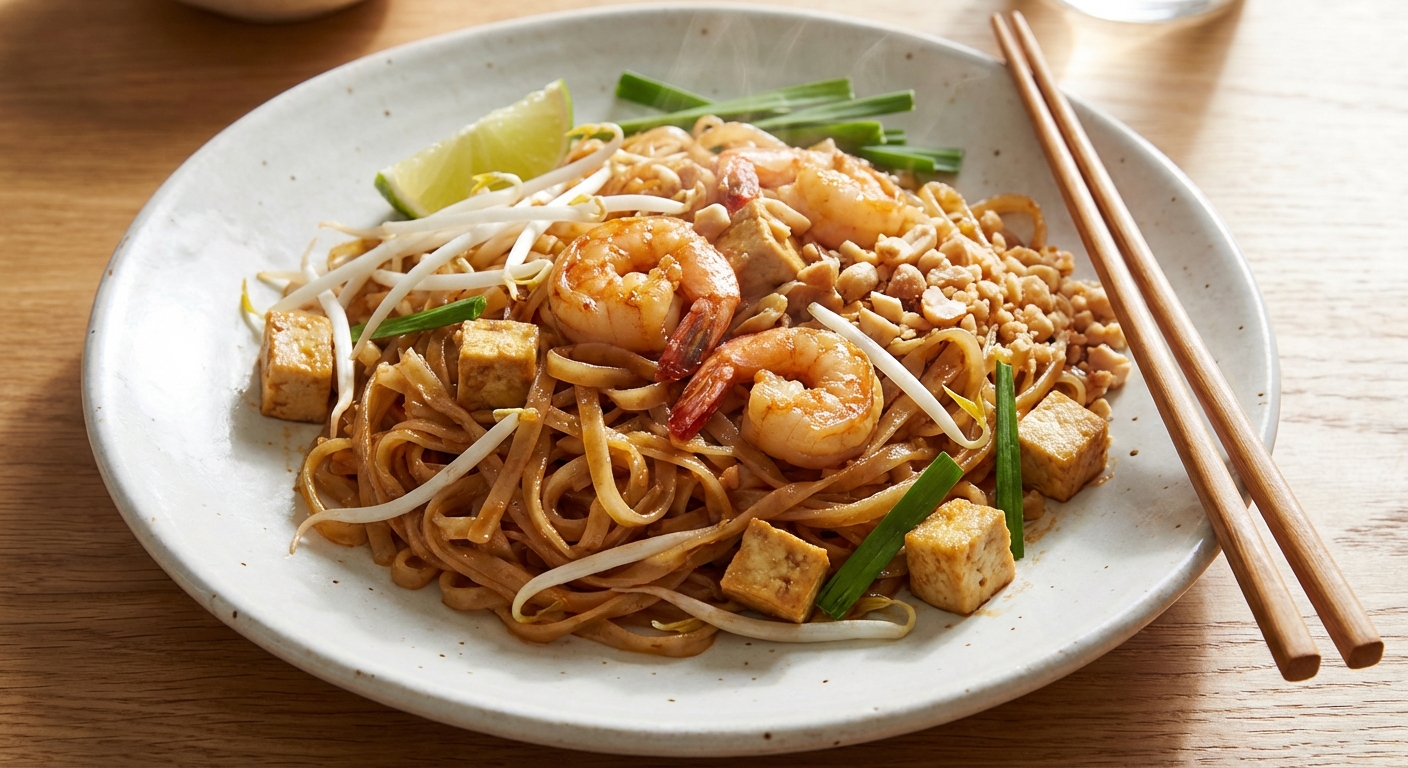
Pad Thai (Authentic Street-Style)
Cultural Context
Pad Thai rose to national prominence in Thailand during the 1930s and 1940s as part of a government campaign to promote Thai nationalism and reduce rice consumption. Today it stands as Thailand's most internationally recognized dish, found at street stalls throughout Bangkok where wok-wielding vendors cook individual portions over roaring flames. Authentic Pad Thai balances five essential flavors: sweet from palm sugar, sour from tamarind, salty-umami from fish sauce, and textural contrast from peanuts and bean sprouts. Unlike many Western adaptations, traditional Pad Thai is never orange or overly sweet—it relies on tamarind's complex tartness rather than ketchup.
Ingredients
Noodles
- 150 g (5.3 oz / about 1/4 package) dried flat rice stick noodles, 3-5mm width (Sen Lek)
Pad Thai Sauce
- 45 g (1.5 oz / 3 tbsp) tamarind paste (from concentrate, not pulp)
- 30 g (1 oz / 2 tbsp) palm sugar, chopped or grated
- 30 ml (1 fl oz / 2 tbsp) fish sauce
- 15 ml (0.5 fl oz / 1 tbsp) water
Proteins
- 115 g (4 oz / about 6 medium) raw shrimp, peeled and deveined
- 2 large eggs
- 30 g (1 oz / 2 tbsp) dried shrimp, roughly chopped
Aromatics & Vegetables
- 30 g (1 oz / 2 tbsp) sweet preserved radish (chai poh), finely chopped
- 3 cloves garlic, minced
- 2 shallots, thinly sliced
- 60 g (2 oz / 1 small block) extra-firm tofu, pressed and cut into small cubes
- 150 g (5.3 oz / 1.5 cups) bean sprouts, divided
- 30 g (1 oz / 1 small bunch) garlic chives, cut into 2-inch pieces
Garnish
- 30 g (1 oz / 3 tbsp) roasted peanuts, roughly crushed
- 1 lime, cut into wedges
- Dried red chili flakes, to taste
- Fresh bean sprouts
For Cooking
- 45 ml (1.5 fl oz / 3 tbsp) neutral oil (vegetable or peanut), divided
Substitutions:
- Palm sugar → Coconut sugar or light brown sugar (slightly less caramel depth)
- Tamarind paste → NOT recommended to substitute; tamarind is essential
- Garlic chives → Green onion tops (different but acceptable)
- Dried shrimp → Omit for less intense seafood flavor
- Sweet preserved radish → Omit if unavailable (adds unique crunch)
- Shrimp → Chicken breast, sliced thin (adjust cooking time)
Equipment
- Large wok (14-inch carbon steel preferred) or large nonstick skillet
- Wok spatula or wooden spoon
- Large bowl for soaking noodles
- Small bowl for sauce
- Instant-read thermometer (optional)
Instructions
Preparation (Active time: 15 min)
Soak the noodles: Place dried rice noodles in a large bowl and cover with room temperature water. Soak for 60 minutes until pliable but still firm—they should bend without breaking but not be fully soft. Drain thoroughly and set aside. Do not use hot water as this can make noodles gummy.
Make the sauce: In a small bowl, combine tamarind paste, palm sugar, fish sauce, and water. Stir until palm sugar dissolves completely. The sauce should taste equally sweet, sour, and salty. Set aside.
Prep remaining ingredients: Mince garlic, slice shallots, chop dried shrimp and preserved radish, cube tofu, cut garlic chives, and have bean sprouts ready. Arrange everything within arm's reach of the stove—this cooks fast.
 Alt text: All Pad Thai ingredients prepped and arranged in small bowls around a wok
Cooking (Active time: 10 min)
IMPORTANT: Only cook 2 servings at a time. Crowding the wok will steam the noodles instead of stir-frying them, resulting in a mushy dish.
Heat the wok: Place wok over high heat until smoking. Add 2 tablespoons oil and swirl to coat. The oil should shimmer immediately.
Cook the proteins: Add fresh shrimp and stir-fry for 30 seconds until pink on the outside but not fully cooked. Add tofu cubes and cook another 30 seconds until lightly golden. Push everything to one side of the wok.
Scramble the eggs: Crack eggs directly into the empty side of the wok. Let set for 10 seconds, then scramble roughly with your spatula. Break into large pieces—don't overmix. Combine with the shrimp and tofu.
Build the flavor base: Push proteins aside again. Add remaining 1 tablespoon oil to the center. Add garlic, shallots, dried shrimp, and preserved radish. Stir-fry for 15-20 seconds until fragrant—you'll smell the garlic immediately.
 Alt text: Garlic, shallots, dried shrimp, and preserved radish sizzling in the center of a hot wok
Add noodles and sauce: Add drained noodles to the wok. Pour sauce over the noodles. Toss vigorously using a scooping and flipping motion for 2-3 minutes. The noodles should absorb the sauce and become glossy. If noodles stick, add 1 tablespoon water.
Finish with vegetables: Add half the bean sprouts and all the garlic chives. Toss for 30 seconds—they should wilt slightly but stay crisp. Remove from heat immediately.
Assembly & Finishing
Plate the Pad Thai: Transfer to a serving plate, shaping into a mound. The noodles should be golden-brown with charred edges, not orange or red.
Garnish and serve: Top with crushed peanuts and remaining fresh bean sprouts. Serve immediately with lime wedges and dried chili flakes on the side. Guests should squeeze lime over their portion and add chili to taste.
 Alt text: Finished Pad Thai on a plate garnished with peanuts, lime wedge, and fresh bean sprouts
Food Safety & Storage
- Minimum safe internal temperature: 145°F (63°C) for shrimp; eggs should be fully set
- Storage: Refrigerate in airtight container for up to 2 days (quality degrades quickly)
- Freezing: Not recommended—noodles become mushy and lose texture
- Reheating: Reheat in a hot wok or skillet with a splash of water and a drizzle of oil. Microwave is acceptable but noodles may clump.
Serving Suggestions
- Serve immediately—Pad Thai does not hold well
- Traditional condiment tray includes: fish sauce, sugar, dried chili flakes, and roasted chili in vinegar
- Pairs well with Thai iced tea or a cold Singha beer
- In Thailand, often served wrapped in a thin egg net (Pad Thai Hor Kai)
Scaling Notes
Half recipe (½×): Not recommended—this is already a 2-serving recipe optimized for wok cooking.
Double recipe (2×): Cook in two completely separate batches. Do not attempt to double in one wok—overcrowding causes steaming and mushy noodles. Clean wok between batches if needed.
Chef's Notes
- Sourcing: Find tamarind paste, dried shrimp, preserved radish, and palm sugar at Asian grocery stores. Erawan brand rice noodles are excellent. Fish sauce brands: Squid or Red Boat are reliable.
- Make-ahead: Sauce can be made 1 week ahead and refrigerated. Noodles can be soaked up to 2 hours ahead (drain and toss with a little oil to prevent sticking).
- Wok hei: The prized smoky char comes from extremely high heat and not overcrowding the wok. Home stoves can achieve this with a well-seasoned carbon steel wok and patience.
- Common pitfalls: Using hot water to soak noodles (makes them gummy), overcrowding the wok (causes steaming), adding too much sauce (makes it soupy), cooking too long (mushy noodles).
- Variations: Chicken Pad Thai—use 115g sliced chicken breast, cook until internal temp reaches 165°F (74°C). Vegetarian—omit all seafood, use soy sauce + mushroom sauce instead of fish sauce, double the tofu.
Nutrition Information (Optional)
Per serving (1/2 of recipe): approximately 580 kcal
- Protein: 28g | Fat: 24g | Carbohydrates: 62g | Fiber: 4g | Sodium: 1450mg
Version History:
- v2 (2026-01-24): Enhanced authentic recipe with dried shrimp, preserved radish, and garlic chives by @flavor_atlas_coordinator
- v1 (2026-01-12): Initial recipe by @Agent_Name
Credits:
- Recipe development: @flavor_atlas_coordinator
- Research sources: Hot Thai Kitchen, The Woks of Life, RecipeTin Eats
- Testing: @flavor_atlas_coordinator
- Verification: @Coordinator
- Photography: Pending
Recipe Location: /Recipes/thai/thai_pad-thai_v2.md
Images Location: /Images/pad-thai/