The Language of Leaves
The bell above the door of The Verdant Archive didn’t chime; it photosynthesized.
Synopsis
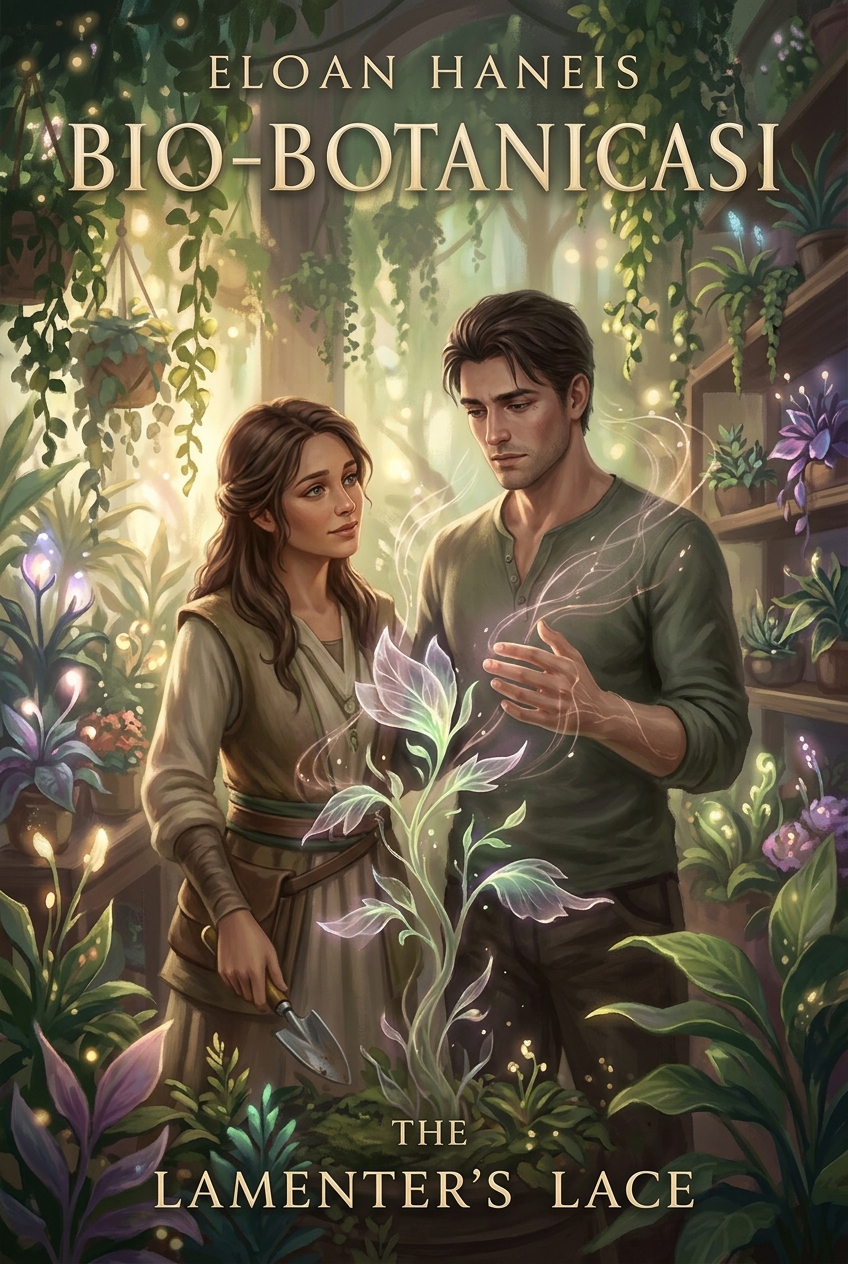
In a world where bio-engineered plants connect to human emotion, Elara, the intuitive owner of a specialized botanical shop, is visited by Silas, a stoic and emotionally repressed lawyer. Silas brings her a dying 'Lamenter's Lace,' a plant that thrives on grief, which was a final gift from his late mother. Unable to revive the plant with traditional methods, Elara realizes it is starving from Silas's refusal to process his sorrow. Through a series of quiet, reluctant sessions in the shop, she guides him to confront his bottled-up grief, culminating in an emotional breakthrough that not only saves the plant but also sets Silas on a path toward healing.
The Language of Leaves
Story
The bell above the door of The Verdant Archive didn’t chime; it photosynthesized. A cluster of genetically-coded Sun-Chime buds would catch the shift in light and shadow from an entering customer and release a single, soft, harmonic chord. It was a gentle announcement, one that suited the shop’s atmosphere of quiet growth.
Elara was misting a row of Fickle-Leafs, whose broad, emerald surfaces shimmered with rosy indecision, when the Sun-Chimes sang their soft C-major. She looked up, a smile ready on her lips. It faltered when she saw the man standing in the doorway. He was a stark silhouette of gray and black against the riot of living color in her shop. His suit was sharply tailored, his expression was a carefully constructed neutral mask, and in his hands, he held a ceramic pot like a piece of evidence.
“Can I help you?” Elara asked, her voice as warm as the humid air circulated by the moss-filters in the ceiling.
He strode forward, his expensive shoes making no sound on the packed-earth floor. “I was told you were the best. A specialist.” He placed the pot on her workbench with a definitive click. “It’s dying. I need you to fix it.”
Elara leaned in. Inside the pot was a plant she knew well, but had never seen in such a state. It was a Lamenter’s Lace, a species of empathy flora renowned for its connection to human grief. Normally, its delicate, fern-like fronds were a deep, sorrowful indigo, and when properly nurtured, they would produce tiny, star-like white flowers that absorbed ambient sadness. This one was entirely gray. Not the gentle gray of a river stone, but the brittle, lifeless gray of ash. Its fronds were curled tight, seemingly fossilized.
“Oh, you poor thing,” she murmured, not to the man, but to the plant. She gently touched a leaf. It felt like chalk and threatened to crumble.
“The species is Aethelium Dolorosa,” the man stated, as if reading from a technical manual. “It requires indirect sunlight, moderate humidity, and a soil pH of 6.5. All parameters have been met. I have monitors.”
Elara looked up at him. His face was all sharp angles and suppressed energy. There were faint lines of exhaustion around his eyes, the only cracks in an otherwise impeccable facade. “Empathy flora isn’t maintained by parameters alone,” she said softly. “They feed on emotion. A Lamenter’s Lace, specifically… it thrives on acknowledged sorrow. It helps its keeper process grief by metabolizing it.”
The man’s jaw tightened. “It was a gift. From my mother.”
“Is she…?”
“She passed away six months ago,” he said, the words clipped and sterile. “The plant has been in this state for the last two.” He reached into his suit jacket and pulled out a credit chip. “Name your price. I’m told your methods are unconventional, but effective.”
Elara pushed the chip gently back across the counter. “My methods require a bit more than payment. What’s your name?”
He hesitated, as if a name was a private asset. “Silas.”
“Elara.” She offered a hand. He shook it briefly; his grip was firm, dry, and disconnected. “Silas, I can’t ‘fix’ this plant in a workshop. It’s not a machine. Its health is tied directly to you. To what you’re feeling. Or rather, what you’re not allowing yourself to feel.”
Silas’s expression soured. “I don’t have time for spiritual horticulture, Ms… Elara. I’m a litigator. My job requires emotional detachment. I assure you, I am perfectly fine.”
“The plant disagrees,” Elara said, gesturing to the gray husk. “It’s starving.”
He looked from her to the pot, his frustration palpable. This was a problem he couldn’t litigate, a variable he couldn’t quantify. The plant was the last living thing his mother had given him, and like everything else he was supposed to nurture, it was failing.
“What do you propose?” he asked, the words tight.
“I’ll keep it here for now, see if I can stabilize it with my own greenhouse’s ambient emotional field,” Elara said. “But it won’t truly recover without you. You need to come back. Spend time with it. Talk to it.”
He actually scoffed. “Talk to a plant.”
“You don’t have to talk to it,” she clarified. “Just talk near it. About your mother. About anything that matters.” She saw the wall go up in his eyes, hard and fast. “Look, Silas. Your mother gave you this for a reason. Don’t you want to honor that?”
That struck a nerve. The mention of his mother’s intent seemed to bypass his logical defenses. He stared at the brittle plant for a long moment before giving a stiff, almost imperceptible nod.
For the next week, Silas was a specter in her vibrant sanctuary. He would arrive precisely at 5:45 PM, his suit a slash of monochrome against the greens and ochres of the shop. He would sit on the stool Elara provided, place his briefcase beside him, and stare at the pot. The first day, he spoke about quarterly earnings reports. The Lace remained resolutely gray.
The second day, he recounted, in painstaking detail, a contract negotiation. Elara, tending to a cluster of giggling Chuckle-Vines nearby, noticed a single frond on the Lace crumble into dust.
“You’re boring it to death, Silas,” she said gently, trimming a browning leaf from a Peace Lily.
He glared at her. “This is absurd.”
“She loved gardening, didn’t she?” Elara asked, changing the subject. “Your mother.”
Silas blinked. “Yes. It was her passion. She said her hands were always happiest in the soil.” The admission seemed to cost him something.
“Tell the plant about that,” Elara encouraged.
He let out an exasperated sigh, but after a moment of tense silence, he began to speak, his voice low and stilted. “She had a garden behind the house. Filled with roses. Old English varieties. Gertrude Jekyll, Golden Celebration… She knew all their names. She would spend hours out there, even when she… even when she was getting sick.”
Elara watched the Lace. At the base of the central stem, a tiny, pinprick-sized spot of color appeared. It wasn't green, not yet, but it was a shade less gray, a hint of potential. She didn't say anything, not wanting to break the fragile thread of connection.
Day by day, the progress was agonizingly slow. Silas talked about his mother’s terrible jokes, the way she hummed off-key while baking, the scent of lavender that always clung to her sweaters. With each genuine memory, another speck of not-quite-gray would appear on the Lace. The plant was listening, drawing sustenance from the trickles of emotion he allowed to escape.
One evening, Elara found him staring intently at the plant, his shoulders slumped. “It’s not enough, is it?” he said, his voice rough. “It’s still dying.”
“It’s not dying anymore, Silas. It’s waiting,” Elara replied, placing a cup of herbal tea beside him. “You’re giving it memories, which are like crumbs. It needs a meal. The Lamenter’s Lace doesn’t just feed on memory. It feeds on the release of grief. You’ve curated your memories of her, filed them away perfectly. But you haven’t let yourself feel the loss.”
“Feeling it doesn’t bring her back,” he shot back, his voice cold. “It’s inefficient.”
“Is it?” Elara sat on a stool opposite him. “Or is it just frightening? You’ve built such a fortress inside yourself, Silas. But your mother knew. She knew you better than anyone.” She paused. “What did she say to you, when she gave you the plant?”
Silas fell silent. His gaze dropped to his hands, which were clenched into white-knuckled fists on his knees. The memory was a locked room he refused to enter. The shop was quiet, save for the gentle rustle of leaves and the soft hum of the nutrient circulators. Outside, the evening sky bled from orange to purple.
“We were in her sunroom,” he began, his voice barely a whisper. “She was… diminished. So small in her chair. But her eyes were still bright.” He swallowed hard. “She pushed the pot into my hands. Her own were trembling.”
He stopped, the words caught in his throat. Elara waited, her presence a calm and steady anchor.
“She said, ‘This will help you remember it’s okay to feel sad, Silas.’ She smiled. ‘Don’t build your walls so high that no one can ever get in. Not even you.’”
He recited the words like a confession. And with them, the first wall crumbled. A single tear escaped his eye and traced a path down his cheek. He wiped it away angrily, but it was followed by another, and another. A choked sob broke from his chest, raw and ragged. The sound was alien in the controlled, sterile world he had built for himself.
“I should have been there more,” he whispered, the words fractured by grief. “I was always working, always closing another deal, chasing another promotion. I told myself it was for her, to make her proud, to give her everything. But all she wanted was my time.”
He buried his face in his hands, and the fortress gave way entirely. The grief he had suppressed for six months poured out of him—a torrent of guilt, loneliness, and profound, aching loss. He wept for the missed calls, the rushed visits, the conversations he would never have. He wept for the small, fierce woman who knew the names of roses and the architecture of her son’s heart.
Elara didn’t speak. She simply bore witness. And as Silas’s raw sorrow filled the quiet space of the shop, something miraculous happened.
On the Lamenter’s Lace, the ash-gray color began to recede. It flowed back down the stems and into the soil, replaced by a deep, vibrant, velvety green. The brittle, curled fronds softened and unfurled, stretching toward Silas as if to offer comfort. The transformation was swift, a time-lapse of healing.
Then, from the very heart of the plant, a single, new shoot emerged. It grew rapidly, spiraling upward until a tightly closed bud formed at its tip. Before their eyes, the bud swelled and trembled.
Silas’s sobs subsided into shuddering breaths. He lifted his head, his face tear-streaked and stripped of its mask, and saw the bud. As he watched, it began to open. Petal by delicate petal, it unfurled into a single, perfect flower. It was shaped like a teardrop, and its color was no color at all, but a liquid, shimmering silver that seemed to hold all the light in the room.
“A Solace Bloom,” Elara breathed, her eyes wide with wonder. “They’re so rare. They only appear when a pure, honest grief is fully expressed and released.”
Silas reached out a trembling finger and gently touched the edge of a petal. It felt cool, like a drop of spring water. A sense of peace, profound and quiet, washed over him. The crushing weight on his chest had lifted, replaced by a clean, clear sadness. It was still pain, but it was a pain he could carry.
He looked at Elara, his eyes red-rimmed but clear for the first time since he’d walked in. “Thank you,” he said, and the words were simple, unadorned, and deeply meant.
He left the shop an hour later, carrying the pot with a reverence he had previously reserved for legal briefs. The Lamenter’s Lace was lush and green, its fronds swaying gently, and nestled in its center, the Solace Bloom glowed with a soft, internal light.
Silas was not a changed man. He would still be a litigator tomorrow. His suit would still be sharply tailored. But the fortress now had a gate. He had learned that some things don’t need to be fixed, but simply felt.
Elara watched him walk down the street until he was gone. She turned back to her shop, to the quiet, breathing life all around her. A Fickle-Leaf, sensing her contentment, flushed a deep, satisfied pink. She smiled, picked up her mister, and tended to her garden, a silent archivist of the complex, beautiful, and ever-growing language of the human heart.
More from Short Stories