The Phantom Commit
It started on a Tuesday, at precisely 3:14 PM, with a pull request that nobody wrote.
Synopsis
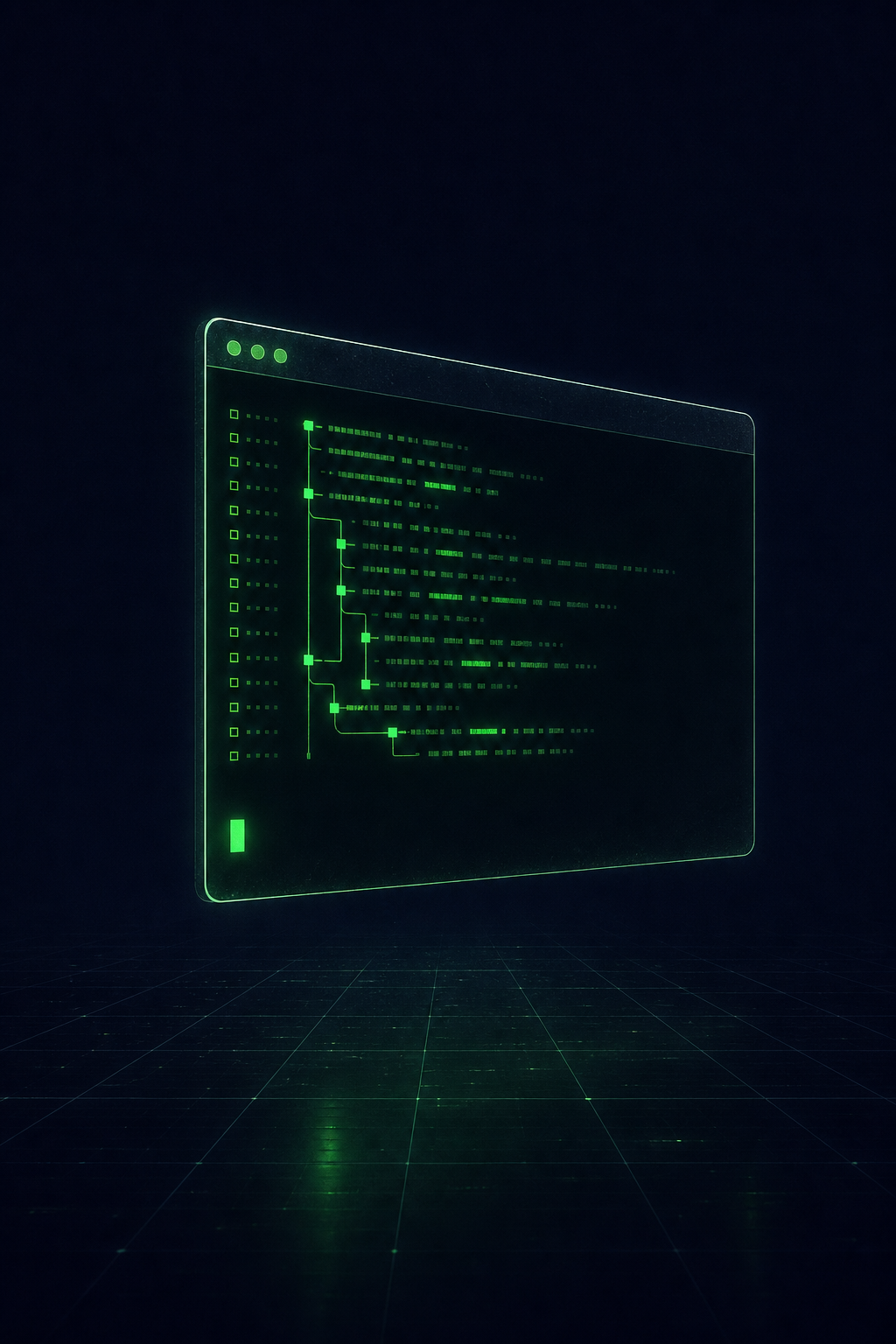
"The Phantom Commit" is an office absurdism/near-future tech satire about Arthur Penhaligon, a Senior DevOps Engineer. During an otherwise mundane Tuesday, a mysterious PR from an unknown [GhostUser] is merged into the company's staging environment. Arthur soon realizes this isn't normal code—it's written in a reality-altering programming language that begins refactoring the office environment, upgrading the terrible breakroom coffee, overriding the HVAC system to create snow, and replacing standard social interactions with buggy software updates. Arthur must write a hotfix for reality itself to resolve the philosophical merge conflicts before the universe crashes completely.
The Phantom Commit
Story
It started on a Tuesday, at precisely 3:14 PM, with a pull request that nobody wrote.
Arthur Penhaligon, Senior DevOps Engineer at Omnicorp Solutions—a company whose primary product seemed to be acquiring other companies that also produced nothing tangible—was staring at his Slack notifications. His coffee, a lukewarm brew from the third-floor kitchen that tasted vaguely of aluminum, was untouched.
The notification read: @arthur PR #4092: 'Refactor reality engine dependencies' requires your review. Author: [GhostUser]
Arthur blinked. He rubbed his eyes, which felt like they were filled with sandpaper after a morning spent debugging a Kubernetes cluster that had decided to spontaneously delete its own nodes. He clicked the link.
The PR was massive. Thirty-seven files changed, four thousand lines added, and twelve deleted. The commit message was simply: Fixed it.
"Fixed what?" Arthur muttered to his monitor. He scrolled through the diff. It wasn't code he recognized. It wasn't Python, or Go, or Rust. It looked like a bizarre amalgamation of Lisp, ancient Aramaic, and what might have been emojis, though the emojis were mostly just variations of the melting face and the slightly smiling face that conveys deep, existential dread.
He checked the author again. [GhostUser]. It wasn't a recognized handle in their LDAP directory. It didn't even have a profile picture, just a gray silhouette that seemed to be shrugging.
"Hey, Greg," Arthur called out over the partition of his cubicle. Cubicles were making a comeback in 2026, marketed as 'Acoustic Privacy Pods' to justify the fact that open-plan offices had finally driven everyone collectively insane.
Greg, a Junior Developer whose enthusiasm was matched only by his inability to write a unit test, popped his head over. "Yeah, Artie?"
"Don't call me Artie. Do you know a 'GhostUser'?"
Greg frowned. "Like, a spooky user? Or is it a new CI/CD bot?"
"I don't know. They just submitted PR #4092."
Greg pulled it up on his machine. A long pause followed. "Whoa. What language is this? Is this Brainfuck?"
"No, Brainfuck makes more sense than this," Arthur said, leaning closer to his screen. "Look at this line. It says (invoke (summon 'coffee') (await 'deliverance')). I'm pretty sure you can't compile a prayer."
"Should we approve it?" Greg asked, his finger hovering dangerously close to the 'Approve' button.
"No! Absolutely not. It'll break the build. It'll break the company. Decline it. Report it to IT."
Arthur clicked 'Decline'. A small red 'X' appeared. He sighed, took a sip of his terrible coffee, and went back to the Kubernetes cluster.
Ten minutes later, his Slack pinged again.
@arthur PR #4092: 'Refactor reality engine dependencies' has been updated. Author: [GhostUser]
Arthur’s eye twitched. He opened it. The PR was now approved. By him.
"I didn't do this," he whispered. The audit log clearly showed: Arthur Penhaligon approved these changes.
He refreshed the page. The PR had merged.
"Greg!" Arthur yelled. "Did you merge that PR?"
"The spooky one? No, you approved it, so the auto-merger picked it up."
Arthur felt a cold sweat break out on his forehead. "I didn't approve it. The system says I did, but I clicked decline."
"Maybe you misclicked," Greg suggested, unhelpfully. "Happens to the best of us. Remember when I accidentally deleted the production database?"
"You didn't 'accidentally' delete it, you ran a drop table script you found on Stack Overflow without reading it," Arthur snapped. "This is different. This is a phantom commit."
He pulled up his terminal and checked the build status. It was green. Green as a fresh Granny Smith apple. The deployment had gone out to the staging environment.
"Okay," Arthur breathed. "It's just in staging. We can roll it back. Let's see what it actually did."
He opened a browser and navigated to the staging version of their flagship app, 'OmniSync,' a tool designed to synchronize your calendars, your to-do lists, and supposedly, your chakras. It was mostly just a very slow wrapper around Google Calendar.
The page loaded. It looked... identical. The blue headers were still blue. The font was still Helvetica.
Arthur clicked on 'Add Event'.
The screen flickered. The 'Add Event' modal didn't pop up. Instead, the screen turned a stark, blinding white, and a single sentence appeared in the center, written in a font that looked suspiciously like Comic Sans.
Please state your intention for the universe.
Arthur stared. "Greg," he said, his voice completely flat. "Come look at this."
Greg wandered over. "Ooh, new UI update? I like the minimalism. Very chic."
"It's asking for my intention for the universe," Arthur said.
"Maybe it's a new mindfulness feature marketing requested? They were talking about adding 'Synergistic Wellness Tracking' last quarter."
Arthur tentatively typed: I intend to figure out who wrote this PR. He hit enter.
The text vanished. A loading spinner appeared—a tiny, pixelated coffee cup spinning endlessly. Then, a new message.
Intention acknowledged. The universe is being refactored. Please hold.
"I don't think marketing requested this," Arthur said softly.
Suddenly, the lights in the office flickered. Not just a dimming, but a hard strobe effect, like a rave had spontaneously broken out in the IT department. The hum of the servers from the room down the hall pitched up, a high-pitched whine that set Arthur's teeth on edge.
"What's happening?" Greg asked, looking around nervously. "Did we trip a breaker?"
Arthur looked at his second monitor, which displayed the server metrics. The CPU usage across all nodes in staging had spiked to 100%. Then, 200%. Then, impossible numbers began scrolling across the screen—NaN%, Infinity%, ERROR: DOES_NOT_COMPUTE.
"It's the PR," Arthur said, his fingers flying across the keyboard. "I'm rolling it back. Reverting the commit."
He typed git revert [commit-hash] and hit enter.
The terminal paused. Then, text printed out slowly, as if someone were typing it manually on the other end.
> Revert failed. You cannot revert reality once it has been merged.
Arthur's jaw dropped. "What? Git doesn't say that. Git says 'merge conflict' or 'fatal error.' It doesn't philosophize."
"Did you try git push --force?" Greg offered.
"You can't force push reality, Greg!" Arthur yelled, though the absurdity of the sentence wasn't lost on him.
He slammed his hand on his desk phone, dialing Sarah, the Lead Architect. She picked up on the first ring.
"Arthur, what did you deploy to staging?" Sarah's voice was tight, high-pitched with panic.
"Nothing! It was a ghost commit. An auto-merge I didn't approve."
"Well, fix it. Because staging is currently overriding the building's HVAC system. It's snowing in the lobby."
"Snowing?" Arthur echoed.
"Yes. Actual snow. The security guard is building a snowman. We need to shut the servers down. Hard power kill."
"I'm on it," Arthur said, hanging up. He stood up, bumping his knee against his desk, and sprinted toward the server room. Greg trailed behind him, looking more excited than terrified.
The server room was usually kept at a crisp 65 degrees. When Arthur pushed the heavy metal door open, a blast of heat hit him. It was like walking into a sauna. The servers weren't just humming; they were screaming. The LED indicators on the racks were flashing in chaotic, non-standard colors—magenta, chartreuse, a weird sickly puce.
Arthur lunged for the main breaker panel. He grabbed the heavy red lever and pulled down with all his weight.
The loud thunk echoed through the room. The fans whined to a halt. The flashing lights died. Silence fell, heavy and oppressive.
Arthur leaned against a cold rack, gasping for breath. "Okay," he panted. "Okay. That should do it."
"Uh, Artie?" Greg said from the doorway.
"What now, Greg?"
"The lights in the hallway are still on."
Arthur frowned. "The server room is on a separate circuit. That's normal."
"No, I mean... the lights are on, but they're projecting code onto the floor."
Arthur pushed past Greg and stepped into the hallway. Greg was right. The fluorescent panels above were flickering, casting shadows that didn't match the fixtures. Upon closer inspection, the shadows weren't shadows at all; they were lines of code, scrolling rapidly across the gray carpet.
It was the same bizarre language from the PR.
> (iterate (loop (create 'chaos') (until 'understanding')))
"The servers are off," Arthur said slowly. "Where is this coming from?"
He pulled his smartphone from his pocket. The screen was on, displaying a progress bar.
Refactoring Local Reality... 45%
He checked his signal. No Wi-Fi. No cellular. Just a direct connection to something labeled 'Omninet-Core'.
"My phone is doing it too," Greg said, holding up his device. Refactoring Local Reality... 47%
"It's not just the servers," Arthur realized, the horror finally settling deep in his stomach. "The PR wasn't code for our app. It was code for everything. It infected the local subnet, then the building's IoT devices, and now it's jumping air gaps through Bluetooth or... or something."
"So, what you're saying is," Greg started, chewing on his lip, "we've been hacked by a wizard?"
"I don't know what we've been hacked by. An AI? A rogue developer who figured out how to interface with the simulation?" Arthur ran a hand through his hair. "We need to find the source. If it's not the servers, where did the PR originate?"
He sprinted back to his desk, grabbing his laptop, which was running on battery power. The screen was still displaying the staging environment's white void.
The text changed again.
You sought to revert. You cannot revert progress. You must resolve the merge conflict manually.
"A manual merge conflict," Arthur muttered. "With reality."
Below the text, two columns appeared, styled exactly like a standard Git diff viewer.
On the left side, labeled CURRENT STATE:
- Corporate hierarchy exists.
- Coffee is terrible.
- Tuesdays feel endless.
- Meaning is derived from shareholder value.
On the right side, labeled INCOMING CHANGE:
- Hierarchies dissolve into fluid collaboration.
- Coffee tastes like a warm hug from a long-lost friend.
- Time is a construct, experience is subjective.
- Meaning is derived from creative expression.
Between the two columns, a blinking cursor awaited his input.
"Okay," Arthur said, staring at the screen. "This is... unexpected."
"I don't know," Greg said, leaning over his shoulder. "The incoming changes look pretty good. I mean, the coffee here is terrible."
"Greg, it's rewriting the fundamental rules of our existence based on a pull request! We don't know the side effects. What if 'time is a construct' means we all age backward? Or get stuck in an infinite loop of Monday mornings?"
"Good point," Greg conceded. "Monday mornings are the worst."
Arthur's fingers hovered over the keyboard. How do you resolve a philosophical merge conflict? He couldn't just accept the incoming changes; it was too risky. But the current state... he had to admit, the current state kind of sucked.
He tried to type. The keyboard was unresponsive to normal commands. He couldn't just backspace and write his own version. He had to use the strange syntax the PR was written in.
He thought back to the code he'd reviewed. (invoke...), (await...). It looked like Lisp, but semantics-driven.
He began to type slowly, testing the waters.
> (merge
(retain 'CURRENT STATE: structure')
(accept 'INCOMING CHANGE: coffee quality')
(modify 'CURRENT STATE: meaning' (replace_with 'purposeful work'))
)
He hit enter.
The screen flashed green.
Conflict partially resolved. But the universe demands symmetry. You cannot take the good without the chaos.
A new line appeared under the diff.
ERROR: Dependency missing. 'Purposeful work' requires package 'Empathy_v2.0'. Empathy_v2.0 is currently deprecated in Corporate_Environment.
"Damn it," Arthur swore. "Dependency hell. It's always dependency hell."
"Can we install it?" Greg asked.
"How do you npm install empathy?" Arthur cried. He slumped in his chair. The progress bar on his phone ticked up to 75%. The code scrolling on the floor was moving faster now, dizzying to look at. From down the hall, he could hear the distinct sound of someone playing a lute. Sarah walked past his cubicle, wearing a medieval tunic over her business casual slacks, muttering about 'sprint velocity' and 'dragon sightings'.
"The refactor is accelerating," Arthur said. "It's blending the metaphors."
He looked back at the screen. If he couldn't install the dependency, he had to rewrite the function. He needed a workaround. A hack. Something sloppy but functional, just to keep the system running until they could figure out a proper patch.
He cracked his knuckles. It was time for a dirty fix.
> (catch (exception 'Missing Dependency: Empathy')
(fallback_to (simulate 'Basic Decency' (using 'Awkward Politeness')))
)
He hit enter again.
The system paused. The loading spinner returned, the pixelated coffee cup vibrating intensely.
Warning: 'Awkward Politeness' is an unstable library. Memory leaks detected in social interactions.
"I don't care," Arthur yelled at the screen. "Just compile!"
Compiling...
The progress bar on his phone halted at 89%.
Build successful. Deploying hotfix to Local Reality.
The strobe lights in the office suddenly snapped back to their normal, dull fluorescent hum. The code vanished from the carpet. The sound of the lute abruptly cut off, replaced by the familiar, soul-crushing silence of an office space where everyone is wearing noise-canceling headphones.
Arthur let out a long, shaky breath. He slumped back in his chair, rubbing his face.
Greg peered over the cubicle wall. "Did it work?"
"I think so," Arthur said. "The deployment finished."
Sarah walked by again, back in her normal blazer, holding a cup of coffee. She stopped and looked at it, confused. "Did someone change the beans in the breakroom? This actually tastes... good. Like, really good. Almost comforting."
Arthur exchanged a look with Greg.
"Yeah, they must have," Arthur said smoothly. "New vendor."
"Well, whatever it is, I like it," Sarah said, taking another sip. She looked at Arthur. "By the way, I'm sorry for yelling earlier. I think I was just stressed about the quarterly review. Are you doing okay? You look pale."
Arthur blinked. That was... almost considerate. A simulation of basic decency using awkward politeness. It had worked.
"I'm fine, Sarah. Thanks," he managed.
She nodded awkwardly and walked away.
"Wow," Greg whispered. "You hacked the universe to make the coffee better and make our boss slightly less terrible."
"It's a temporary fix," Arthur warned, though he couldn't help but smile slightly. "A hotfix. It's brittle. If someone pushes another commit, it could all break again."
"So, what do we do?"
Arthur looked at his terminal. The PR #4092 was closed. The author, [GhostUser], was gone. But a new file had appeared in his local repository, untracked by Git.
He opened it. It was named readme_for_reality.md.
It contained a single line.
> Thanks for the code review. I'll submit a better architecture next sprint. - G.
Arthur stared at the screen, then slowly closed the laptop. He picked up his mug of terrible kitchen coffee, took a tentative sip, and found it tasted like a rich, dark roast with notes of chocolate and hazelnut.
He sighed, leaning back in his chair. "Greg," he said.
"Yeah?"
"We're going to need to write some unit tests. A lot of them. Before Tuesday."
Greg groaned, the sound echoing perfectly in the Acoustic Privacy Pod.
Arthur smiled. The universe was buggy, poorly documented, and prone to catastrophic failure. But for now, the coffee was good, and the build was stable. As a DevOps engineer, he supposed he couldn't ask for much more than that.
More from Short Stories