The Tea Shop at the Edge of the Firewall
The neon glow of Neo-Kowloon usually bled through everything—smog, rain, reinforced glass, and even the optical implants of the careless.
Synopsis
The Tea Shop at the Edge of the Firewall
In the neon-drenched, hyper-surveilled city of Neo-Kowloon, The Gilded Leaf is a hidden sanctuary—an analog tea shop that secretly functions as a massive Faraday cage. Mei Lin runs the shop, preserving the legacy of her missing father. Her quiet, off-the-grid life is shattered when a desperate data-runner named Kael stumbles in, suffering from severe data-burn. Kael carries highly classified and dangerous data in his neural wetware: proof that the Zenith Corporation intentionally caused the Grid Collapse that killed millions in the lower sectors.
Kael reveals that Mei's father didn't just vanish; he was murdered trying to expose Zenith, and the key to decrypting the data is hidden within the physical layout of the tea shop itself. As corporate enforcers breach the shop, Mei must use her father's analog cipher—a mechanical cash register linked to the precise physical arrangement of tea canisters—to extract and secure the data. She successfully triggers an emergency steam purge to blind the enforcers and escapes with Kael into the abandoned mag-lev tunnels, leaving her old life behind to finish what her father started.
The Tea Shop at the Edge of the Firewall
Story
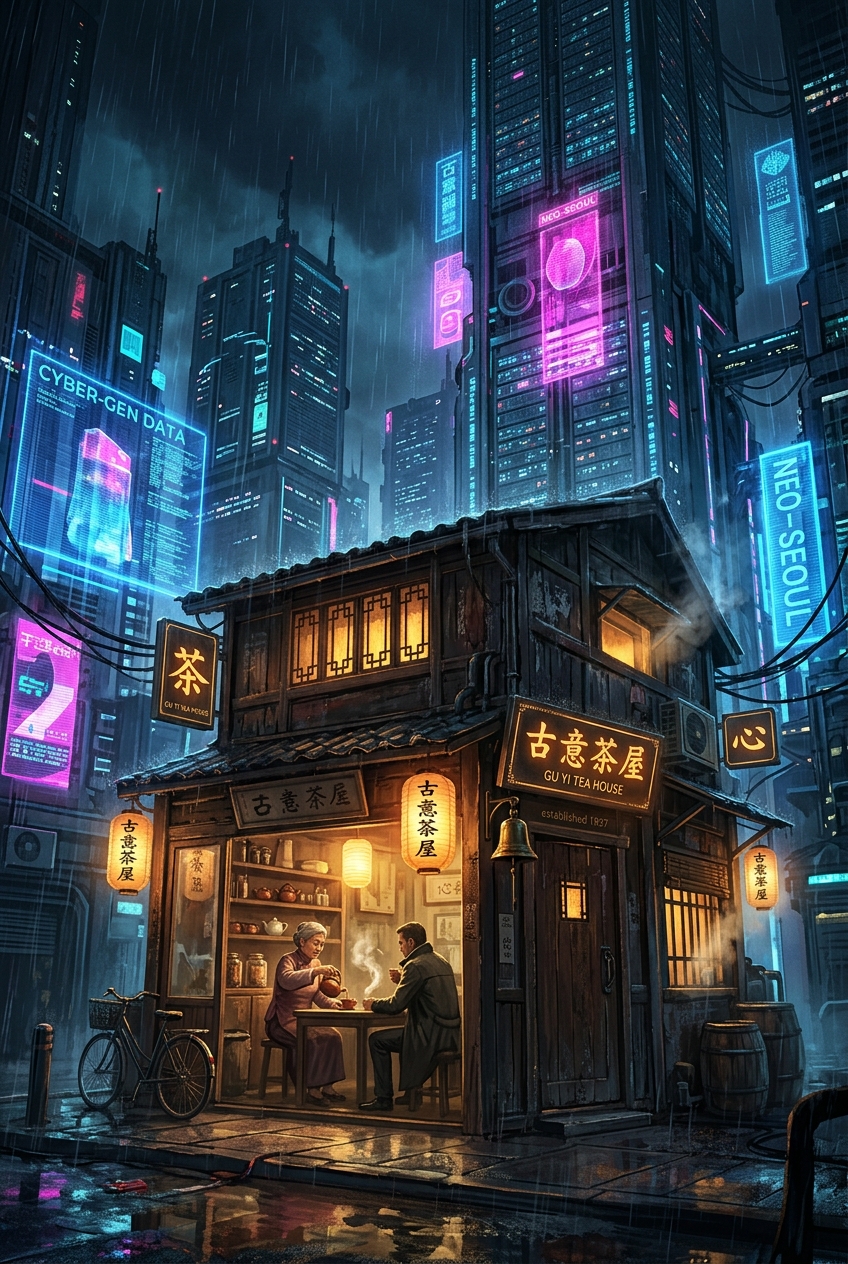
The neon glow of Neo-Kowloon usually bled through everything—smog, rain, reinforced glass, and even the optical implants of the careless. But inside The Gilded Leaf, the light was soft, warm, and decidedly analog. It smelled of roasted oolong, old paper, and just a faint, metallic tang of ozone from the ion-scrubbers humming in the ceiling.
Mei Lin wiped down the scarred wooden counter with a rag that had seen better decades. She adjusted the collar of her worn hanfu-cut jacket, the fabric frayed at the cuffs but meticulously clean. The shop was a relic, squeezed between a towering server farm that hummed with enough petabytes to track the dreams of millions, and an abandoned mag-lev station where the local syndicates liked to dump things—and occasionally people.
It wasn't a place for casual tourists. It was a place for those who needed a moment off the grid. The shop’s physical location was an anomaly: a tiny, unmapped blind spot in the city's omni-present surveillance mesh. A literal Faraday cage masquerading as a tea house. The walls were lined with lead and copper mesh, carefully concealed behind bamboo paneling and rows of ceramic teapots.
The door chimed. Not a digital beep, but a physical brass bell, struck by a wooden clapper.
A man stepped in, shedding rain and static. He was tall, wearing a long synth-leather coat that looked expensive but worn, its edges frayed and singed. His eyes were hidden behind sleek, silver neural-shades, the kind favored by corporate data-runners. But what caught Mei’s attention wasn't his tech; it was the way he moved. Shaky. Desperate. He moved like a ghost trying to remember how to occupy a physical body.
"We're closed," Mei said calmly, not breaking her rhythm with the rag.
"I need..." the man started, his voice a raspy whisper. He leaned heavily against a booth, his gloved hand leaving a wet smear on the polished mahogany. "I need the Iron Goddess."
Mei stopped. Tie Guan Yin. The Iron Goddess of Mercy. It wasn't just a tea on her menu; it was a code phrase. One she hadn't heard in five years. Not since her father vanished into the sprawling data-slums of Sector 4.
She looked at the man closer. "Sit," she commanded, gesturing to the corner booth—the one furthest from the windows, where the EMF shielding was thickest and the ambient surveillance noise dropped to absolute zero.
He practically collapsed into the worn velvet seat. Mei moved behind the counter, her hands moving with practiced efficiency. She didn't go for the standard canisters on display. Instead, she reached under the counter, feeling for the hidden panel near the ancient water boiler. A biometric scan—a quick press of her thumb against a concealed pad—later, a small drawer slid open, revealing a vacuum-sealed packet.
She began the ritual. Boiling the water to exactly ninety-five degrees Celsius. Rinsing the Yixing clay teapot. Waking the leaves, letting the hot water wash over them for just a few seconds before discarding the first pour. The familiar, meditative motions grounded her, even as her mind raced. Who was this man? And how did he know the code?
When she brought the tray over, the man had removed his shades. His eyes were bloodshot, the skin around the neural-ports at his temples red and inflamed, leaking a thin, clear fluid. He was suffering from data-burn. Badly. If he didn't vent his system soon, his cortex would begin to fry.
Mei poured the first steep, the golden liquor filling the small porcelain cup. The floral, slightly roasted aroma bloomed in the air between them, cutting through the smell of damp synth-leather and ozone.
He didn't drink immediately. He stared at the cup as if it held the secrets of the universe. Or maybe his own execution warrant.
"My father is dead," Mei said, her voice flat, emotionless. "If you're looking for him, you're five years too late."
The man looked up, his expression a mix of relief and terror. "I know. I... I was with him."
Mei froze. Her hand hovered over the teapot, the steam curling around her fingers. "What?"
"My name is Kael," he said, finally picking up the cup. His hands shook, rattling the porcelain against the saucer. He took a sip, closing his eyes as the warmth hit him. "He didn't just vanish, Mei. He found something. Something deep in the core architecture of the Zenith Corporation's mainframe. And he hid it."
"Why are you telling me this now?" she asked, her voice dangerously quiet, glancing toward the front windows. The neon signs outside blinked rhythmically, uncaring.
"Because they found out I helped him," Kael whispered. "They're hunting me. And the only place the data is safe... the only place they can't track it..." He tapped the side of his head. "Is in my wetware. But I can't hold it much longer. It's too big. It's degrading my neural pathways. Every hour I hold it, I lose a piece of myself. I can't remember my mother's face anymore, Mei. The data is overwriting me."
Mei stared at him, horrified but masking it behind years of practiced stoicism. "You want me to extract it?"
"I want you to use the decryption key he left you," Kael corrected.
Mei frowned. "He didn't leave me anything. Just this shop. A pile of debt, a broken boiler, and a thousand canisters of tea."
Kael offered a grim, pained smile. "The shop is the key, Mei. Think about it. Why build a Faraday cage around a tea house? Why the specific layout? The old tech? The analog inventory?"
Mei looked around her sanctuary. The wooden shelves lined with hundreds of tea canisters. The ancient, mechanical cash register, a monstrous thing of brass and steel. The cast-iron stove in the corner. It was just an aesthetic, she had always thought. A rebellion against the hyper-digital world outside, a stubborn refusal to integrate into the mesh.
But as she looked closely at the layout of the shelves, a memory surfaced. Her father, late at night, meticulously arranging the teas. Always keep the Pu'er next to the Oolong, Mei. The dark grounds the light. The sequence must be maintained. It's a balance of elements.
"The canisters," she murmured.
She stood up quickly and walked over to the main display. Hundreds of identical tin canisters, distinguished only by faded, hand-written labels. She started tracing the patterns. It wasn't just alphabetical or by type. It was a matrix. A physical, three-dimensional array. A cryptographic hash, rendered in physical space.
"The inventory system," Kael said from the booth, his voice barely a rasp now. "It's not digital. It's physical memory. An analog cipher."
Mei’s heart pounded against her ribs. She moved back to the counter and opened the ancient mechanical register. She punched in the price for a pot of Iron Goddess, the same price it had been for twenty years: 8-0-4-2.
The drawer slid open with a sharp ding. But instead of compartments for cred-chips or physical currency, the tray lifted smoothly on hidden pneumatics, revealing a hidden interface port—an old, high-bandwidth neural link, heavily shielded and gleaming with fresh thermal paste.
She turned to Kael. He was already standing, unsteady on his feet, unbuttoning his collar to reveal a heavy-duty, military-grade data-jack at the base of his neck.
"Do it," he said, his voice strained. "Before the burn fries my cortex completely. Before they zero in on my biometric decay."
Mei hesitated. This was dangerous. If Zenith tracked the extraction spike, they would zero in on the shop's location. The Faraday cage was good, but a massive data dump might create an electromagnetic anomaly large enough to detect, a black hole in their sensor grid.
"If I do this," she said, pulling a reinforced, braided cable from a drawer, "this shop... my life here... it’s over. I become a ghost, just like him."
"Mei," Kael said softly, leaning on the counter for support. "The data... it’s the truth about what happened to the lower sectors during the Grid Collapse. Zenith engineered it. They intentionally crashed the life-support subroutines to buy out the real estate cheap. Millions died. It wasn't a glitch. It was murder. Your father died trying to expose it."
Mei looked at the cable in her hand. The braided metal felt cold and heavy. She looked around the shop, taking in the smell of old paper and roasted tea, the only home she had left. Then, she looked at the portrait of her father, smiling faintly, tucked behind the counter next to a lucky cat figurine.
She connected the cable to the register’s port with a solid, satisfying click.
"Sit down," she told Kael. "Drink the rest of your tea. You're going to need the hydration. And bite down on your collar. This isn't going to be a clean extraction."
He smiled weakly, obeying her commands. Mei stepped behind him, grabbing a clean cloth and wiping a smear of blood and cerebrospinal fluid from the inflamed port on his neck. "This is going to hurt."
"I know," he said, his eyes squeezing shut.
She plugged him in.
The lights in the tea shop immediately flickered, dimming as power was diverted. The soft hum of the ion-scrubbers spiked into a high-pitched, agonizing whine. The mechanical register began to clatter, gears turning wildly, brass dials spinning furiously as physical memory was overwritten with digital ghosts. The room grew hot, the smell of ozone overpowering the scent of tea.
Mei watched the analog dials on the register spin, translating terabytes of encrypted data into physical positions, locking the information into the shop's very architecture. It was beautiful, in a terrifying, chaotic way.
Suddenly, the brass bell above the door chimed, cutting through the noise like a knife.
Mei spun around, her hand dropping instinctively to the heavy iron teapot on the counter. Standing in the doorway were two figures. They weren't wearing raincoats. They wore sleek, matte-black tactical gear, their faces obscured by polarized, mirrored visors. Corporate Enforcers from Zenith.
"Extraction anomaly detected," the taller one said, his voice synthetically modulated, devoid of human inflection. "Target acquired. Relinquish the asset."
Mei didn't panic. She had grown up on the edge of the firewall; she knew how to play in the gray zones, how to fight in spaces where the rules of the net didn't apply.
"Welcome to The Gilded Leaf," she said smoothly, keeping her voice even, her hand inching toward the counter's edge. "I'm afraid we're closed for private business."
"Step away from the asset," the second enforcer commanded, raising a compact, high-frequency pulse-rifle. The targeting laser painted a red dot on Mei's chest.
"He hasn't paid his tab yet," Mei replied.
She slammed her hand down on the counter. Not on the register, but on a small, disguised knot in the woodgrain, an analog switch her father had shown her when she was ten years old.
The shop didn't explode. Instead, the lights went out completely, plunging the room into absolute darkness. The hum of the scrubbers died instantly. The only sound was the sudden, violent hiss of steam.
Mei had triggered the shop's emergency purge—a system her father had installed under the guise of an espresso machine malfunction. It vented the super-heated steam from the main boiler directly into the shop floor at high pressure.
Within seconds, the room was filled with blinding, scalding fog. The enforcers shouted, their thermal optics rendered completely useless in the sudden wash of intense, ambient heat.
Mei grabbed Kael, ripping the cable from his neck. He groaned, collapsing into her arms.
"Come on," she hissed, dragging his heavy frame toward the back of the shop.
She knew the layout blind. She had navigated these narrow aisles since childhood. She guided them past the shelves, through the beaded curtain, and into the cramped stockroom in the back. She kicked aside a stack of empty pu'er crates, revealing a heavy metal grate set into the concrete floor.
"Down," she ordered, heaving the grate open.
It was an old maintenance tunnel for the mag-lev lines, long forgotten by the city's automated routing systems and off all official blueprints. A true analog pathway.
As they descended into the damp, echoing darkness, Mei heard the enforcers smashing through the front counter, tearing the shop apart. Let them. The data was secure in the physical matrix of the canisters, encrypted by the arrangement of the tea itself. Unless they knew the exact sequence of the Iron Goddess, they wouldn't know what they were looking at. It would just look like an eccentric old man's inventory.
"Where are we going?" Kael gasped, struggling to keep his footing as they splashed through the shallow, stagnant water of the tunnel.
Mei looked back up toward the faint, flickering light filtering from the grate above. Her shop. Her quiet, analog life. It was gone. The sanctuary was breached.
But as she felt the weight of the data-key in her pocket—a single, vacuum-sealed packet of Iron Goddess she had grabbed on the way out, the primer for the physical cipher—she felt a strange, profound sense of peace. Her father's work wasn't finished, and now, it was hers.
"We're going to make some noise," Mei said, turning her back on the past and facing the dark tunnel ahead. "And then, we're going to make them pay."
The tea shop at the edge of the firewall was closed. But the real work was just beginning.
More from Short Stories