The House Was Unusually Quiet
The house was unusually quiet. That's what Patrick Clancy told police when he walked back in the door in Duxbury, Massachusetts, a little after six on January 24th, 2023.
The House Was Unusually Quiet
Category: True Crime Trials Topic: Lindsay Clancy and the Duxbury Killings Length: 152 seconds (~406 words) Read by: voiceover narrator (third person)
The house was unusually quiet. That's what Patrick Clancy told police when he walked back in the door in Duxbury, Massachusetts, a little after six on January 24th, 2023.
He'd been gone less than an hour.
That day had looked ordinary. His wife, Lindsay, took their daughter Cora to the pediatrician for a stomachache. In the afternoon she built a snowman with the kids and did art projects. Cora was five. Dawson was three. Callan was eight months old.
At 4:02 p.m., Lindsay searched her phone for kids' Miralax. At 5:10, she called in a takeout order. Around 5:15, at her request, Patrick drove out to pick up the food and the medicine. Prosecutors would later say she picked a restaurant farther away than the family's usual spots, and that the errand bought her time.
When he got home, an upstairs window was open. Lindsay was on the ground outside. She had jumped from the second floor. Still on the phone with 911, Patrick went down to the basement and found all three children. Cora and Dawson died that night. Callan was taken off life support three days later.
Lindsay survived, paralyzed from the waist down. She was charged with first-degree murder. Within days, Patrick asked the public to forgive her. He described her as mentally ill, not malicious.
Her trial opened in July 2026. Seven weeks. More than seventy witnesses. Nobody fought over what happened in that basement. The fight was over what was happening in her head.
The defense said postpartum psychosis, made worse by too much medication. Their psychiatrist testified she heard a male voice and was "just following the command." The prosecutor said she was depressed, not psychotic, and told the jury: "She knew what she did was wrong."
Nine women and three men deliberated for about a week. Then they sent the judge a note. "It is with a heavy heart that we report we are unable to come to a unanimous decision." Her lawyer says it was eleven to one for not guilty by reason of insanity. One juror wouldn't move.
On September 4th, the judge declared a mistrial.
Lindsay Clancy went back to a state psychiatric hospital in Tewksbury. On November 2nd, a prosecutor told the court, "This would be a retrial." The judge said March is probably realistic.
So a second jury gets the same question. Not whether she did it. Whether she can be blamed for it.
Sources
- Killing of the Clancy children (Wikipedia)
- Judge declares mistrial in Clancy case after jurors, with 'heavy heart,' fail to reach verdict (WBUR)
- Lindsay Clancy murder case ends in mistrial (CBS News Boston)
- 'She killed the kids': Prosecutors outline chilling timeline in Duxbury tragedy (NBC Boston)
- Lindsay Clancy could potentially face new trial in March 2027 (ABC News)
Direction notes
Direction Notes — The House Was Unusually Quiet
Tone
Hushed and restrained, like a reporter outside a courthouse who knows the family's neighbors are watching. No true-crime theatrics and no relish. Let the facts carry the weight. Warm and plain on the snowman and the children's ages. Drop to near-flat during the 911 paragraph. Firmer, more procedural through the trial section. Quiet and level on the kicker. Don't push it.
Pacing
- Target run time: 152 seconds
- Reading speed: ~160 wpm; slow to ~130 wpm on the kicker
- Beats / pauses:
- Full beat after "He'd been gone less than an hour."
- Short beat between each age: "Cora was five. / Dawson was three. / Callan was eight months old."
- Read the timestamps (4:02, 5:10, 5:15) evenly, like a clock ticking.
- Long beat after "found all three children." Do not rush into the next sentence.
- Beat after "The fight was over what was happening in her head."
- Beat after "One juror wouldn't move."
- Two-beat pause before "So a second jury gets the same question."
Emphasis cues
- unusually quiet — the hook. Say it softly, not dramatically.
- less than an hour — the time window that runs through the whole case.
- forgive her — the husband's response is the emotional surprise of the story.
- "just following the command" / "She knew what she did was wrong." — the two sides of the trial. Give each its own weight, no editorializing in the voice.
- eleven to one — attribute it ("Her lawyer says"). Don't punch it as settled fact.
- blamed — the last word. Land it and stop.
B-roll / visual hooks (optional)
- Snow-covered suburban street at dusk, shot wide (generic, not the real house)
- On-screen clock ticking from 4:02 to 6:11 p.m.
- A single snowman in an empty yard
- Courthouse exterior, Plymouth County (stock or file footage)
- On-screen text: "7 weeks · 70+ witnesses"
- Empty jury box
- On-screen text: "Mistrial: Sept. 4, 2026" → "Retrial: March 2027?"
- Do NOT use the children's photos or any 911 audio. The judge barred public release of the call.
Music / SFX (optional)
Sparse piano or a low ambient pad, very low in the mix. Cut music entirely under the basement paragraph and bring it back in at "Lindsay survived." No stingers, no heartbeat SFX, no suspense hits. This is about real children who died.
Provenance
Metadata — The House Was Unusually Quiet
- Category: true-crime-trials
- Topic slug: lindsay-clancy-duxbury-mistrial
- Date: 2026-11-03
- Generated by: Claude Code (
script/categories/audio/voiceover-script-generator/) - Workflow prompt:
My-Library/Content/Voiceover-Scripts/Prompts/generate-voiceover-script.md - Word count: 406
- Estimated read time: 152 seconds at ~160 wpm
- Research tool: WebSearch (built-in)
- Cover image model: codex gpt-image-2
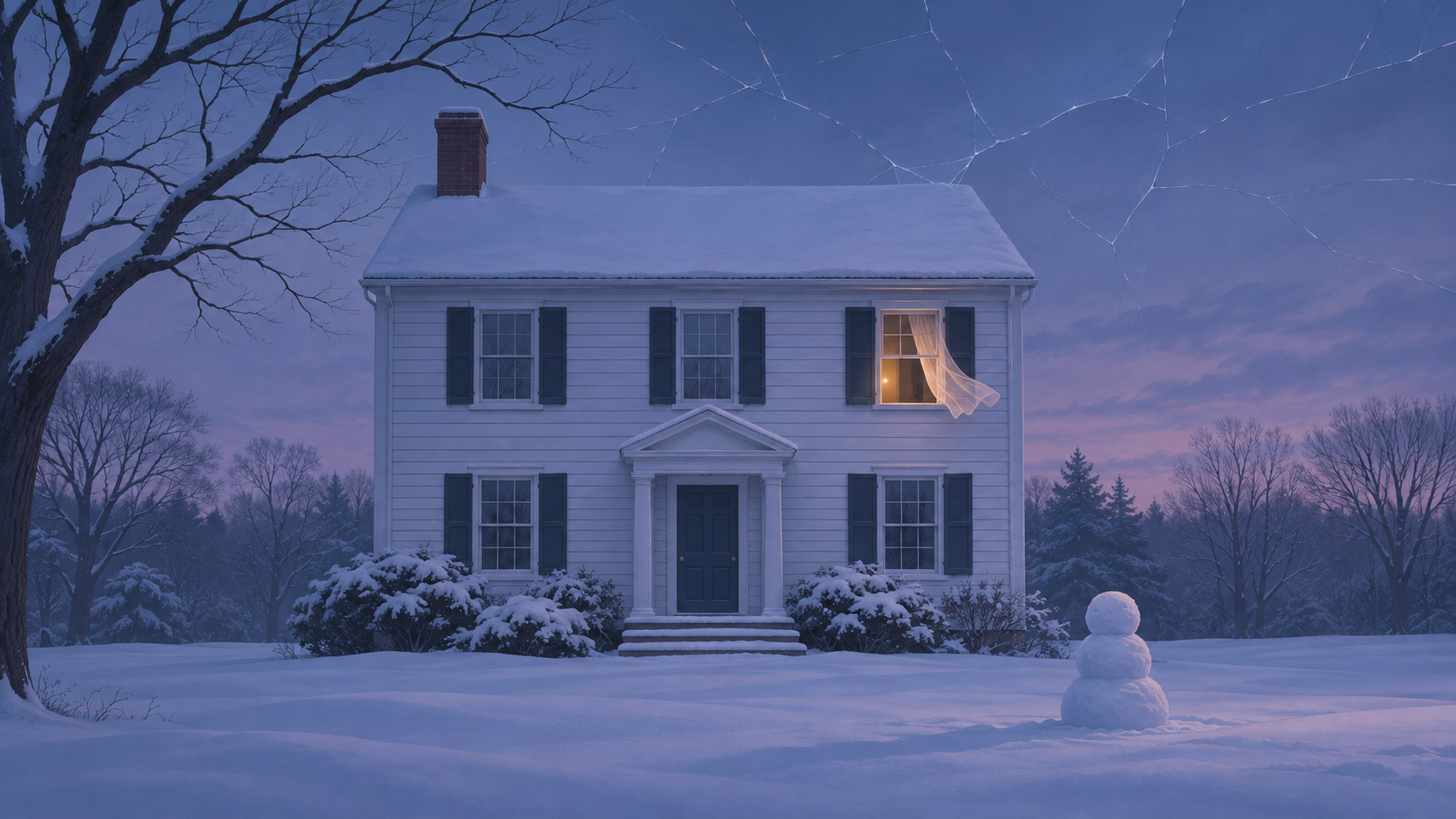
- Cover image prompt: A lone white New England colonial house in snow at blue-hour dusk, one upstairs window open with a curtain drifting out, a small snowman alone in the yard, hairline cracked-glass fractures across the sky; slate blue, snow white, muted lavender, one dim amber window; no people, no violence, no text.
- Custom idea slug: lindsay-clancy-the-story-of-the-night-of-the-murder-as-well-as-the-events-follow
- Sources:
- https://en.wikipedia.org/wiki/Killing_of_the_Clancy_children
- https://www.wbur.org/news/2026/09/04/lindsay-clancy-murder-trial-verdict-massachusetts
- https://www.cbsnews.com/boston/live-updates/lindsay-clancy-murder-trial-hung-jury-mistrial-verdict-watch-live-updates/
- https://www.nbcboston.com/news/local/she-killed-the-kids-prosecutors-outline-chilling-timeline-in-duxbury-tragedy/2966770/
- https://abcnews.com/US/lindsay-clancy-due-court-hearing-future-criminal-case/story?id=137756310
More from Short Video Voiceovers