Cosmic Wallpapers — 15 August 2026
Credits — Cosmic Wallpapers, 15 August 2026
All 5 wallpapers are published by ESA/Webb, ESA/Hubble, ESO under CC BY 4.0 — free to share and adapt with attribution.
Abstract Cosmic Flow — abstract-cosmic-flow.jpg
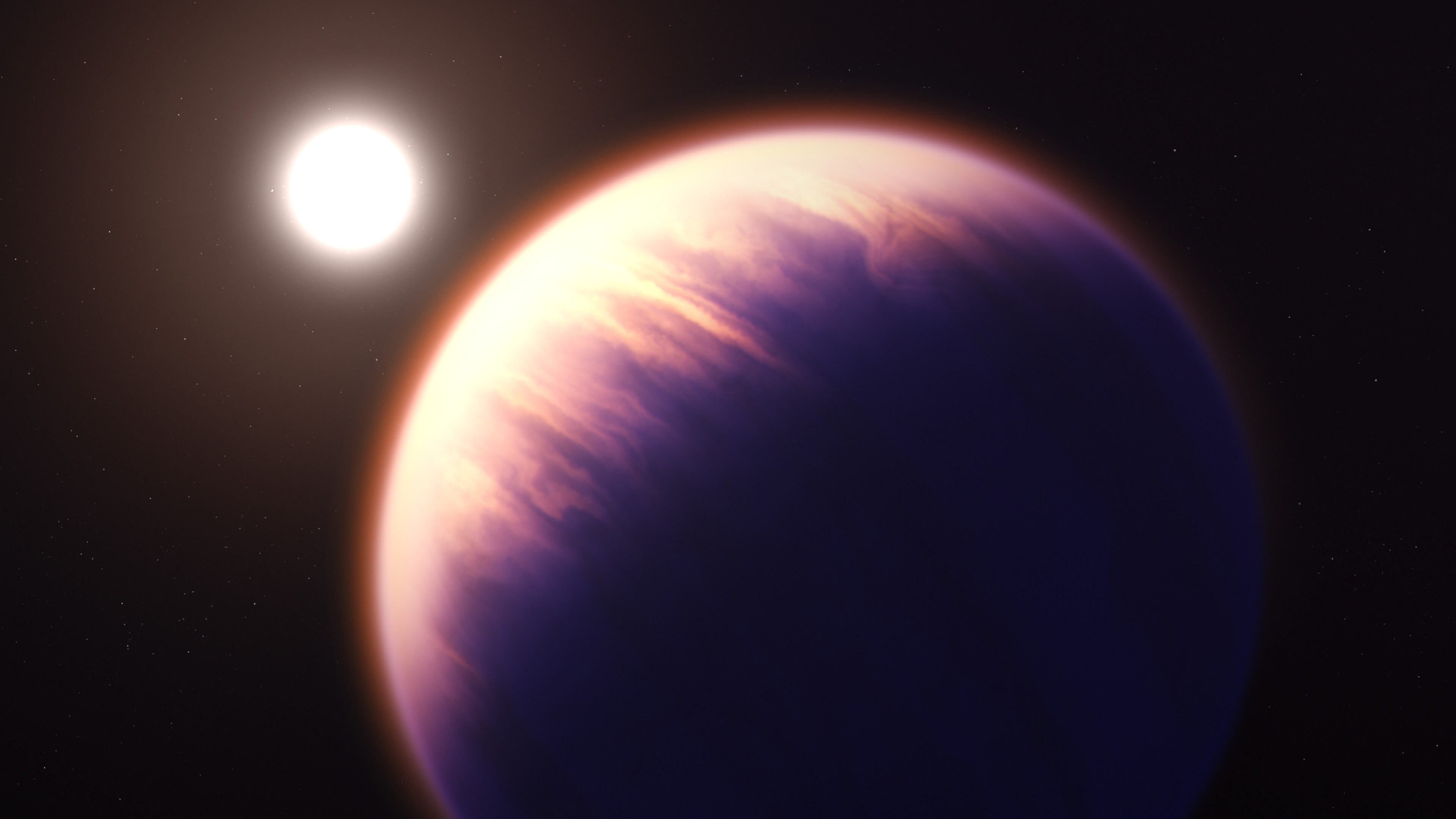
Illustration (Artist’s Impression) of WASP-39 b and Its Star
- Credit: NASA, ESA, CSA, J. Olmsted (STScI)
- Source: ESA/Webb — weic2221a
- Licence: CC BY 4.0
- Image type: Artwork
- Native resolution: 3840x2160
This illustration shows what exoplanet WASP-39 b could look like, based on current understanding of the planet. WASP-39 b is a hot, puffy gas giant with a mass 0.28 times Jupiter (0.94 times Saturn) and a diameter 1.3 times greater than Jupiter, orbiting just 0.0486 astronomical units (7,200,000 kilometres) from its star. The star, WASP-39, is fractionally smaller and less massive than the Sun. Because it is so close to its star, WASP-39 b is very hot and is likely to be tidally locked, with one side facing the star at all times. NASA’s James Webb Space Telescope’s exquisitely sensitive instruments have provided a profile of WASP-39 b’s atmospheric constituents and identified a plethora of contents, including water, sulphur dioxide, carbon monoxide, sodium and potassium. This illustration is based on indirect transit observations from Webb as well as other space and ground-based telescopes. Webb has not captured a direct image of this planet. [Image Description: This image shows an artist's impression of the planet WASP-39 b and its star. The planet has a fuzzy orange-blue atmosphere with hints of longitudinal cloud bands below. The left quarter of the planet (the side facing the star) is lit, while the rest is in shadow. The star is bright yellowish-white, with no clear features.]
Planetary Vista — planetary-vista.jpg
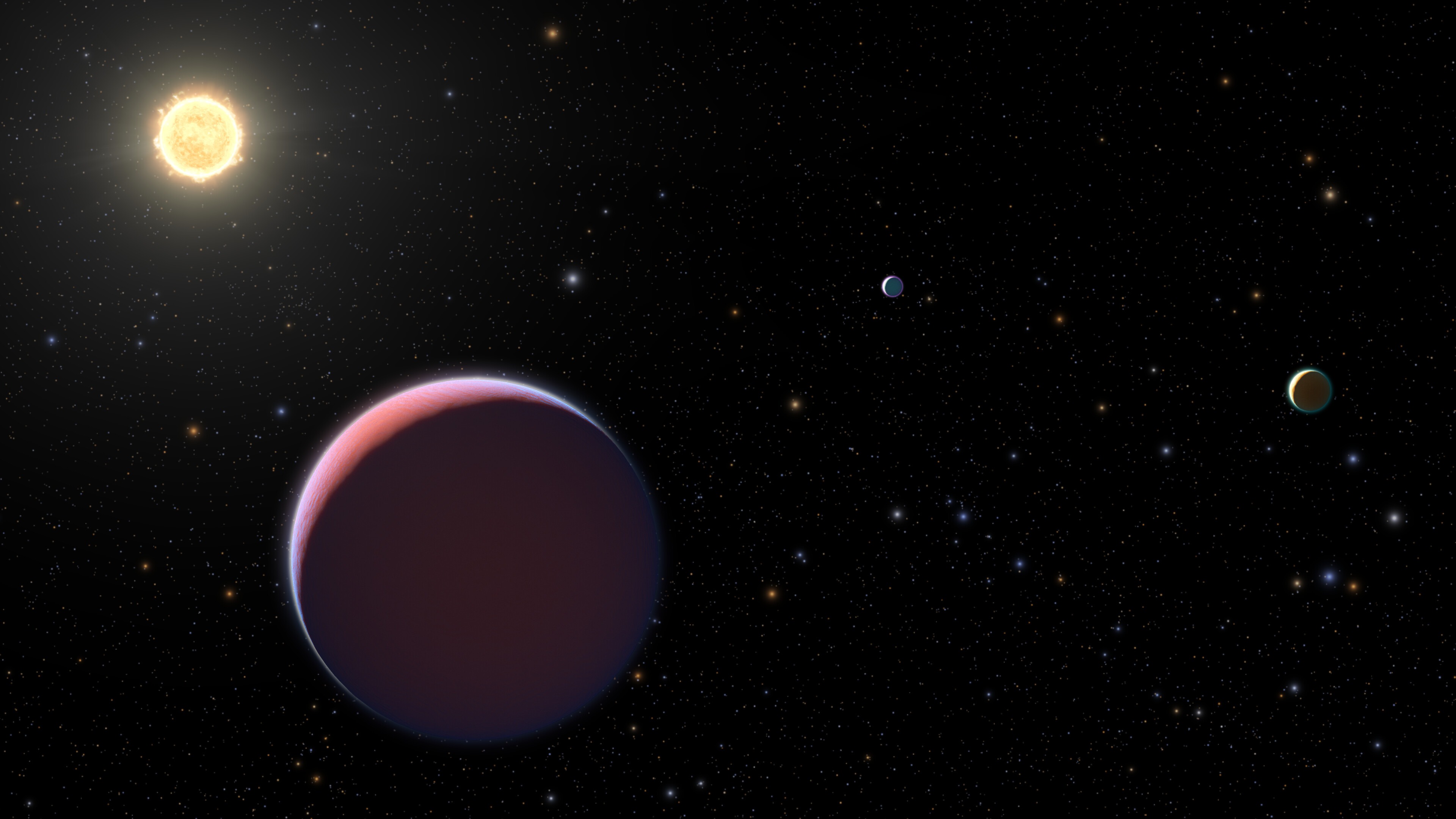
Hubble Probes Cotton Candy Planets
- Credit: NASA, ESA, and NRAO
- Source: ESA/Hubble — opo1960a
- Licence: CC BY 4.0
- Image type: Artwork
- Native resolution: 3840x2160
New observations from the NASA/ESA Hubble Space Telescope have provided the first spectroscopic observations of two of these super-puffy planets, which are located in the Kepler-51 system. The recent Hubble observations allowed a team of astronomers to refine the mass and size estimates for these worlds – independently confirming their “puffy” nature. Though no more than several times the mass of Earth, their hydrogen/helium atmospheres are so bloated they are nearly the size of Jupiter. In other words, these planets might look as big and bulky as Jupiter, but are roughly 1/100th the mass of Jupiter. How and why their atmospheres balloon outwards remains unknown, but this feature makes super-puffs prime targets for atmospheric investigation. Using Hubble, the team went looking for evidence of components, notably water, in the atmospheres of Kepler-51b and 51d. Hubble observed the planets when they passed in front of their star, aiming to observe the infrared color of their sunsets. Astronomers deduced the amount of light absorbed by the atmosphere across a range of infrared light wavelengths, thus creating a spectrum for each planet in hopes of seeing the telltale signs of constituents like water in the features of the spectra. The team concluded that the low densities of these planets are in part a consequence of the young age of the system, a mere 500 million years old. Models suggest these planets formed outside of the star’s “snow line” where icy materials can survive. The planets then migrated inward, like a string of railroad cars. Link: NASA Press Release
Solar System Vista — solar-system-vista.jpg
Hubble's last look at Ccomet ISON before perihelion
- Credit: NASA, ESA, and the Hubble Heritage Team (STScI/AURA)
- Source: ESA/Hubble — opo1347a
- Licence: CC BY 4.0
- Image type: Observation
- Native resolution: 3925x3912
As of mid-November, ISON is officially upon us. Hubble has taken its closest look yet at the innermost region of the comet, where geysers of sublimating ice are fueling a spectacular tail. Made from observations on 2 November 2013, the image combines pictures of ISON taken through blue and red filters. The round coma around ISON's nucleus is blue and the tail has a redder hue. Ice and gas in the coma reflect blue light from the Sun, while dust grains in the tail reflect more red light than blue light. This is the most colour separation seen so far in ISON and the comet, nearer than ever to the Sun, is brighter and more structured than ever before. Comet ISON will come closest to the Sun on November 28, a point in its orbit known as perihelion. Comet ISON was fairly quiet until 1 November 2013, when it experienced an outburst that doubled the amount of gas the comet emitted. After this image was taken, a second outburst shook the comet, increasing its activity by a factor of ten. Over the past couple of nights, the comet has stabilised at its new level of activity. It is now bright enough to be seen with a good pair of binoculars from a dark site, in the morning skies towards the East. Hubble Heritage release ISONblog, an online source offering analysis of Comet ISON by Hubble Space Telescope astronomers and staff at the Space Telescope Science Institute in Baltimore, USA.
Galaxy Spiral — galaxy-spiral.jpg
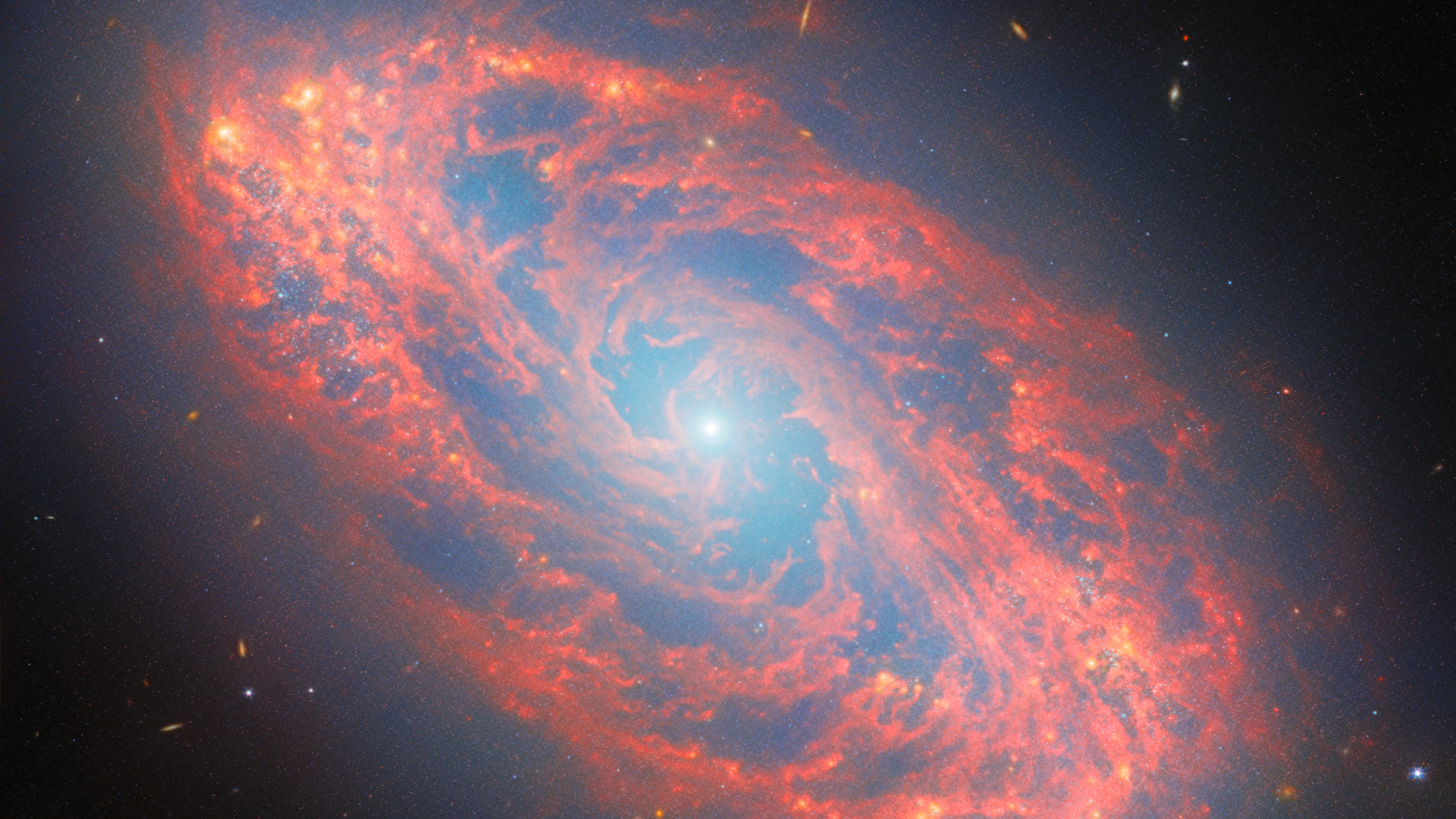
The stellar lifecycle in a nearby spiral
- Credit: ESA/Webb, NASA & CSA, A. Leroy
- Source: ESA/Webb — potm2602a
- Licence: CC BY 4.0
- Image type: Observation
- Native resolution: 4204x4202
Two powerful instruments of the NASA/ESA/CSA James Webb Space Telescope joined forces to create this scenic galaxy view for today’s Picture of the Month. This spiral galaxy is named NGC 5134, and it’s located 65 million light-years away in the constellation Virgo. Though 65 million light-years may seem like a huge distance — the light that Webb collected to create this image has been journeying to us from NGC 5134 since soon after Tyrannosaurus rex went extinct — NGC 5134 is fairly close by as far as galaxies go. Because of the galaxy’s relative proximity, Webb can spot incredible details in its tightly wound spiral arms. Webb’s Mid-InfraRed Instrument (MIRI) collects the mid-infrared light emitted by the warm dust that speckles NGC 5134’s interstellar clouds, tracing clumps and strands of dusty gas. Some of the dust is composed of complex organic molecules called polycyclic aromatic hydrocarbons, which feature interconnected rings of carbon atoms and provide a way for astronomers to study the chemistry happening in interstellar clouds. Webb’s Near-InfraRed Camera (NIRCam) records shorter-wavelength near-infrared light, mostly from the stars and star clusters that dot the galaxy’s spiral arms. Together, the MIRI and NIRCam data paint a portrait of a galaxy in constant ebb and flow. The gas clouds that billow along NGC 5134’s spiral arms are the sites of star formation, and each star that forms chips away at the galaxy’s supply of star-forming gas. When stars die, they recycle some of that gas back into the galaxy. Massive stars more than about eight times the mass of the Sun do so spectacularly, in cataclysmic supernova explosions that spread stellar material across hundreds of light-years. Stars like the Sun give back some of their material as well, though more gently; these stars will balloon into bubbling red giants before shrugging off their atmospheres and sending them into space. Whether expelled by explosive supernovae or gentle red giants, this gas can then be incorporated into new stars. This give and take between gas and stars is the focus of the observing programme (#3707) for which these images were taken. This programme aims to study 55 galaxies in the nearby Universe that are actively forming new stars and have been studied across a broad range of wavelengths. The new Webb data contribute a rich understanding of individual star clusters and star-forming clouds and have already been used to study the life cycle of tiny dust grains, the shape and properties of star-forming clouds, the links between interstellar gas and dust, and the process by which newly formed stars reshape their surrounding environment. By using Webb to study the infrared light nearby galaxies like NGC 5134 whose stars and gas can be seen in detail, astronomers can apply their knowledge to galaxies too distant to be observed so closely — like those that are scattered in the background of this image, barely more than points of light. [Image Description: A spiral galaxy, seen tilted diagonally. It has a blue-white, glowing spot at its core. Its oval-shaped disc glows faintly blue throughout with light from its many stars. The disc is filled with waves and strands of bright red dust that swirl around the core. At places there are holes torn in the dust, while elsewhere it forms dense clumps that glow orange. Several tiny, distant galaxies appear across the background.] Links Pan video: NGC 5134 Space Sparks Episode 22: NGC 5134 Image on ESA website
Black Hole Horizon — black-hole-horizon.jpg
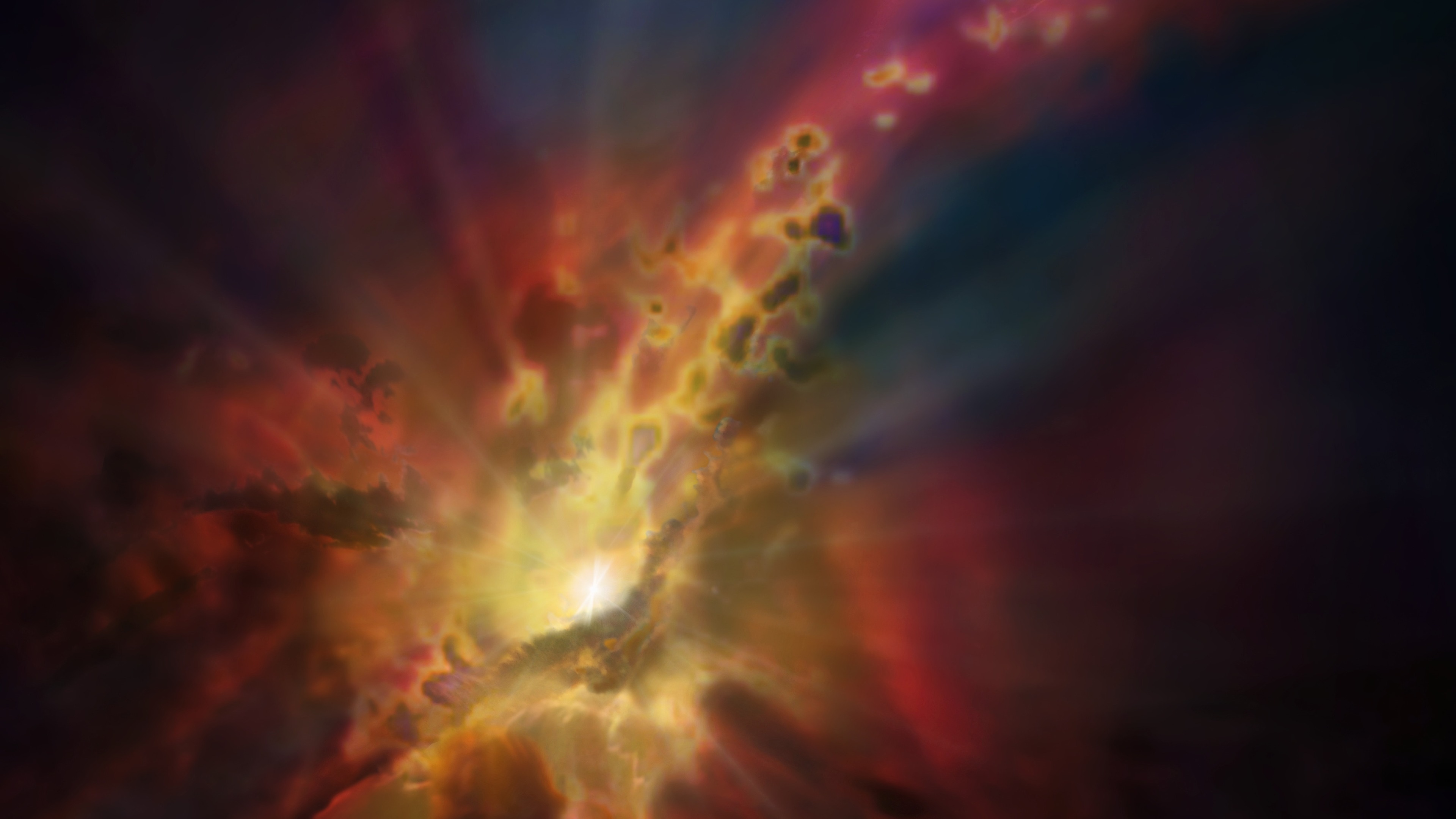
Artist’s impression of cold intergalactic rain
- Credit: NRAO/AUI/NSF; Dana Berry/SkyWorks; ALMA (ESO/NAOJ/NRAO)
- Source: ESO — eso1618a
- Licence: CC BY 4.0
- Image type: Artwork
- Native resolution: 4500x6000
The cosmic weather report, as illustrated in this artist’s concept, calls for condensing clouds of cold molecular gas around the Abell 2597 Brightest Cluster Galaxy. The clouds condense out of the hot, ionised gas that suffuses the space between the galaxies in this cluster. New ALMA data show that these clouds are raining in on the galaxy, plunging toward the supermassive black hole at its centre.
More from Wallpapers