Future Cities — Toronto
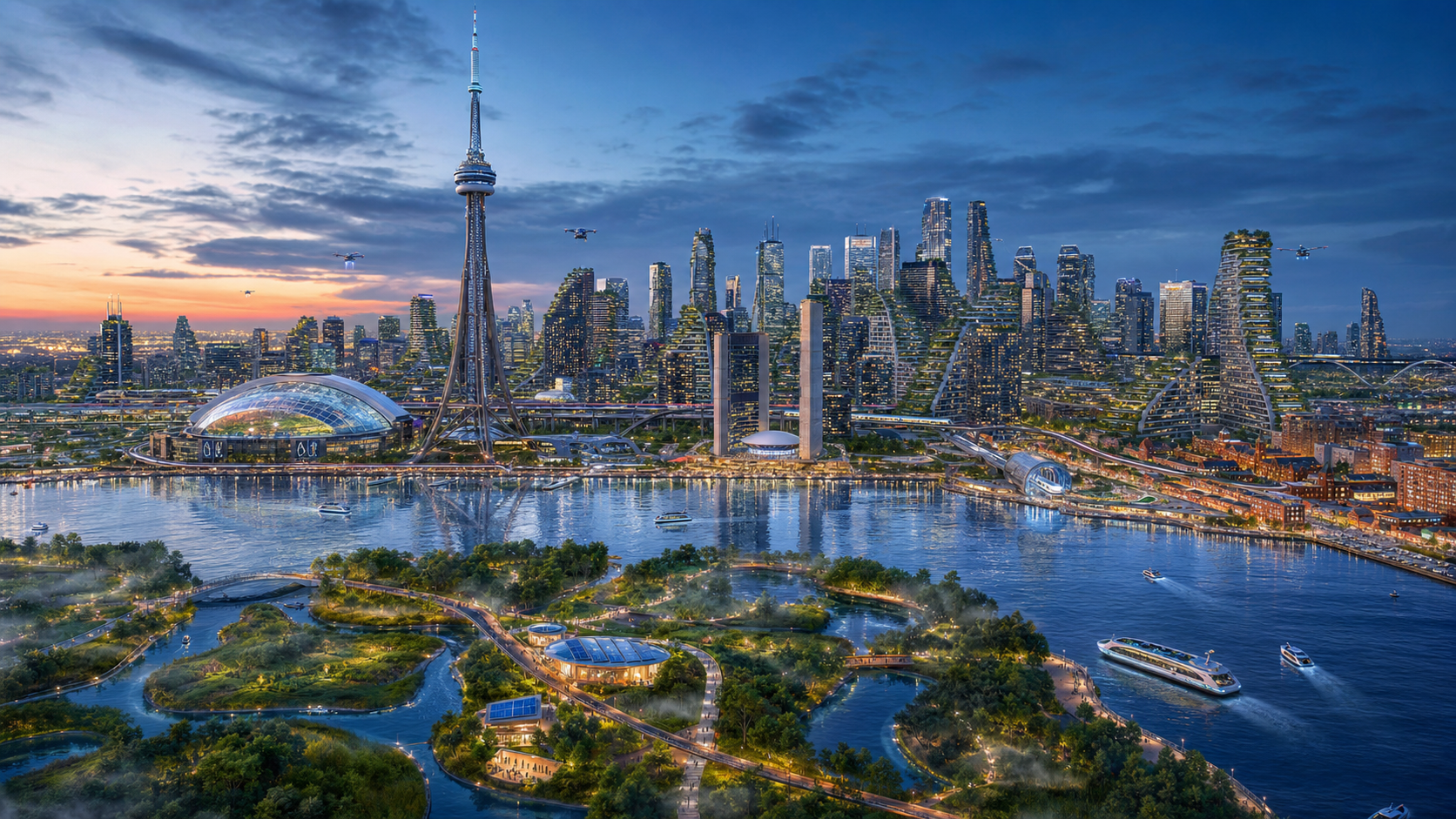
Toronto in 2500 grows northward from Lake Ontario as a dense ravine metropolis whose towers, transit, and ecology operate as one system.
Toronto in 2500
- City: Toronto
- Year: 2500
- Title: The Ravine Metropolis
- Style: Photorealistic cinematic architectural concept art
- Keywords: Toronto, CN Tower, Lake Ontario, Toronto Islands, ravines, wetlands, climate adaptation, arcologies, maglev streetcars, blue hour
- Saved image path:
My-Library/Images/Collections/Future-Cities/Images/Future-Cities_Toronto.png - Model: built-in gpt-image
- Generation date: 2026-07-25
Vision
Toronto in 2500 grows northward from Lake Ontario as a dense ravine metropolis whose towers, transit, and ecology operate as one system. The CN Tower has become a carbon-lattice atmospheric observatory and clean-energy beacon, while the familiar domed stadium shelters a vast bioclimatic garden. The Toronto Islands form a living flood barrier of wetlands, beaches, public paths, and water gardens; beyond them, terraced arcologies and vertical forests follow the old street grid and connect to the city's green ravines. Quiet maglev streetcars, lake ferries, and elevated transit preserve Toronto's movement patterns beneath an optimistic blue-hour skyline.
Caption
Across the living islands, Toronto's familiar tower guides a lakefront city where ravines, transit, and climate architecture have converged.
Final Prompt Used
Use case: stylized-concept
Asset type: Future Cities collection entry
Primary request: Create one ultra-detailed, high-definition cinematic cityscape of Toronto in the year 2500, roughly 475 years in the future. It must remain unmistakably Toronto, not a generic science-fiction city.

Scene/backdrop: A sweeping elevated view from above the Toronto Islands looking north across Lake Ontario at blue hour after a summer rain. In the foreground, the islands have evolved into a lush engineered wetland archipelago with reed gardens, restored beaches, transparent flood-control channels, public paths, and small solar ferries. The lake surface carries reflections toward the dense downtown skyline.

Recognizable geography and landmarks: The CN Tower remains the unmistakable central vertical landmark, respectfully reimagined as a slender carbon-lattice atmospheric observatory and clean-energy beacon with its familiar needle, circular observation form, and tripod-like base still legible. Beside it, the rounded white dome of the Rogers Centre is transformed into a vast retractable bioclimatic garden arena. Preserve the street grid and Lake Ontario waterfront orientation. Include a futuristic echo of Toronto City Hall’s two curved towers embracing a central civic chamber in the mid-distance, and a subtle historic red-brick Distillery District woven into new architecture. The Toronto ravine network continues into the city as green ecological corridors.

Future systems: graceful terraced arcologies rise behind and between recognizable landmarks without obscuring them; vertical forests suited to Ontario seasons, luminous geothermal cores, solar glass skins, and snow-shedding roofs. Quiet maglev streetcars follow the familiar red streetcar corridors at ground level while elevated transit ribbons thread between towers. Small electric air taxis move sparingly above the waterfront. A high-speed submerged lake transit portal sits near Union Station. Civic spaces are lively with tiny crowds, markets, cyclists, and service robots at believable scale. Climate adaptation is visible through wetlands, floodable parks, water gardens, and layered shoreline defenses that feel beautiful rather than dystopian.

Composition/framing: ONE unified wide cinematic 16:9 LANDSCAPE establishing shot, dense layered detail from foreground island habitat and lake traffic through the midground waterfront to the distant skyline and ravine-green horizon. The CN Tower is the visual anchor slightly left of center, with lake reflections and transit lines guiding the eye. Deep atmospheric perspective, enormous sense of scale, professional concept-art composition.

Style/medium: photorealistic architectural visualization blended with premium cinematic science-fiction concept art; hyper-detailed, sharp focus, physically plausible materials and infrastructure, believable future urban life. Not a cartoon, not panels.

Lighting/mood: serene blue hour after rain, cool cobalt sky with a warm peach band at the western horizon, tasteful amber interior lights, teal ecological illumination, wet glass and lake reflections, thin mist over the islands. Awe-inspiring, humane, optimistic, culturally layered.

Constraints: Toronto in year 2500; real landmarks and geography recognizable; 16:9 landscape; one coherent scene. No text, letters, captions, signs, flags, logos, watermarks, borders, real-person likenesses, branded vehicles, destruction, dystopian grime, generic flying-car congestion, or disconnected collage.
More from Image Collections