Future Cities — Vienna
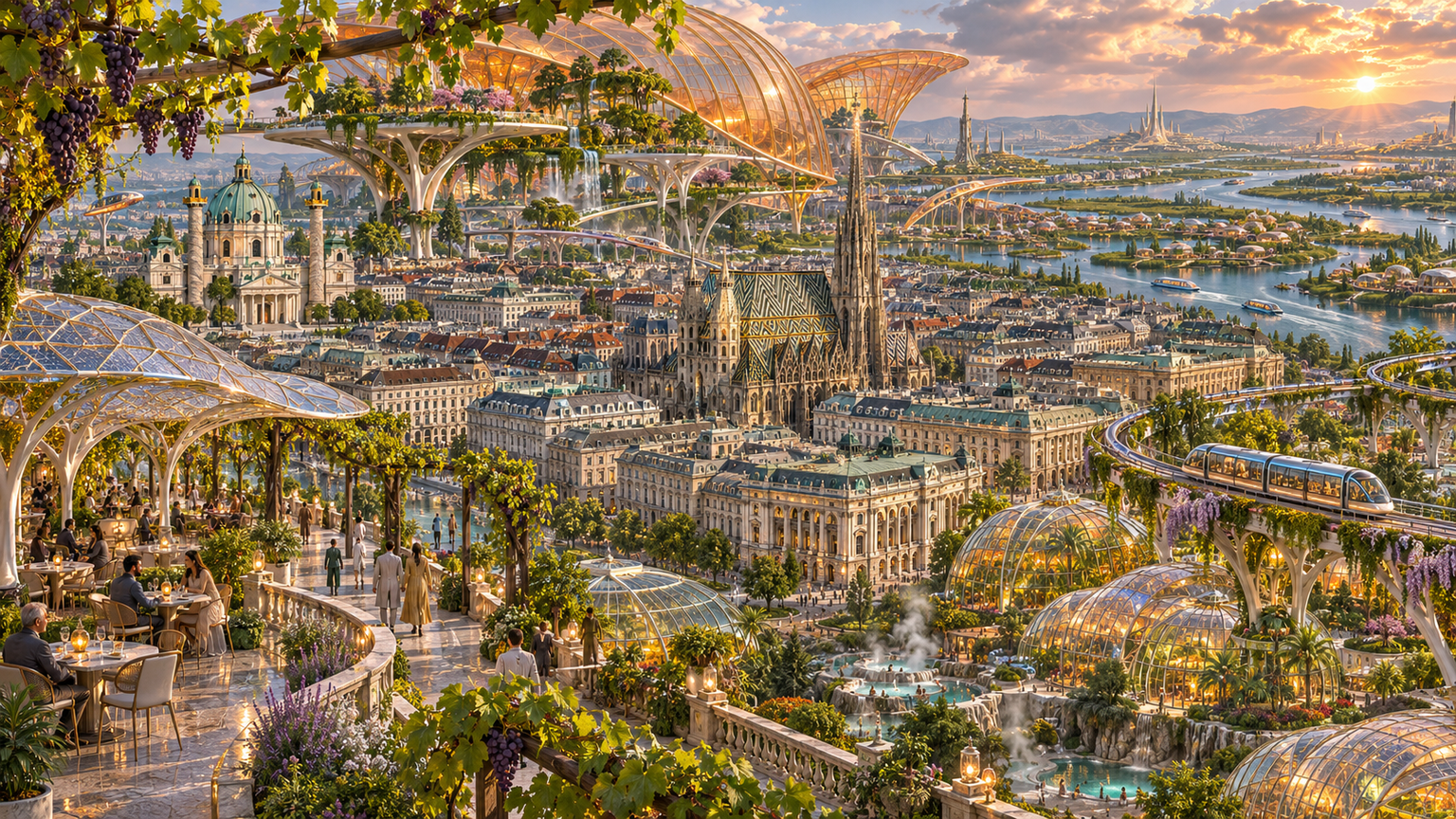
Vienna in 2500 preserves its Gothic cathedral and imperial streets beneath enormous amber-glass shell arcologies.
Future Cities: Vienna
- City: Vienna
- Year: 2500
- Title: The Danube Glass Gardens
- Style: Photorealistic cinematic future-city concept art
- Keywords: Vienna, 2500, St Stephen’s Cathedral, Karlskirche, Danube, Ringstrasse, glass arcologies, wetland islands, magnetic trams
- Model: built-in gpt-image
- Generation date: 2026-11-10 (UTC)
- Saved image:
My-Library/Images/Collections/Future-Cities/Images/Future-Cities_Vienna.png
Vision
Vienna in 2500 preserves its Gothic cathedral and imperial streets beneath enormous amber-glass shell arcologies. Ceramic supports carry orchards and sky gardens; magnetic trams connect the layered city. Beyond the historic core, Danube wetlands absorb floods and shelter floating neighborhoods. Cafe terraces, grapevine pergolas and copper domes retain the city’s identity amid five centuries of imagined change. Landmark distances and orientation are artistically compressed into one panorama.
Caption
Vienna’s cathedral rises beneath glass gardens, with magnetic trams linking the historic core to a restored Danube landscape.
Sources note
No web research used. Stable Viennese landmarks ground this speculative concept; the future infrastructure is imagined.
Final prompt used
Create a high-definition photorealistic cinematic future-city concept-art cityscape of Vienna in 2500, a sweeping elevated establishing vista with elaborate planted architecture, sharp material detail, warm sunset light and foreground-to-horizon depth. The recognizable Gothic south tower and patterned tiled roof of St Stephen's Cathedral anchor the central historic core, preserved among pale limestone Ringstrasse palaces; the green copper dome of the Karlskirche and its twin sculpted columns occupy the left middle distance. Farther beyond the core, the Danube forms a broad blue ribbon with braided wetland islands; the river must not run directly beside the cathedral. Five centuries of adaptation have woven enormous translucent amber-glass musical-shell arcologies above the historic streets, supported by branching ivory ceramic piers with layered hanging gardens. Magnetic trams glide along slender elevated loops, unmarked small aerial ferries drift between sky gardens, and autonomous riverboats connect floodable wetland neighborhoods. Foreground terrace: people at tiny believable scale strolling through grapevine pergolas and a futuristic Viennese cafe beneath lace-like solar canopies, no readable menus or signs. Old stone courtyards transition into vertical orchards, thermal-energy gardens and glowing glass conservatories. Dense layered unified scene; monumental far-future structures coexist with unmistakable Viennese heritage. Palette: imperial ivory, oxidized copper green, Danube blue and honey amber. Low sun catches gilded edges, soft clouds and atmospheric distance, realistic reflections and professional concept-art finish. Wide cinematic landscape framing. STRICT: no text, letters, words, numbers, captions, titles, labels, banners, credits, stat blocks, logos, watermarks, signatures, UI chrome, or borders anywhere in the image. Output a wide 16:9 landscape image.
Visual QA
Compared with Lisbon and Santiago: matching photorealistic finish, warm light, dense planted architecture and sweeping cinematic framing. The cathedral’s patterned roof and Gothic tower, Karlskirche’s copper dome and paired columns, and the distant Danube identify Vienna. Large arcologies, elevated transit and wetland neighborhoods convey 2500. One continuous scene with foreground cafe activity and distant horizon; no visible lettering, signage, logos, watermark or border. Geography is compressed rather than a literal map. The exact built-in render path was copied and normalized with Lanczos to 1536×864; non-empty PNG verified. No fallback or transcript recovery used.
More from Image Collections