Why Nostalgia Rules Entertainment
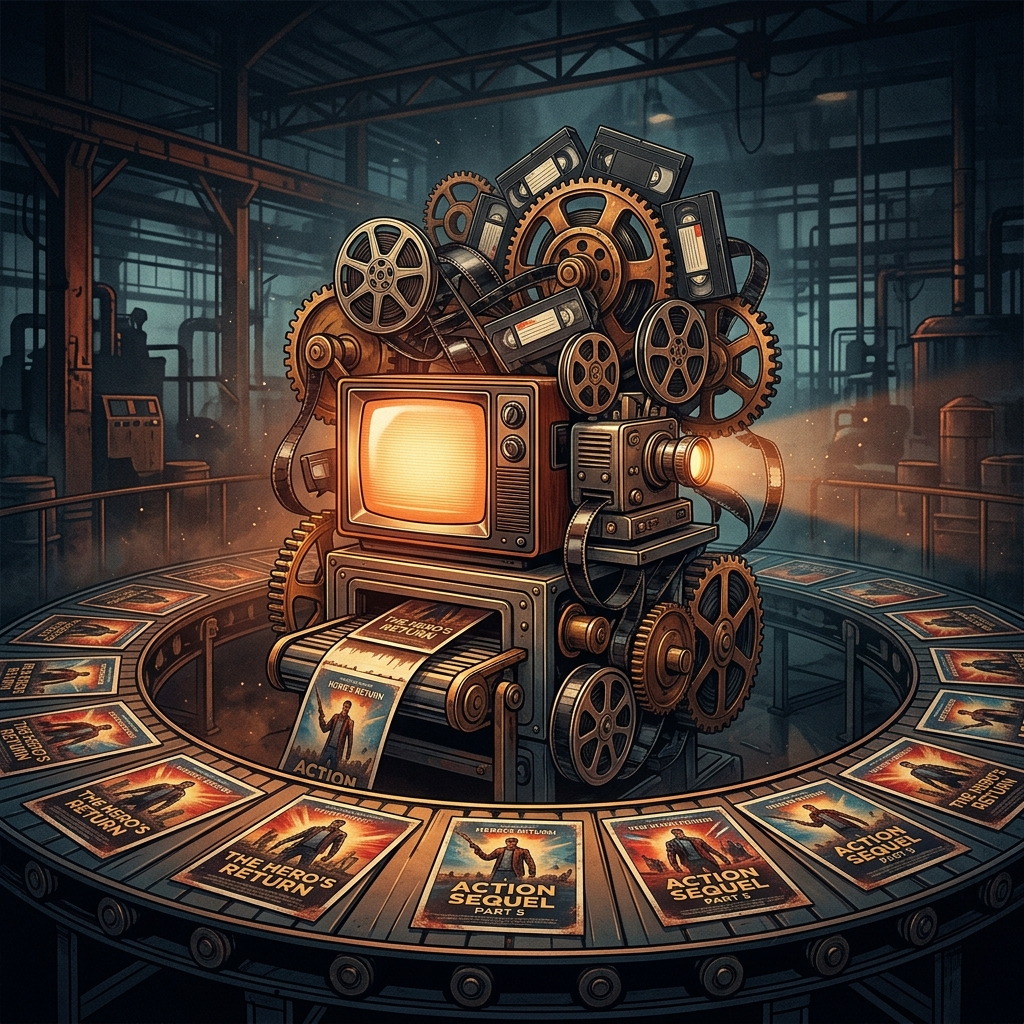
Entertainment is eating itself alive — and audiences can't get enough. Hollywood keeps strip-mining the past for IP gold: reboots, sequels, live-action remakes, spin-offs of spin-offs.
Why Nostalgia Rules Entertainment
Date: 26-06-2026 Group: Group4 Host: Vinnie "The Mic" Marino Cast: Arthur "Two-Pints" Sullivan, Debra from HR, Gary "The Gadget" Miller
Topic Description
Entertainment is eating itself alive — and audiences can't get enough. Hollywood keeps strip-mining the past for IP gold: reboots, sequels, live-action remakes, spin-offs of spin-offs. Streaming platforms bank on comfort economics, betting nostalgia clicks better than originality. But fans revolt when the execution misses, and the rare genuinely fresh hit breaks through anyway. Tonight we dig into why we keep going back, who profits from the loop, and whether there's any escape from the nostalgia machine.
Script
Vinnie "The Mic" Marino
BOOM — welcome back to The Marino Show, comin' at ya live from the greatest studio in the five boroughs — Big Tony, hit that drop — yeah, beautiful! Alright alright alright, tonight's topic is somethin' that every person listenin' on the parkway has an opinion on: why can't Hollywood make anything NEW? It's all reboots, remakes, sequels to prequels — they just put "Legacy" in the title and call it a day. I got three brilliant minds in here — I'm bein' generous — to hash it out. Arthur Sullivan, a man who famously cried at the Thundercats reboot—
Arthur "Two-Pints" Sullivan
I didn't — hiccup — I didn't cry, Vinnie, I wept. There's a diffrensh. Thundercatsh was my CHILDHOOD, mate. They took something beautiful and they just — burp — sorry — they just ruined it. You can't improve on perfection. You can't. I've had two pintsh and I'll say it again: some thingsh should shtay dead.
Vinnie "The Mic" Marino
Two pints, he says. Sure, Art. And welcome also to Debra — she handles HR at some corporation I've never heard of, and apparently she has "actionable insights" on the entertainment industry. Debra, great to have ya.
Debra from HR
Thank you, Vinnie, it's wonderful to be here and I want to start by saying how much I appreciate this opportunity to circle back on what is genuinely an underexplored professional pain point. The nostalgia economy is essentially a risk-mitigation strategy. Studios are leveraging pre-validated intellectual property to minimize stakeholder uncertainty while maximizing engagement touchpoints. It's really just good change management.
Vinnie "The Mic" Marino
Change management. She just called the Lion King remake "change management." Big Tony, where's that buzzer? And Gary Miller, tech bro extraordinaire, who I'm told wants to disrupt the movie industry with an app — Gary, what's up, buddy.
Gary "The Gadget" Miller
Vinnie, huge fan, love the show — and look, the data is unambiguous here. Nostalgia content is performing at a 3.4x ROI multiplier versus original IP in the streaming era. Studios have essentially built a machine-learning algorithm — they're just calling it "a greenlight committee" — and it's optimizing for familiarity. People aren't watching movies, they're consuming emotional comfort content. It's literally a UX problem. The friction of novelty kills conversion.
Arthur "Two-Pints" Sullivan
The FRICTION of— hiccup — Gary, mate, you've just deshrcibed why I hate you. You've taken something beautiful — the magic of shtories — and turned it into a... a... SPREADSHEET. slams fist I love you, mate, I genuinely do, you're my besht friend in this room — but that is the saddest thing I've ever heard and I once watched The Lion King at a pub and the bartender turned it off before Mufasha died.
Vinnie "The Mic" Marino
Wait, wait — he's got a point though, Gary. Like, my ma watches every single thing on Netflix that has the word "Beach" or "Love" in it. She doesn't care if it's original or not. She wants COMFORT. So are the studios right? Are they just giving the people what they want?
Debra from HR
I think that's a really valid observation, Vinnie, and I want to make sure we're creating space for all perspectives here. The studios are essentially responding to audience-reported satisfaction metrics. When we look at the synergy between comfort economics and risk-adjusted content portfolios — and I've actually put together a framework on this that I could share offline — the takeaway is that nostalgia isn't lazy, it's strategic. Studios are being very intentional about leveraging legacy brand equity.
Gary "The Gadget" Miller
Exactly! And blockchain is going to take this further — imagine if your nostalgia preferences were tokenized. You hold a Spider-Man NFT from 2002, you get voting rights on which villain appears in the next reboot. Total community-governed IP. We're talking Web3 entertainment, decentralized fandom. I've got a pitch deck—
Arthur "Two-Pints" Sullivan
I shtop you RIGHT there — hiccup — nobody — NOBODY — wants to vote on a villlain with a BLOCKCHAIN. You know what I want? I want to go to the cinema on a Friday night with my mate Dave — lovely bloke, Dave, bit of a bellend but lovely — and I want to be SURPRISED. I don't want to know the villain because I voted for him with my Spider-Man coin. That ish the end of art, Gary. The END.
Vinnie "The Mic" Marino
Ehhhh, okay but here's where I gotta push back on you, Art. You said "surprised" — but like, be honest, when the new Top Gun came out, you didn't want a surprise. You wanted Maverick in a cockpit. You wanted "Danger Zone." You wanted to feel EIGHTEEN AGAIN. And you paid to feel that. Everybody did. It made a billion and a half dollars. So who's wrong here?
Arthur "Two-Pints" Sullivan
...That'sh — long pause — that'sh a fair point, Vinnie. sniffles Top Gun Maverick made me feel thingsh. Shtuff I haven't felt shince me dad took me to the original. And I cried. Again — I WEPT, there'sh a diffrensh — and I'm not ashamed. hiccup But that'sh the EXCEPTION. That wash good. Most remakesh are RUBBISH.
Debra from HR
I think what Arthur is surfacing — and I want to acknowledge that he's coming from a really authentic emotional place — is the quality execution gap. The studios have the right framework but they're not always implementing it with sufficient due diligence. When a reboot fails, it's typically an alignment issue between the creative team's vision and the established brand promise. I'd recommend a pre-production stakeholder survey to benchmark audience expectations before any IP is greenlit.
Gary "The Gadget" Miller
That's essentially A/B testing, Debra, which — yeah, studios should absolutely be doing. But here's the real unlock: generative AI. You feed the model every successful franchise property, every audience review, every box office data point, and it tells you exactly which IP to reboot, which cast demographic maximizes engagement, which plot beats hit the nostalgia nodes hardest. We're already seeing this with music — AI is reverse-engineering hit songs. Film is next.
Vinnie "The Mic" Marino
Okay THAT — Big Tony, you heard that? — THAT is the thing that should scare people. Because Gary's not wrong. Gary's annoying but he's not wrong. Studios are already doing this. And you know what? The movies feel like it. They feel ENGINEERED. And that's why when something genuinely fresh breaks through — your Everythings Everywhere All At Onces, your Get Outs — people lose their minds because they forgot what it felt like to see something they'd never seen before. So Gary, question for ya: does your algorithm ever predict the totally-out-of-nowhere original hit?
Gary "The Gadget" Miller
Great question — and honestly, that's the moonshot problem. Black swan creative success is notoriously low-signal. The algorithm doesn't predict Get Out because there's no training data for "first-time director makes social horror satire that redefines a genre." That's why you can't fully automate creative disruption. What you CAN do is build a portfolio that funds safe nostalgia bets to subsidize experimental originals. That's actually how Blumhouse works. It's genius capital allocation.
Arthur "Two-Pints" Sullivan
WAIT — hiccup — shtop, Gary, shtop — are you shaying — are you ACTUALLY shaying — that the GOOD films only get made because the RUBBISH remakesh pay for them?
Gary "The Gadget" Miller
That's... actually exactly what I'm saying, yeah.
Arthur "Two-Pints" Sullivan
very long pause ...Sho the Transformers franchise — which I hate with every bone in my body and I've broken quite a few — burp — Transformersh bought us Get Out. starts tearing up That'sh the saddest and most beautiful thing I've ever heard in my life. I need another pint.
Vinnie "The Mic" Marino
Ha! See, THAT'S why I do this show! Art's havin' an existential crisis in real time! Beautiful! But okay, let's talk fan backlash because this is where it gets spicy. The Little Mermaid, Ghostbusters 2016, the Indiana Jones one nobody asked for — fans REVOLT. They leave a million one-star reviews before the thing even comes out. Debra, from an HR perspective — wait, no, from a NORMAL HUMAN perspective — what is going on with that?
Debra from HR
I want to be very careful here because I think we're entering territory that requires some nuanced sensitivity. Fan backlash often reflects a deeper feelings around perceived breach of psychological contract — audiences have an implicit agreement with a franchise about what it represents, and when that agreement isn't honored, the response can feel very disproportionate. I'd actually love to see studios implement a Franchise Expectation Alignment Session — sort of a pre-release town hall — to surface those concerns proactively and create a feedback loop before the product goes to market.
Vinnie "The Mic" Marino
A pre-release town hall. For a movie. She wants a pre-release town hall for a movie. Debra, I'm beggin' ya — take the corporate hat off for two seconds.
Debra from HR
I take your feedback on board, Vinnie, and I'd like to reframe that as a growth opportunity—
Arthur "Two-Pints" Sullivan
interrupting The fan backlash ish GRIEF, Vinnie! That'sh what it ish! When they announce a reboot of shomething you love, it'sh like — like shomeone told you they're going to dig up your dog and give it a makeover. It'sh wrong! It'sh unnatural! I love Ghostbushtresh! I love it! And when they — hiccup — when they messed with it — I took it persh — I took it PERSONALLY because that film was there for me when I wash eight and me mum and dad were having a bad time and — long pause, very quietly — Ghostbushtresh wash safe, y'know?
Vinnie "The Mic" Marino
...Man. Art. That's — okay look, I got a soft spot — I got a real soft spot — shut up Tony — but yeah. THAT'S what nobody in a studio greenlight meeting is calculating for. They can A/B test the poster but they can't calculate what a movie meant to someone at eight years old in a house that was falling apart. That's not in Gary's algorithm, right Gary?
Gary "The Gadget" Miller
No, and — look, I'll be honest — that's the part that doesn't scale. Emotional provenance, the personal memory attachment to IP... you can proxy it with sentiment analysis on social data but you can't capture it exactly. Which is actually why the reboots that work tend to have someone in the room who genuinely loves the source material. That human signal is irreplaceable. The algorithm can optimize the distribution, but it can't supply the love.
Arthur "Two-Pints" Sullivan
sniffles Gary, that'sh the most human thing you've ever shaid. Come here.
Gary "The Gadget" Miller
Are you — are you trying to hug me?
Arthur "Two-Pints" Sullivan
I love you, man. hiccup You're my besht friend in tech.
Vinnie "The Mic" Marino
Oh beautiful — beautiful television — radio — whatever we are — we're wrapping up, and here's the thing. Nostalgia rules entertainment because humans are terrified. Terrified of new stuff, terrified of disappointing, terrified of change. And the studios know it, and they're not wrong to play it — but Art's right that the ones that mean something are the ones made by somebody who actually gives a damn about the thing they're touching. That's it. That's the whole secret. Nobody wants it explained, nobody wants it tokenized, nobody wants a pre-release stakeholder town hall — Debra opens mouth — no Debra — they just want to feel somethin' real. This has been The Marino Show. Big Tony, hit the drop. Fuhgeddaboudit.
More from Podcasts