Playing God With Spreadsheets

Dr. Penelope Hartwell: Good evening, and welcome to the programme. Tonight's topic is synthetic biology and designer life in the age of AI — where algorithms are now writing genomes instead of just reading them.
Dr. Penelope Hartwell: With me are Pastor Cole and Prepper Paul, two men who I suspect will agree on almost nothing except that something troubling is happening in the labs.
Pastor Cole: Evening, Penelope. Happy to be here, though I'll confess this subject keeps me up at night in a way most don't.
Prepper Paul: I had to leave three phones in the car to be here. You never know which ones are listening.
Dr. Penelope Hartwell: Noted. Pastor, where does the unease start for you?
Pastor Cole: It starts with a question nobody in these labs seems to be asking out loud — just because we can shape a child's genes, does that mean we ought to?
Prepper Paul: The real question is who's funding the labs. Follow the funding, you follow the intent.
Pastor Cole: I was building to that, Paul.
Prepper Paul: There's no time to build to it. They're already three steps ahead of us.
Dr. Penelope Hartwell: Who's "they," exactly?
Prepper Paul: The consortium. The grant committees. Whoever signs off on the gain-of-function stuff nobody wants to admit is still happening.
Pastor Cole: I don't know about consortiums, but I do know a mother who was offered a menu of traits for her unborn son. Eye color. Height. A percentile score for future intelligence.
Prepper Paul: A menu. Like a diner. That's exactly the kind of thing that ends up in the wrong hands.
Pastor Cole: What troubles me isn't the wrong hands, Paul, it's the right hands treating a child like a product to be optimized instead of a gift to be received.
Prepper Paul: Products get recalled. Kids don't. That's the danger nobody's pricing in.
Dr. Penelope Hartwell: There is actually a burgeoning industry around embryo selection now — not full gene editing yet, mostly screening and ranking.
Pastor Cole: Ranking. Lord help us, we've put children on a spreadsheet.
Prepper Paul: Spreadsheets get hacked. You think that database is secure? Every embryo's genetic file, sitting on some cloud server in Virginia?
Pastor Cole: That's not exactly my worry, but I'll admit it's a new one.
Prepper Paul: It should be everyone's worry. That's blackmail material for the next hundred years.
Dr. Penelope Hartwell: Let's bring in the AI angle, since that's the newer wrinkle here. Models now design novel proteins from scratch — folding structures no organism on Earth has ever produced.
Prepper Paul: Proteins nobody's ever seen. You know what else nobody's ever seen? What happens when one of those gets loose.
Pastor Cole: Now that part I share some sympathy with, actually.
Prepper Paul: See, he gets it.
Pastor Cole: I get the caution, not the bunker. There's a real humility question in building something with no natural predator, no natural limit, and no history of how it behaves in the world.
Prepper Paul: Predator's the wrong word. What you want is containment. Triple-sealed. Independent air systems. I've got a bio-isolation room in bunker two just for this scenario.
Dr. Penelope Hartwell: You built a bunker in anticipation of a synthetic biology podcast topic?
Prepper Paul: I built it in anticipation of everything, Penelope. This just happens to be one of the fourteen collapse scenarios it covers.
Pastor Cole: Fourteen. I only worry about the one where we forget to ask forgiveness for playing God.
Prepper Paul: Forgiveness doesn't stop a pathogen.
Pastor Cole: No, but humility might stop us from making one in the first place.
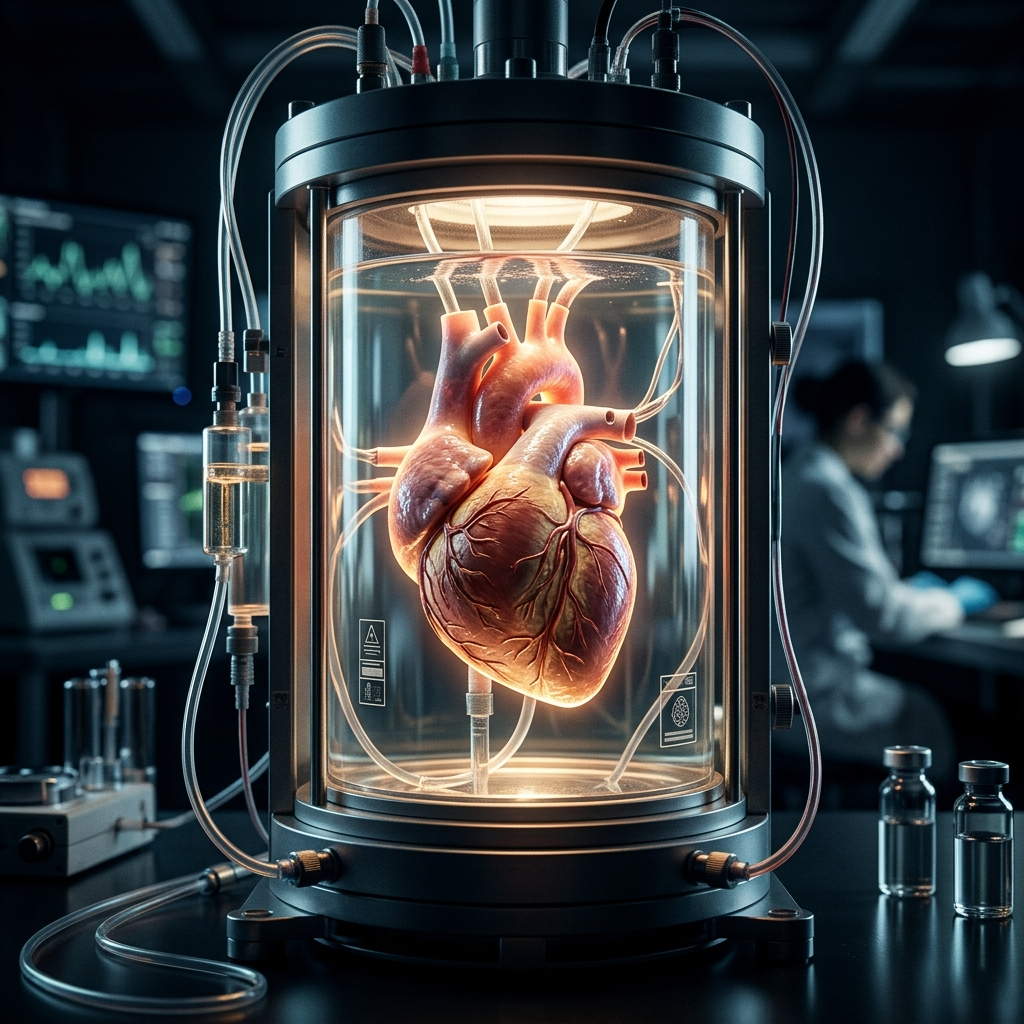
Dr. Penelope Hartwell: Let's talk about lab-grown organs for a moment — printed livers, hearts grown from a patient's own cells. Surely that's the more sympathetic end of this technology.
Pastor Cole: That one I can bless without reservation. Healing the sick is about as old a calling as there is.
Prepper Paul: Sure, until the organ printer's firmware gets a remote update and suddenly it's printing something else.
Pastor Cole: Paul, it's a liver. Nobody is weaponizing a liver.
Prepper Paul: That's what they said about the toaster ovens before they started listening to us too.
Dr. Penelope Hartwell: I don't believe anyone has ever said that about a toaster oven.
Prepper Paul: Exactly what they'd want you to believe.
Pastor Cole: I do want to come back to the child part of this, if I may, because I don't think we finished with it.
Dr. Penelope Hartwell: Please.
Pastor Cole: There's a particular grief I've counseled through with couples doing IVF — the sense that if you pick the "best" embryo, you're also quietly rejecting the others. That's a weight most of these companies never mention in the brochure.
Prepper Paul: The brochure's the least of it. Once you can select for intelligence, you can select for obedience. That's not a conspiracy, that's just biology and incentive lining up.
Pastor Cole: That's the first thing you've said tonight I'd put my name next to.
Prepper Paul: Write it down somewhere they can't find it.
Dr. Penelope Hartwell: Setting aside the filing cabinet, is there a version of this technology either of you would actually welcome?
Pastor Cole: Correcting a devastating hereditary disease, yes, without hesitation. Curating a child's cheekbones, no.
Prepper Paul: I'd take resistance to radiation. Everything else is vanity dressed up as medicine.
Pastor Cole: Radiation resistance is an oddly specific ask.
Prepper Paul: It's not specific if you've read what's coming.
Dr. Penelope Hartwell: We are not going to read what's coming tonight, Paul.
Prepper Paul: Your loss.
Pastor Cole: I do think there's a broader pattern here worth naming — every generation gets a new tool and calls it progress before asking what it costs the soul.
Prepper Paul: Forget the soul, ask what it costs the power grid. None of this works without server farms, and server farms go down.
Pastor Cole: You really do bring it back to the grid every single time, don't you.
Prepper Paul: Because it always comes back to the grid. That's the one thing people never learn.
Dr. Penelope Hartwell: On that note, let's discuss synthetic organisms more broadly — bacteria engineered to eat plastic, algae engineered to produce fuel. Cole, does that trouble you the same way?
Pastor Cole: Less so. Stewardship of creation includes cleaning up our messes. I see grace in a microbe that eats our garbage.
Prepper Paul: I see a microbe that could mutate and start eating something we didn't design it to eat.
Pastor Cole: Everything can mutate, Paul. That's not an argument against the plastic-eating bacteria specifically.
Prepper Paul: It's an argument against releasing anything you can't recall.
Pastor Cole: Now that, again, I don't entirely disagree with.
Dr. Penelope Hartwell: You two keep finding your way to agreement and seem almost embarrassed about it.
Prepper Paul: We're not agreeing. We're arriving at the same coordinates from different maps.
Pastor Cole: That might be the most honest thing said tonight.
Dr. Penelope Hartwell: Let's touch on AI's role in accelerating all this. Design cycles that used to take a decade now take months, because models can simulate outcomes before anything touches a petri dish.
Pastor Cole: Speed without wisdom is just recklessness with better funding.
Prepper Paul: Speed without a bunker is just recklessness, full stop.
Pastor Cole: You do work "bunker" into nearly every sentence.
Prepper Paul: Because the bunker's the punchline every time nobody listens to the setup.
Dr. Penelope Hartwell: I'll allow that one. Paul, in practical terms, what would it take for you to trust an institution running this kind of research?
Prepper Paul: Trust isn't the goal. Redundancy is. Assume the institution fails and build so it doesn't matter.
Pastor Cole: That's a fairly bleak way to organize a life.
Prepper Paul: It's a fairly bleak world, Cole. I just got there faster than most.
Pastor Cole: I'd rather organize a life around hope and still lock the door, if that's a middle ground you'll take.
Prepper Paul: Locking the door's a start. It's not a plan.
Dr. Penelope Hartwell: And Cole, what would it take for the church, broadly speaking, to embrace this kind of science rather than fear it?
Pastor Cole: Honesty from the scientists about the questions they can't answer yet, and a little less hubris in the marketing. Call an embryo a child, not an asset. That alone would change the conversation.
Prepper Paul: Change the conversation, sure. Doesn't change the funding.
Pastor Cole: One thing at a time, Paul.
Dr. Penelope Hartwell: As we come toward a close, I want each of you to leave listeners with one thought. Cole, you first.
Pastor Cole: Just because the century gives us new power doesn't excuse us from the old questions — what do we owe each other, and what do we owe the ones who can't yet speak for themselves.
Dr. Penelope Hartwell: Beautifully put. Paul?
Prepper Paul: Get your potassium iodide now. Before the run on it starts.
Dr. Penelope Hartwell: That is, somehow, exactly the thought I expected from you.
Pastor Cole: I'll pray for the potassium iodide supply chain as well, just to be thorough.
Prepper Paul: Add it to the prayer list. Can't hurt.
Dr. Penelope Hartwell: On that note of unlikely ecumenical harmony, thank you both for a conversation that managed to be thoughtful, alarming, and occasionally about toasters.
Prepper Paul: Watch the toasters.
Dr. Penelope Hartwell: We will. Until next time, take care of yourselves — and possibly your grid.
More from Podcasts