Japchae (Korean Glass Noodles with Beef and Vegetables)
Japchae (잡채) is a Korean holiday and celebration staple, also served as a side dish at everyday meals.
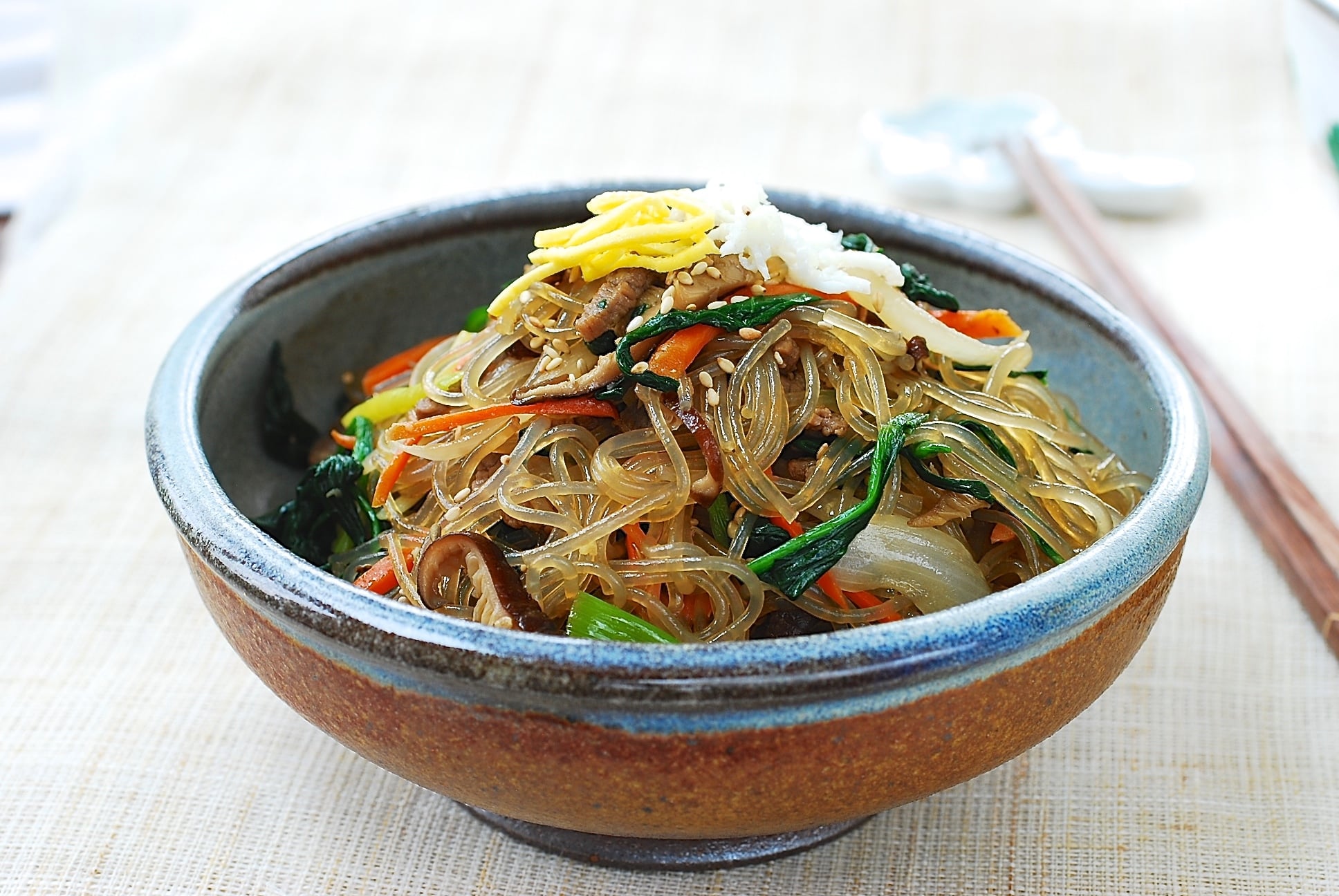
Japchae (Korean Glass Noodles with Beef and Vegetables)
Cultural Context
Japchae (잡채) is a Korean holiday and celebration staple, also served as a side dish at everyday meals. Chewy dangmyeon noodles carry a sweet soy and sesame dressing; cooking the vegetables separately keeps their colors and textures distinct. Korean Bapsang and Maangchi describe this traditional approach.
Ingredients
Main Components
- 200 g (7 oz) dried Korean sweet potato starch noodles (dangmyeon)
- 115 g (4 oz) beef sirloin, cut into thin strips
- 100 g (3½ oz) fresh shiitake mushrooms, stems removed, caps sliced
- 170 g (6 oz) spinach, washed
- 85 g (3 oz) carrot, cut into matchsticks
- 125 g (4½ oz) onion, thinly sliced
- 2 scallions, cut into 5 cm (2-inch) pieces
- 1 tablespoon (15 ml) canola oil, divided
- ⅛ teaspoon fine salt, divided between vegetables
- Water for boiling
For the Sauce/Garnish
- 3½ tablespoons (52 ml) regular brewed soy sauce
- 3 tablespoons (38 g) sugar
- 2 tablespoons (30 ml) toasted sesame oil
- 2 teaspoons minced garlic
- 1 tablespoon toasted sesame seeds
- ¼ teaspoon ground black pepper
- 1 large egg, optional garnish
- 1 teaspoon canola oil, only if making egg garnish
Substitutions:
- Fresh shiitake → the same weight of fresh button mushrooms; the flavor will be milder.
- Beef → 115 g (4 oz) additional mushrooms for a meatless version.
- Regular soy sauce → gluten-free tamari in the same volume; check all package labels. The base recipe declares gluten.
Equipment
- Large saucepan and strainer
- Wide nonstick skillet and spatula
- Large mixing bowl, tongs, and kitchen shears
- Thin-tip instant-read thermometer
- Separate cutting board for raw beef
Instructions
Preparation (Active time: 15 min)
- Prepare the components: Slice the vegetables and beef as listed. Keep the beef refrigerated until cooking; wash hands, board, and knife after handling it.
- Mix the sauce: Stir soy sauce, sugar, sesame oil, garlic, and pepper until the sugar dissolves. Keep the sesame seeds separate for finishing.
Cooking (Active time: 25 min)
- Blanch the spinach: Bring a saucepan of water to a boil. Blanch spinach for 30–60 seconds, rinse cold, squeeze dry, and roughly chop. Season with half the salt and place in the mixing bowl. Keep the water boiling.
- Cook the noodles: Boil for about 6–8 minutes, or according to the package, until translucent and tender throughout. Drain, rinse cold, and drain thoroughly. Cut into 15–18 cm (6–7-inch) lengths. Toss with 3 tablespoons of sauce. Heat half the tablespoon of oil in the skillet over medium heat; toss noodles for about 4 minutes until glossy and slightly sticky. Add to the bowl.
- Stir-fry the vegetables: Heat the remaining half tablespoon of oil over medium-high heat. Cook carrot for 1 minute, add onion and remaining salt, and cook about 2 minutes until onion is translucent. Add scallions for 30 seconds. Transfer to the bowl while vegetables still have some bite.
- Cook the beef and mushrooms: In the same skillet, cook beef and mushrooms with 2 tablespoons of sauce over medium-high heat, stirring, for about 3–5 minutes. Verify the thickest beef strip reaches 145°F (63°C) with a thin-tip thermometer; extend cooking as needed. Transfer to a clean plate and rest for 3 minutes before adding to the bowl.
- Make the optional egg garnish: Separate the egg. Beat white and yolk separately. Wipe the skillet clean and lightly coat with the extra teaspoon of oil. Over medium-low heat, cook each separately as a thin sheet, about 1–2 minutes per side, until completely firm with no wet patches. Cool briefly and slice into ribbons.
Assembly & Finishing
- Toss: Add the remaining sauce and most of the sesame seeds to the bowl. Mix thoroughly with tongs so the spinach and vegetables are evenly distributed.
- Garnish and serve: Transfer to a serving bowl or platter. Scatter over the remaining sesame seeds and optional egg ribbons. Serve promptly while warm.
Food Safety & Storage
- Minimum safe internal temperature: Whole-cut beef strips must reach 145°F (63°C), followed by a 3-minute rest. Cook egg sheets until fully firm; egg dishes should reach 160°F (71°C).
- Storage: Refrigerate in shallow airtight containers within 2 hours, or 1 hour above 90°F (32°C). Keep at 40°F (4°C) or below and use within 3 days.
- Freezing: Freeze cooled portions for up to 1 month; thaw in the refrigerator. Vegetables may soften.
- Reheating: Add a splash of water and toss in a covered skillet, or microwave with a loose cover, until the whole portion reaches 165°F (74°C).
Serving Suggestions
- Serve as a shared side dish with a Korean meal.
- For japchae-bap, spoon a portion over steamed rice; rice is additional to the stated yield.
Scaling Notes
Half recipe (½×): Halve the ingredients and use a smaller skillet. Keep the temperature targets and beef rest unchanged.
Double recipe (2×): Cook noodles, vegetables, and beef in batches; crowding the skillet steams the vegetables. Allow extra active time.
Chef's Notes
- Sourcing: Buy dangmyeon made from sweet potato starch at a Korean grocer; rice vermicelli has a different texture.
- Make-ahead: Slice vegetables and mix sauce a day ahead, storing each refrigerated. Slice beef on a separate board.
- Variations: Omit the optional egg if desired; it remains declared in the allergen list because this version offers it.
- Common pitfalls: Drain noodles and squeeze spinach well so the sauce does not become watery. Noodles should be tender rather than firm in the center.
- Nutrition: Estimated sodium is elevated for a side dish; this is a traditionally seasoned recipe, not a low-sodium dish. Serve modest portions.
Nutrition Information (Optional)
Estimates per serving, including the optional egg; not laboratory analyzed.
- Sodium: approximately 950 mg, depending on soy sauce brand.
- Saturated fat: approximately 2 g.
- Added sugar: approximately 9.5 g.
- Estimate basis: soy sauce 3½ tablespoons × 900 mg sodium, plus ⅛ teaspoon salt × 2,300 mg per teaspoon, plus roughly 300 mg naturally present sodium, divided by 4 ≈ 935 mg. Sugar 38 g ÷ 4 = 9.5 g. Estimated saturated fat for oil, beef, egg, and sesame seeds totals about 8 g ÷ 4 = 2 g.
Sources
- Hyosun, Korean Bapsang: Japchae — ingredient proportions and sauce; adapted with measured oil and salt.
- Maangchi: Japchae — separate cooking technique, spinach blanching, and egg garnish reference.
- Hero photograph: Korean Bapsang — finished beef and vegetable japchae with egg ribbons.
- USDA FSIS safe temperature chart.
- USDA FSIS leftovers guidance.

Version History:
- v1 (2026-10-09): Initial source-synthesized recipe by @Codex.
Credits:
- Recipe adaptation: @Codex, synthesized from Hyosun's Korean Bapsang and Maangchi recipes above, with explicit food-safety targets and storage guidance.
- Testing: @Codex performed a source, quantity, allergen, and safety review; this recipe has not been kitchen-tested.
- Verification metadata: @Coordinator; no independent cooking trial is claimed.
- Food safety and storage: USDA FSIS guidance linked above.
- Photography: Hyosun / Korean Bapsang, copyright retained by the creator; original image, source recipe page. Publisher photograph, not represented as openly licensed. Downloaded unchanged; HTML renderer resizes it for embedding.
Recipe Location: /Recipes/korean/korean_japchae_v1.md
Images Location: /Images/japchae/
More from Recipes