Chinese Tomato and Egg Stir-Fry
Tomato and egg stir-fry is everyday Chinese home cooking, often spooned over rice. The Woks of Life describes it as a familiar comfort food with a version in every family.
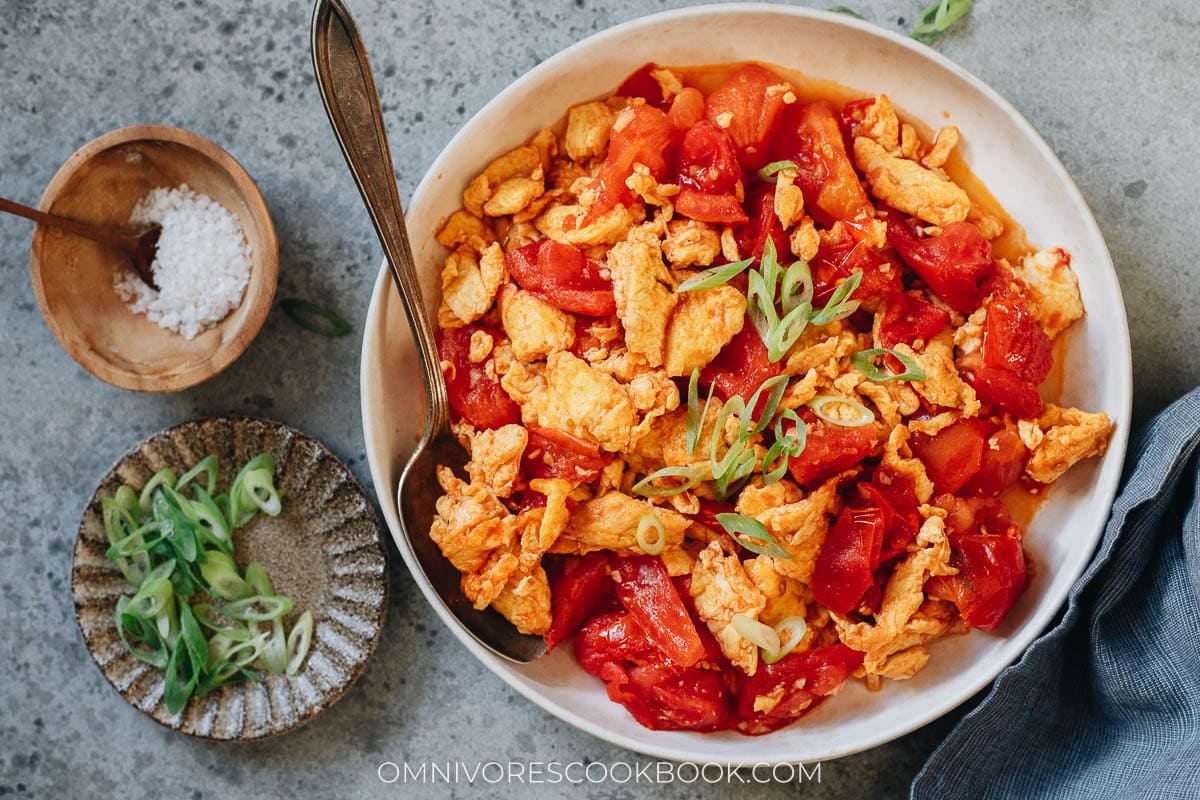
Chinese Tomato and Egg Stir-Fry
Cultural Context
Tomato and egg stir-fry is everyday Chinese home cooking, often spooned over rice. The Woks of Life describes it as a familiar comfort food with a version in every family. Its mild seasoning makes it an easy dish to share at the table. Chinese home-cooking context.
Ingredients
Main Components
- 4 large eggs
- 454 g (1 lb) ripe tomatoes, cored and cut into bite-size wedges
- 22.5 ml (1½ tablespoons) canola oil, divided
- 2 garlic cloves, minced
For the Sauce/Garnish
- ¾ teaspoon fine table salt
- 1 teaspoon granulated sugar
- 1 scallion, thinly sliced, optional garnish
Substitutions:
- Canola oil → sunflower oil in the same quantity.
Equipment
- 10- to 12-inch nonstick skillet
- Flexible spatula, mixing bowl, and clean plate
- Knife, cutting board, and measuring spoons
- Instant-read thermometer
Instructions
Preparation (Active time: 5 min)
- Prepare the produce: Wash and cut the tomatoes and scallion; mince the garlic.
- Beat the eggs: Whisk until uniform. Wash hands and utensils that touched raw egg.
Cooking (Active time: 8 min)
- Scramble: Heat 1 tablespoon oil over medium-high heat. Add eggs; after about 30 seconds, fold into large curds. Cook until set, about 1–2 minutes total; transfer to the clean plate.
- Soften the tomatoes: Add the remaining ½ tablespoon oil and garlic. Stir briefly until fragrant, then add tomatoes. Cook 1–2 minutes, or longer if needed to soften. Return eggs; fold in salt and sugar. Heat until the egg mixture reaches 160°F (71°C), checking several spots without touching the pan. Allow about 1–2 minutes; cook longer if needed.
Assembly & Finishing
- Finish: Remove from heat once safely cooked; keep the tomato juices in the dish.
- Garnish and serve: Scatter scallion over the top, if using, and serve immediately.
Food Safety & Storage
- Minimum safe internal temperature: 160°F (71°C) for this egg dish. No liquid raw egg should remain.
- Storage: Refrigerate promptly in shallow airtight containers at 40°F (4°C) or colder; use within 3–4 days. Refrigerate within 2 hours, or within 1 hour above 90°F (32°C). Apply the same cooling rules to any accompanying rice.
- Freezing: Best eaten fresh; frozen scrambled eggs can become rubbery and tomatoes release extra liquid.
- Reheating: Warm gently in a covered skillet or microwave, stirring for even heating, until every portion reaches 165°F (74°C).
- Allergens: Egg is the only Big-9 allergen in the listed ingredients, including the oil substitution and garnish. Check packaged ingredients for additional allergens.
Serving Suggestions
- Spoon over freshly steamed plain rice; rice is additional and not included in the nutrition estimate or timing.
- Serve as one shared dish alongside steamed vegetables and another main course. This quantity makes 4 side servings or 2 larger portions.
Scaling Notes
Half recipe (½×): Use 2 eggs and halve the other ingredients. A smaller skillet keeps the tomato juices from evaporating too quickly.
Double recipe (2×): Cook two batches to avoid crowding; allow about 10 extra minutes. Check each batch for safe doneness.
Chef's Notes
- Sourcing: Choose ripe tomatoes that yield slightly under gentle pressure.
- Make-ahead: Measure seasonings and prepare vegetables ahead; refrigerate cut produce until cooking.
- Variations: Keep the base recipe mild and let diners season their own portions.
- Common pitfalls: Lower the heat if garlic starts browning before the tomatoes go in. An overly dry pan needs a little water, added a teaspoon at a time.
- Adaptation: Adapted from Maggie Zhu's Omnivore's Cookbook recipe, retaining its ratios and cooking sequence. Canola specifies the source's vegetable-oil option; garnish quantity, thermometer guidance, and a more generous 15-minute home-kitchen allowance are added. The Woks of Life provides a second reference for the dish and serving style.
- Nutrition context: This is moderately salty for a small side serving. Reducing the salt to ½ teaspoon lowers estimated sodium to about 370 mg per side serving. Two larger portions each contain roughly twice the listed nutrition.
- Review status: Source and food-safety review only; this adaptation has not been physically kitchen-tested. Metadata credits identify the automation roles.
Nutrition Information (Optional)
Per side serving: approximately 145 kcal, excluding rice; ingredient-based estimate, not laboratory analysis.
- Protein: 7 g | Fat: 10 g | Carbohydrates: 6 g | Fiber: 1.5 g
- Sodium: approximately 515 mg | Saturated fat: approximately 2 g | Added sugar: 1 g
- Estimate basis for 4 servings: sodium ≈ (1,725 mg from salt + 280 mg from eggs + 55 mg from produce) ÷ 4 = 515 mg; saturated fat ≈ (6.4 g from eggs + 1.5 g from oil) ÷ 4 ≈ 2 g; added sugar = 4 g ÷ 4 = 1 g. Brand and produce size change these values.
Sources
Research checked on 2026-09-19. Selection is based on established home-cooking appeal and reader ratings, rather than a claim of a new trend.
- Maggie Zhu, Omnivore's Cookbook: Tomato and Egg Stir Fry — primary recipe; 4.88/5 from 16 votes at research time.
- Sarah Leung, The Woks of Life: Chinese Tomato Egg Stir-fry — comparison and cultural context; 4.97/5 from 158 votes at research time.
- FoodSafety.gov: safe cooking temperatures and egg handling.
- FoodSafety.gov: leftover storage and reheating.
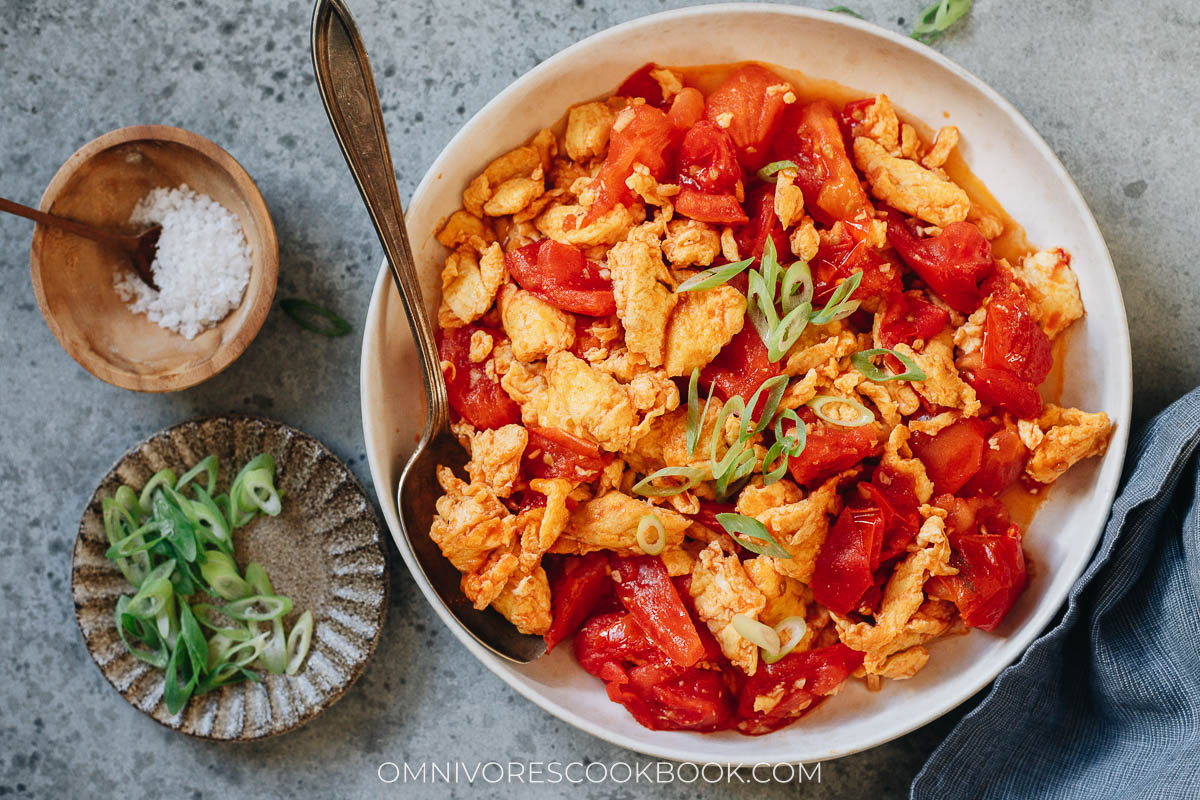
- Hero image source, Omnivore's Cookbook.
Version History:
- v1 (2026-09-19): Initial adaptation by @Codex.
Credits:
- Recipe development: Maggie Zhu; adaptation by @Codex.
- Testing: @Codex (document review only; no physical cooking test).
- Verification: @Coordinator (workflow role).
- Photography: Omnivore's Cookbook / Maggie Zhu, from the source recipe; original image. Publisher image; no free-use license asserted.
Recipe Location: My-Library/Cooking/Recipes/Recipe-of-the-Week/Recipes/2026-09-19_chinese-tomato-and-egg-stir-fry.md
Images Location: ../Images/chinese-tomato-and-egg-stir-fry/
More from Recipes