Zaalouk (Moroccan Eggplant and Tomato Salad)
Zaalouk is a Moroccan cooked salad made with eggplant, tomato, garlic, and herbs. It is often served with khobz, Moroccan bread, for scooping.
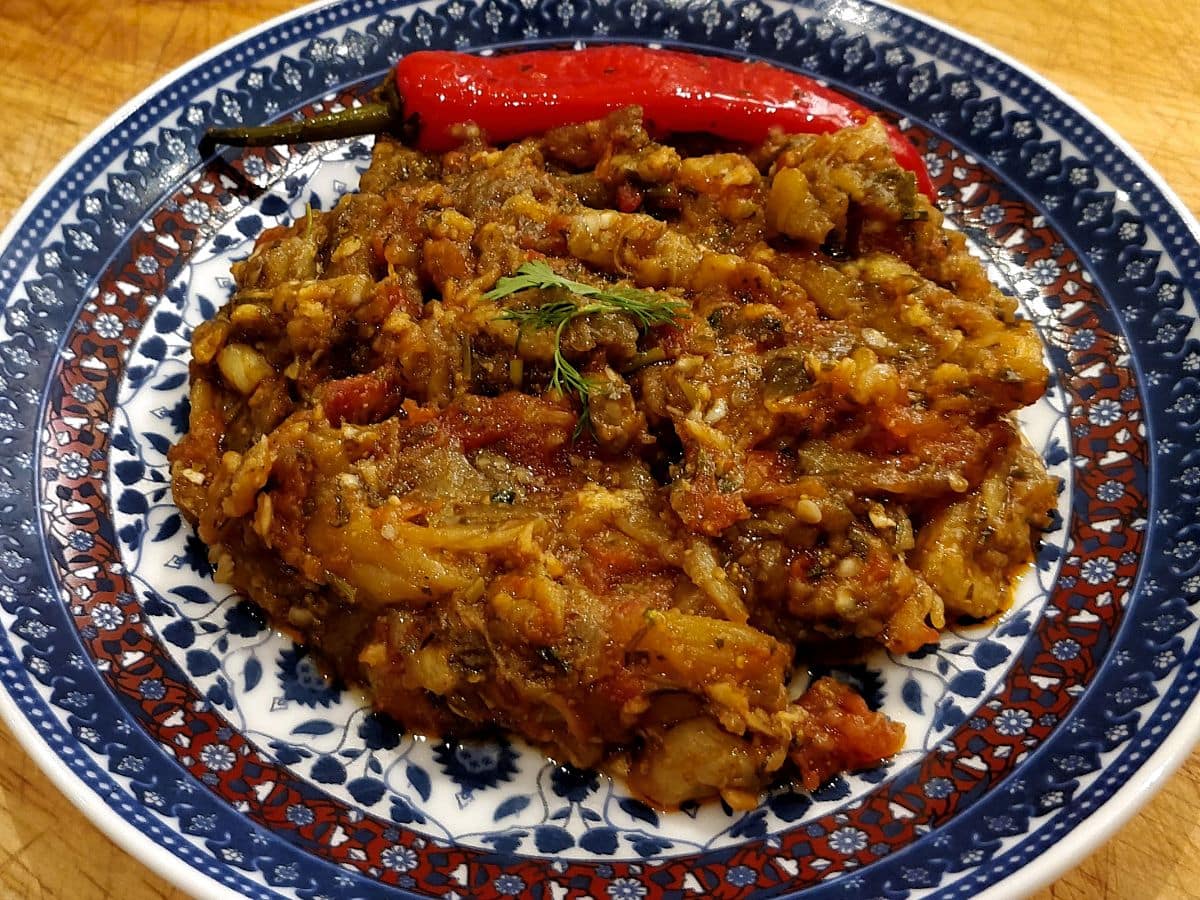
Zaalouk (Moroccan Eggplant and Tomato Salad)
Cultural Context
Zaalouk is a Moroccan cooked salad made with eggplant, tomato, garlic, and herbs. It is often served with khobz, Moroccan bread, for scooping. Household versions vary in texture and cooking method; this version uses roasted eggplant, following Christine Benlafquih's recipe at Taste of Maroc, with serving and storage guidance cross-checked against The Mediterranean Dish.
Ingredients
Main Components
- 2 large eggplants, about 900 g (2 lb) total
- 2 large ripe tomatoes, about 450 g (1 lb), peeled, seeded, and chopped
- 6 garlic cloves, finely minced
- 2 tablespoons chopped fresh parsley
- 2 tablespoons chopped fresh cilantro
- 1 teaspoon fine salt (6 g)
- 2 teaspoons sweet paprika
- 2 teaspoons ground cumin
- 60 ml (4 tablespoons) olive oil
- 1 small fresh red chili, optional, left whole with a slit in the side
For the Sauce/Garnish
- 15 ml (1 tablespoon) lemon juice, optional
- 1 tablespoon chopped parsley or cilantro
- 5 ml (1 teaspoon) olive oil, optional, for drizzling
- 200 g (7 oz) plain wheat khobz, for serving; choose bread without sesame or other added allergens
Substitutions:
- Large globe eggplants → 3 medium eggplants of the same total weight.
- Khobz → plain wheat pita without sesame; the bread is the gluten source.
Equipment
- Broiler and broiler-safe rimmed baking sheet
- Aluminum foil (no parchment under the broiler)
- Large deep skillet
- Cutting board, knife, spoon, and fork or potato masher
Instructions
Preparation (Active time: 15 min)
- Prepare the vegetables: Wash the produce. Heat the broiler on high and position the rack about 15 cm (6 inches) below the element, following the appliance's clearance guidance. Line the baking sheet with foil. Remove eggplant stems, halve the eggplants lengthwise, and arrange cut sides down. Prepare the tomatoes, garlic, and herbs while the eggplants cook.
Cooking (Active time: 15 min)
- Broil the eggplant: Cook for 20–25 minutes, checking frequently near the end, until the skins blister and the flesh collapses easily under a spoon. If the skin darkens before the centers soften, lower the rack and continue cooking. Let stand about 5 minutes, then scoop out the flesh and discard the skins.
- Cook the tomatoes: Meanwhile, put the tomatoes, 4 tablespoons olive oil, garlic, 2 tablespoons each parsley and cilantro, salt, paprika, cumin, and optional chili in the skillet. Cook over medium heat for 10–20 minutes, stirring often, until the tomatoes have broken down. Lower the heat if the garlic starts to catch.
- Combine and reduce: Add the eggplant and optional lemon juice. Mash with a fork or masher, leaving some texture. Cook uncovered for 5–10 minutes, stirring and scraping the bottom, until thick enough to scoop without a watery puddle. Allow extra time if the tomatoes are very juicy.
Assembly & Finishing
- Plate: Spoon into a shallow serving dish. Place the cooked chili on top if used, then scatter over the garnish herbs and add the optional teaspoon of oil.
- Garnish and serve: Serve warm or chilled with the khobz torn into pieces. For room-temperature service, follow the time limits below.
Food Safety & Storage
- Minimum safe internal temperature: No raw animal protein is used; cook the eggplant until completely tender. Reheated leftovers should reach 165°F (74°C).
- Storage: Refrigerate promptly in shallow airtight containers at 40°F (4°C) or below; use within 4 days. Refrigerate within 2 hours of cooking or serving, or within 1 hour above 90°F (32°C).
- Freezing: Freeze the salad without bread or garnish for up to 3 months for best quality. Thaw in the refrigerator; stir after thawing.
- Reheating: Warm in a saucepan over medium-low heat, stirring frequently, to 165°F (74°C). Add a small splash of water if needed to prevent sticking.
Serving Suggestions
- Serve the salad in a shared shallow dish with khobz for scooping.
- Offer alongside other Moroccan vegetable salads or as a side to a tagine.
- Bread is included in the allergen declaration. Check packaged bread for additional allergens; salad alone contains no Big-9 ingredients as listed.
Scaling Notes
Half recipe (½×): Use a smaller skillet so the tomatoes do not scorch; eggplant roasting time stays similar.
Double recipe (2×): Broil in batches and use a wide skillet or two pans. Reduction takes longer in a crowded pan; judge by texture.
Chef's Notes
- Sourcing: Choose firm, glossy eggplants and ripe tomatoes. Sweet paprika keeps the heat mild; the whole chili is optional.
- Make-ahead: Prepare a day ahead, refrigerate promptly, and add the fresh garnish at serving.
- Variations: Some cooks simmer peeled eggplant with the tomatoes instead of roasting it. Keep the cumin, paprika, garlic, and herbs for the characteristic seasoning.
- Common pitfalls: Undercooked eggplant stays spongy. Excess liquid makes a thin salad; reduce uncovered while stirring rather than adding more spices.
- Review status: Source-adapted and checked for safety, ratios, and allergens by @Codex; not kitchen-tested. The metadata records the requested automation roles, not a claim of independent tasting.
Nutrition Information (Optional)
Estimated per serving, including 50 g plain wheat bread, lemon juice, and garnish oil: approximately 355 kcal. Bread brands and vegetable sizes affect the result.
- Protein: 9 g | Fat: 17 g | Carbohydrates: 46 g | Fiber: 10 g
- Sodium: approximately 850 mg | Saturated fat: approximately 2.5 g | Added sugar: 0 g with unsweetened bread
- Sodium is high, mostly from salt and bread: approximately (2,360 mg from salt + 1,000 mg from bread + 40 mg from vegetables) ÷ 4 = 850 mg. Saturated fat is approximately (9 g from oil + 1 g from bread and vegetables) ÷ 4 = 2.5 g. These are ingredient estimates, not laboratory measurements.
Sources
- Primary recipe and cultural context: Christine Benlafquih, Taste of Maroc: Moroccan Zaalouk. Preserves the roasted-eggplant method and seasoning quantities; vegetable weights, bread portions, and garnish amounts are specified for repeatability.
- Comparison recipe, texture, serving, and refrigerated storage: Suzy Karadsheh, The Mediterranean Dish: Zaalouk.
- Food safety: USDA FSIS: Leftovers and Food Safety.
- Hero image source: Taste of Maroc finished zaalouk photograph.

Version History:
- v1 (2026-11-13): Initial source-adapted recipe by @Codex.
Credits:
- Recipe adaptation and prose: @Codex, based primarily on Christine Benlafquih's recipe; comparison with Suzy Karadsheh's version as described above.
- Testing: @Codex (document review only; not kitchen-tested).
- Verification role: @Coordinator (requested metadata; no independent cooking test claimed).
- Food safety and storage guidance: USDA FSIS; refrigerate cooked vegetables promptly and reheat leftovers to 165°F (74°C).
- Photography: Christine Benlafquih / Taste of Maroc, from the linked recipe and direct image URL above. Publisher image; copyright remains with the creator, no open license asserted. Downloaded unchanged; automatically resized for the HTML attachment.
Recipe Location: /Recipes/moroccan/moroccan_zaalouk_v1.md
Images Location: /Images/zaalouk/
More from Recipes