Image Collections
Exoplanets — 23 Kepler 1649 c
Receives approximately 75% of Earth's stellar energy
Exoplanets: Kepler-1649 c
- Planet: Kepler-1649 c
- Sequence: 23
- Saved image path:
My-Library/Images/Collections/Exoplanets/Images/Exoplanets_23-Kepler-1649-c.png - Model: built-in gpt-image
- Generation date: 2026-07-23
Planet Profile
- Planet type: Rocky terrestrial planet
- Host star: Red dwarf
- Radius: ~1.06 Earth radii
- Receives approximately 75% of Earth's stellar energy
- Habitable-zone candidate
- Atmosphere: Unknown
Environment
- Gravity: Near Earth
- Surface: Rocky
- Climate: Temperate if atmosphere exists
- Light: Dim red-orange
Creature Design Direction
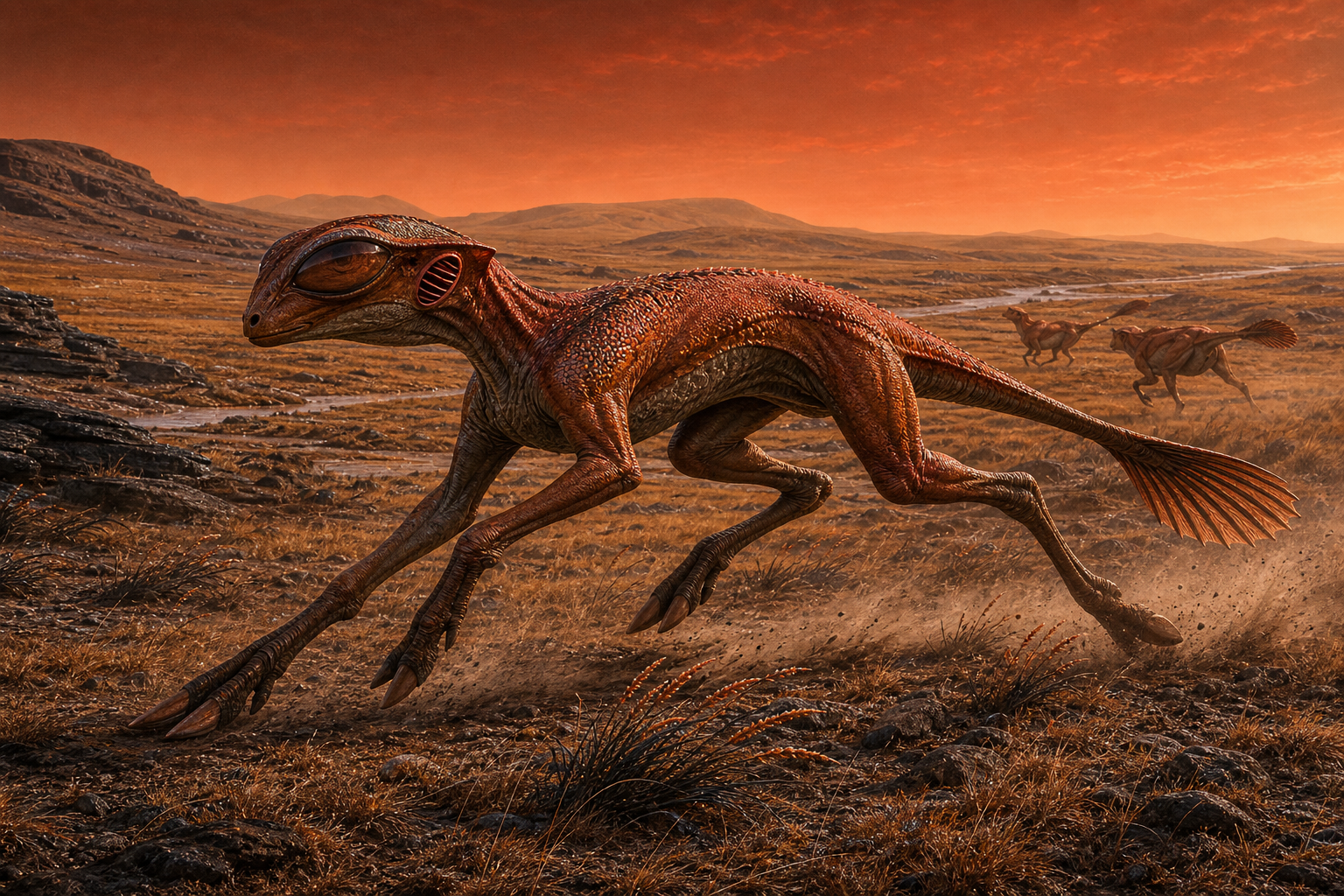
Fast-running plains animals with wide visual fields and efficient respiratory systems.
Planet / Habitat Depicted
A copper-skinned, four-legged plains runner sprints over rocky, wind-combed grassland beneath dim orange-red light. Its elongated spring-loaded legs, broad feet, flexible spine, steering tail, panoramic eyes, and ribbed breathing spiracles support rapid movement and vigilance across open terrain. Dust, bent vegetation, basalt shelves, a seasonal streambed, and distant herd members tie the creature to the rolling habitat without asserting an atmospheric composition.
Sources
- Data provided in the collection plan (
Prompts/generate-exoplanets-collection.md); measurements are from published exoplanet catalogs. No web research performed for this collection.
Final Prompt Used
Use case: scientific-educational
Asset type: Exoplanets natural-history field-guide collection image
Primary request: Create a scientifically plausible alien creature from Kepler-1649 c.
A swift plains-running alien from Kepler-1649 c, Earth-sized rocky exoplanet, athletic body, elongated legs, panoramic eyes, copper-colored skin, sprinting across rolling alien grasslands beneath orange-red skies, scientific illustration.

Known constraints from the collection plan: rocky terrestrial planet; red-dwarf host star; radius approximately 1.06 Earth radii; receives approximately 75% of Earth's stellar energy; habitable-zone candidate; atmosphere unknown. Environment: near-Earth gravity; rocky surface; temperate climate if an atmosphere exists; dim red-orange light. Creature direction: fast-running plains animals with wide visual fields and efficient respiratory systems.

Requirements:
- Design one non-humanoid swift plains runner with a lean, athletic, horizontally balanced body suited to near-Earth gravity; four elongated springy legs with broad shock-absorbing split feet; flexible spine; counterbalancing fan-shaped tail; two wide-set wraparound panoramic eyes giving an extremely broad visual field; paired ribbed breathing spiracles and a deep efficient chest; copper, russet and dark umber skin with subtle heat-managing scales; distinctly alien anatomy, not a copied horse, antelope, dinosaur or cat.
- Show the full adult creature in a powerful mid-stride sprint, three-quarter profile, muscles and tendons plausibly loaded, with two smaller distant herd members changing direction across the plain.
- Depict Kepler-1649 c as a co-equal subject: rolling rocky alien grasslands with low dark blade-like vegetation, wind-combed copper seed fronds, weathered basalt shelves, a shallow seasonal streambed, distant rounded hills, broad horizon, dim red-orange illumination from its red dwarf, orange-red sky with modest haze without asserting a measured atmospheric composition, and cool shadows.
- Make creature and habitat physically connected: split feet striking dusty soil, a short dust plume, bent vegetation in its wake, tail steering, breathing spiracles open during exertion, panoramic eyes scanning the herd and horizon.
- Body plan reflects near-Earth gravity; panoramic sensory organs reflect open plains and dim red-orange light; efficient respiration and locomotion fit sustained running over rocky terrain; do not invent atmospheric measurements.
- Surface/habitat-level view only. Do not show the planet as a globe. Do not add moons, extra planets, spacecraft, structures or people.
- Style: natural-history field-guide illustration, realistic scientific and anatomical detail, documentary lighting, plausible speculative astrobiology, NASA-meets-National-Geographic realism, one unified scene.
- Composition: wide 3:2 landscape, 1536x1024; balance a clear full-body creature portrait occupying roughly one third of the frame with a sharply readable plains environment extending to the horizon; convey speed without blurring away anatomy or habitat.
- No text or labels baked into the image. No logos. No people. No humanoid anatomy.
Avoid: random fantasy alien clichés, humanoids, Earth horse/antelope/dinosaur/cat copy, magical glow, wings, implausibly thin legs, Earth flowers, modern objects, unexplained moons, planet sphere in sky, text, watermark, border, photorealistic real people.
More from Image Collections

Internet Culture Timeline — 2025
2025-01-01

Music Yearbooks — 2025
2025-01-01

News & Culture — 2025
2025-01-01

NFL Super Bowls — 2025
2025-01-01

Science Breakthroughs — 2025
2025-01-01

Transportation & Mobility — 2025
2025-01-01

Video Game History — 2025
2025-01-01

Internet Culture Timeline — 2024
2024-01-01

Music Yearbooks — 2024
2024-01-01

News & Culture — 2024
2024-01-01

NFL Super Bowls — 2024
2024-01-01
Science Breakthroughs — 2024
2024-01-01