Lost Cities of Antiquity — Angkor
Angkor was the capital region of the Khmer Empire from the ninth through fifteenth centuries, containing successive royal cities, monumental Hindu and Buddhist temples, roads, reservoirs, dykes…
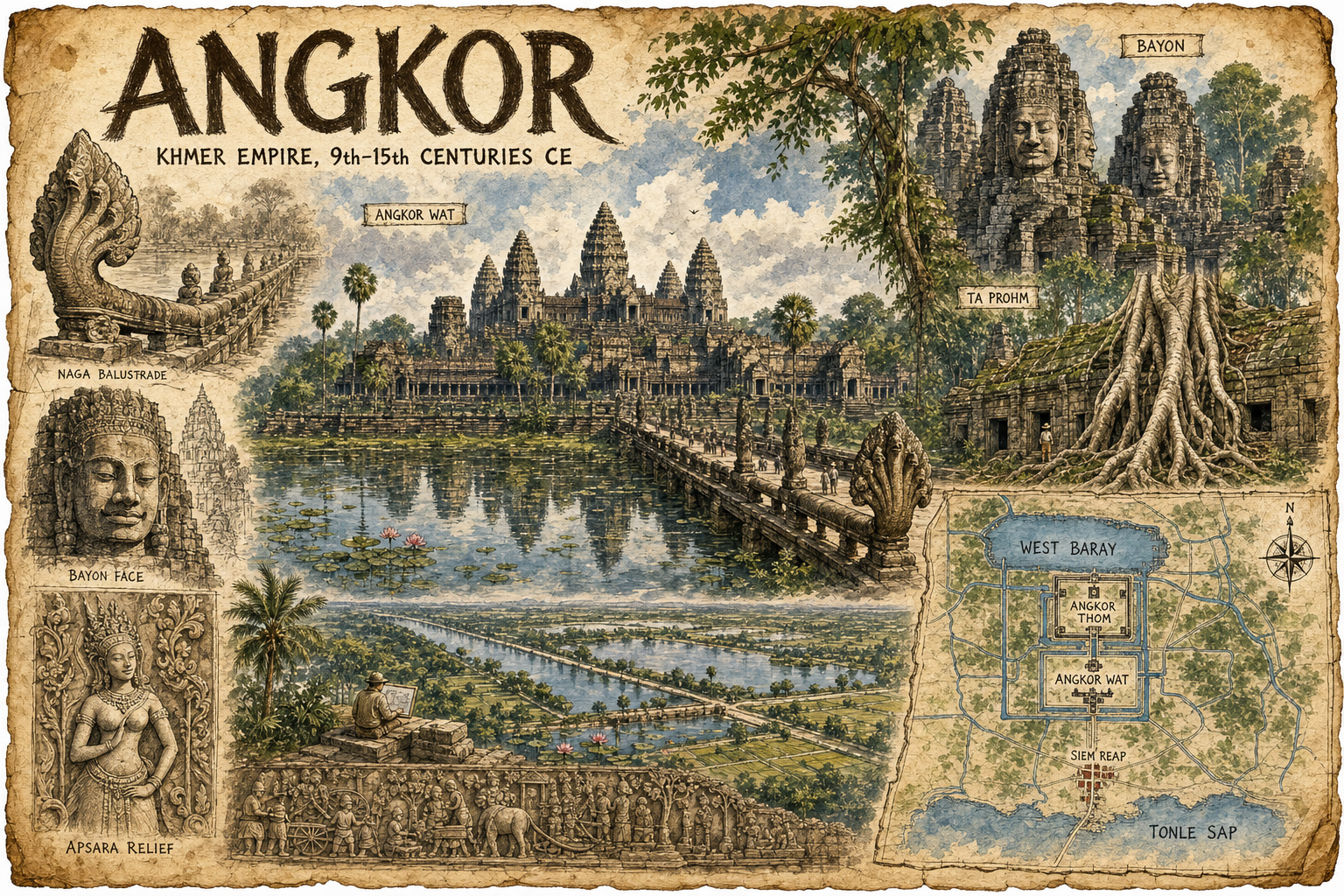
Lost Cities: Angkor
- Entry slug: Angkor
- Lost city: Angkor
- Civilization / era: Khmer Empire, 9th–15th centuries CE
- Modern-day setting: Siem Reap Province, Cambodia, north of Tonle Sap
- Presentation: Overgrown ruins. Angkor Wat, Bayon, and Ta Prohm remain instantly recognizable amid forest, roots, water, and monsoon atmosphere, while the map and lower vista reveal that Angkor was a vast engineered urban landscape rather than an isolated jungle temple.
- Generation date: 2026-08-08
- Model: built-in gpt-image
- Saved image:
My-Library/Images/Collections/Lost-Cities/Images/Lost-Cities_Angkor.png
History and rediscovery
Angkor was the capital region of the Khmer Empire from the ninth through fifteenth centuries, containing successive royal cities, monumental Hindu and Buddhist temples, roads, reservoirs, dykes, canals, and agricultural landscapes. Angkor Wat was built under Suryavarman II in the twelfth century; Jayavarman VII later established Angkor Thom and the Bayon. Political power shifted south after the fifteenth century, but Angkor Wat remained a living religious site and local knowledge never disappeared. European accounts and nineteenth-century publication helped make the ruins widely known abroad; systematic conservation began in the twentieth century and is now coordinated by Cambodian authorities with international partners.
Selected visual details
- Angkor Wat's five lotus-bud towers, three terraces, broad moat, and long naga-lined causeway dominate because they are the complex's most recognizable architectural silhouette.
- Bayon's clustered towers with serene carved stone faces represent Angkor Thom and the distinctive late-twelfth-century Buddhist capital.
- Ta Prohm's sandstone and laterite galleries intertwined with immense tree roots express the famous visual relationship between ruins and tropical forest.
- Apsara reliefs, narrative bas-reliefs, naga balustrades, lotus ponds, and weathered sandstone provide specific Khmer motifs instead of generic ancient-ruin imagery.
- The West Baray, canals, dykes, rice fields, and waterways show the enormous hydraulic and agricultural landscape that supported the metropolis.
- The map corner locates Angkor Wat and Angkor Thom on the Siem Reap plain north of Tonle Sap and connects the monuments to reservoirs and water routes.
Sources
- UNESCO World Heritage Centre, Angkor's 400-square-kilometre complex of temples, hydraulic structures, routes, and successive Khmer capitals: https://whc.unesco.org/en/list/668
- APSARA National Authority, Angkor Wat, Bayon, Ta Prohm, Preah Khan, Khmer architectural significance, and the inhabited cultural landscape: https://apsaraauthority.gov.kh/international-cooperation/world-heritage-committee/
- Metropolitan Museum of Art, Angkor Wat's moat, causeway, terraces and five towers; Angkor Thom and Bayon's face towers and bas-reliefs: https://82nd-and-fifth.metmuseum.org/toah/ht/07/sse.html
- APSARA National Authority, Ta Prohm's sandstone/laterite construction, scale, date, and dedication: https://apsaraauthority.gov.kh/2025/11/18/ta-prohm-temple-is-renowned/
- UNESCO, Angkor's scale, history, and international preservation work: https://www.unesco.org/en/cultural-heritage-7-successes-unescos-preservation-work
Final prompt used
Create a polished cartoon-editorial archaeological sketchbook / explorer travel-journal page about ANGKOR, shown as majestic overgrown ruins in Cambodia's humid forest, grounded in Khmer architecture of the 9th–15th centuries. One cohesive wide aged-parchment page with a dominant central ink-and-watercolor vista: Angkor Wat's five lotus-bud sandstone towers and long naga-lined causeway rise beyond a broad reflective moat; nearby, Bayon's densely clustered stone towers carry serene carved faces; Ta Prohm's laterite-and-sandstone galleries are embraced by enormous silk-cotton and strangler-fig roots. Show jungle canopy, monsoon haze, lotus water, weathered bas-reliefs of apsaras and daily life, and glimpses of the vast hydraulic city—canals, dykes, reservoirs and rice fields—rather than generic ruins. In one corner include a hand-drawn map of the Siem Reap plain north of Tonle Sap, with Angkor Wat, Angkor Thom, West Baray, waterways, a small city marker, and a compass rose. Add restrained field-sketch studies of a naga balustrade, a Bayon face, and an apsara relief. Large high-contrast correctly spelled hand lettering must read “ANGKOR”; directly beneath it, smaller clear lettering must read “KHMER EMPIRE, 9th–15th CENTURIES CE”. Optional labels only: “ANGKOR WAT”, “BAYON”, “TA PROHM”, “WEST BARAY”. Match the sibling collection exactly: confident sepia ink linework, transparent watercolor washes, weathered parchment texture, warm museum-quality expedition-journal illustration, detailed yet readable at thumbnail size, one unified journal spread. Palette: parchment cream, sepia ink, jungle emerald, moss green, sandstone gray-gold, lotus pink, and monsoon blue. Only tiny generic stylized visitors or conservators, no identifiable real people. Avoid photorealism, modern buildings or vehicles, generic Greco-Roman ruins, invented temple forms, long captions, fake paragraphs, tiny distorted lettering, misspellings, logos, gore, watermarks, borders beyond the natural page edge, and sticker-collage composition.
More from Image Collections