Lost Cities of Antiquity — Troy
Troy occupied the mound of Hisarlik for roughly four millennia, controlling a strategic landscape near the southern entrance to the Dardanelles.
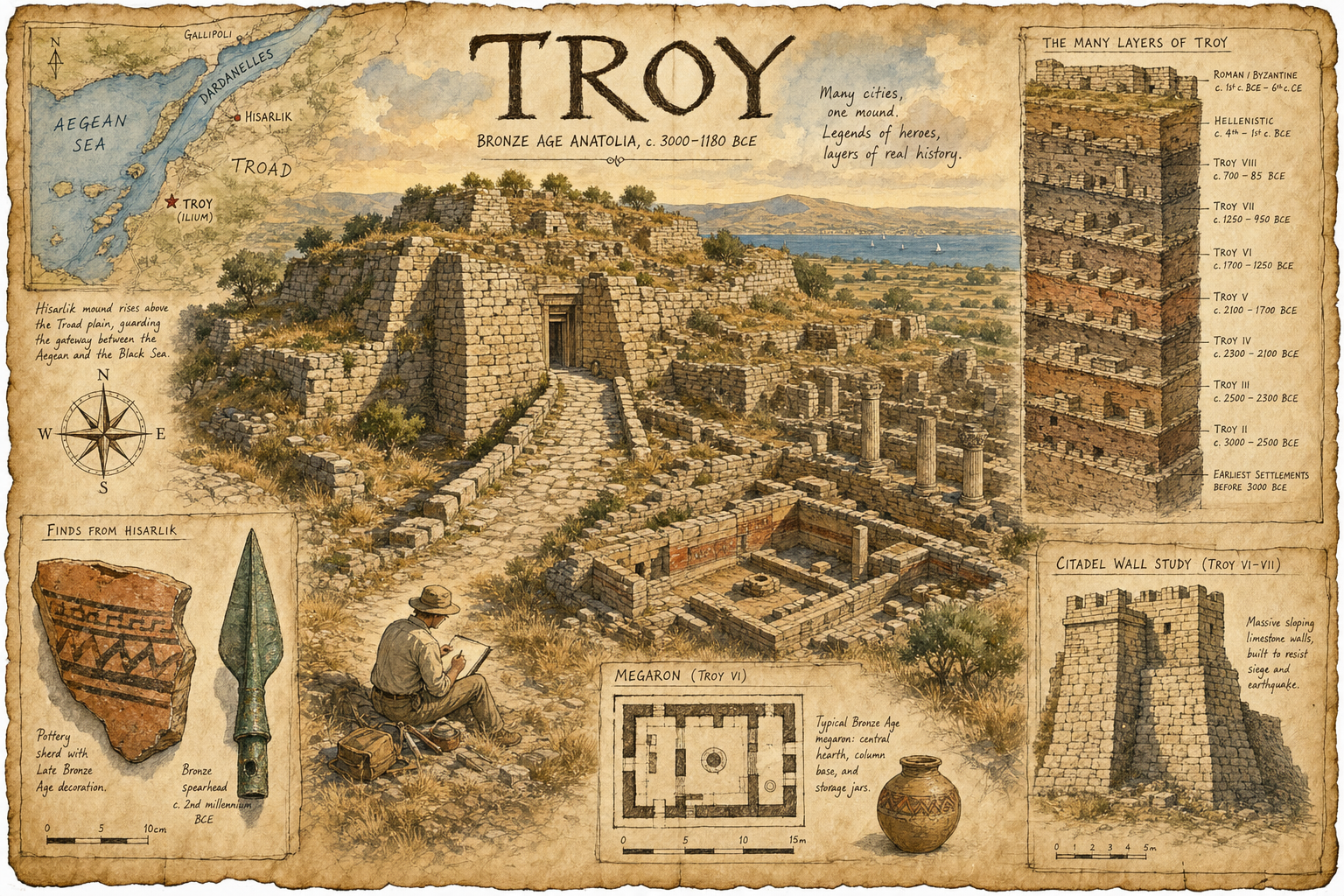
Lost Cities: Troy
- Entry slug: Troy
- Lost city: Troy
- Civilization / era: Bronze Age Anatolia, c. 3000–1180 BCE
- Modern-day setting: Hisarlik, Çanakkale, Türkiye
- Presentation: Overgrown excavated ruins. Troy's exposed settlement layers, sloping fortifications, gates, and later remains make its archaeology more recognizable and historically honest than an imagined Homeric battle scene.
- Generation date: 2026-07-28
- Model: built-in gpt-image
- Saved image:
My-Library/Images/Collections/Lost-Cities/Images/Lost-Cities_Troy.png
History and rediscovery
Troy occupied the mound of Hisarlik for roughly four millennia, controlling a strategic landscape near the southern entrance to the Dardanelles. The archaeological site contains successive settlements from the Early Bronze Age through Greek, Roman, and Byzantine occupation; several Bronze Age levels built formidable citadel defenses. Frank Calvert helped identify Hisarlik as the likely site of Troy, and Heinrich Schliemann's excavations beginning in the 1870s made the site internationally famous, although his destructive methods damaged important layers. Archaeology establishes a major, long-lived city at Hisarlik; the exact relationship between its remains and the Trojan War tradition remains a matter distinct from Homer's poetry.
Selected visual details
- The mound of Hisarlik above the Troad plain and near the Dardanelles grounds Troy in its strategic geography.
- Massive sloping limestone fortification walls and a stone-paved ramp leading toward a citadel gate provide the central architectural anchors.
- Exposed layers of successive settlements make Troy's unusual depth of occupation immediately legible.
- A Bronze Age megaron plan and later Greek/Roman columns show how different phases overlap at the site.
- Dry Anatolian grasses, olive scrub, low hills, and the distant blue strait establish the landscape.
- A Dardanelles map, compass rose, pottery shard, bronze spearhead, citadel-wall study, and stratigraphic cutaway reinforce the archaeological-journal framing.
These details were selected because they distinguish the real excavated city from a generic legendary battlefield while preserving the wonder of Troy's connection to ancient literature.
Sources
- UNESCO World Heritage Centre, Archaeological Site of Troy: https://whc.unesco.org/en/list/849/
- UNESCO, Troy World Heritage nomination dossier: https://whc.unesco.org/uploads/nominations/849.pdf
- British Museum, the search for the lost city of Troy and the roles of Calvert and Schliemann: https://www.britishmuseum.org/blog/search-lost-city-troy
- World History Encyclopedia, Troy's settlement history and archaeology: https://www.worldhistory.org/troy/
Final prompt used
Use case: illustration-story. Asset type: Lost Cities of Antiquity collection entry. Create a polished cartoon-editorial archeological sketchbook / travel-journal page about Troy, matching the existing collection’s richly detailed ink linework, watercolor washes, aged parchment texture, centered monumental vista, researched marginal studies, and warm expedition-journal finish. The main vista shows the overgrown excavated ruins on the mound of Hisarlik above the windswept Troad plain near the Dardanelles: massive sloping limestone fortification walls, a stone-paved ramp approaching a fortified gate, successive exposed settlement layers, foundations of a Bronze Age megaron, and later Greek/Roman columns woven visibly into the stratified site. Golden late-afternoon light, dry Anatolian grasses, olive scrub, distant blue strait and low hills. Include a small generic archaeologist sketching at the edge, never a real-person likeness. Around the margins, integrate a hand-drawn map corner showing the Dardanelles, Aegean coast, Hisarlik and a small Troy marker; a compass rose; a cutaway study of the many city layers; a pottery vessel shard; a bronze spearhead; and a simplified citadel wall study. Clear readable hand-lettered title “TROY” and smaller line “BRONZE AGE ANATOLIA, c. 3000–1180 BCE”. One cohesive 3:2 journal spread, not disconnected stickers; Troy’s layered archaeology and defensive citadel dominate at thumbnail size. Palette: aged parchment, sepia ink, sun-baked ochre stone, dry olive green, muted terracotta, distant Aegean blue. Warm, wondrous rediscovery mood. Avoid photorealism, real identifiable people, fantasy wooden horses, cinematic battle scenes, generic marble-temple cityscapes, modern buildings, official logos, fake paragraphs, garbled title text, borders outside the natural parchment edge, watermarks, and signatures.
More from Image Collections