Lost Cities of Antiquity — Tikal
Tikal grew into one of the most powerful cities of the ancient Maya, with its greatest monumental development during the Classic period.
Lost Cities: Tikal
- Entry slug: Tikal
- Lost city: Tikal
- Civilization / era: Classic Maya, c. 200–900 CE
- Modern-day setting: Petén Basin, Guatemala
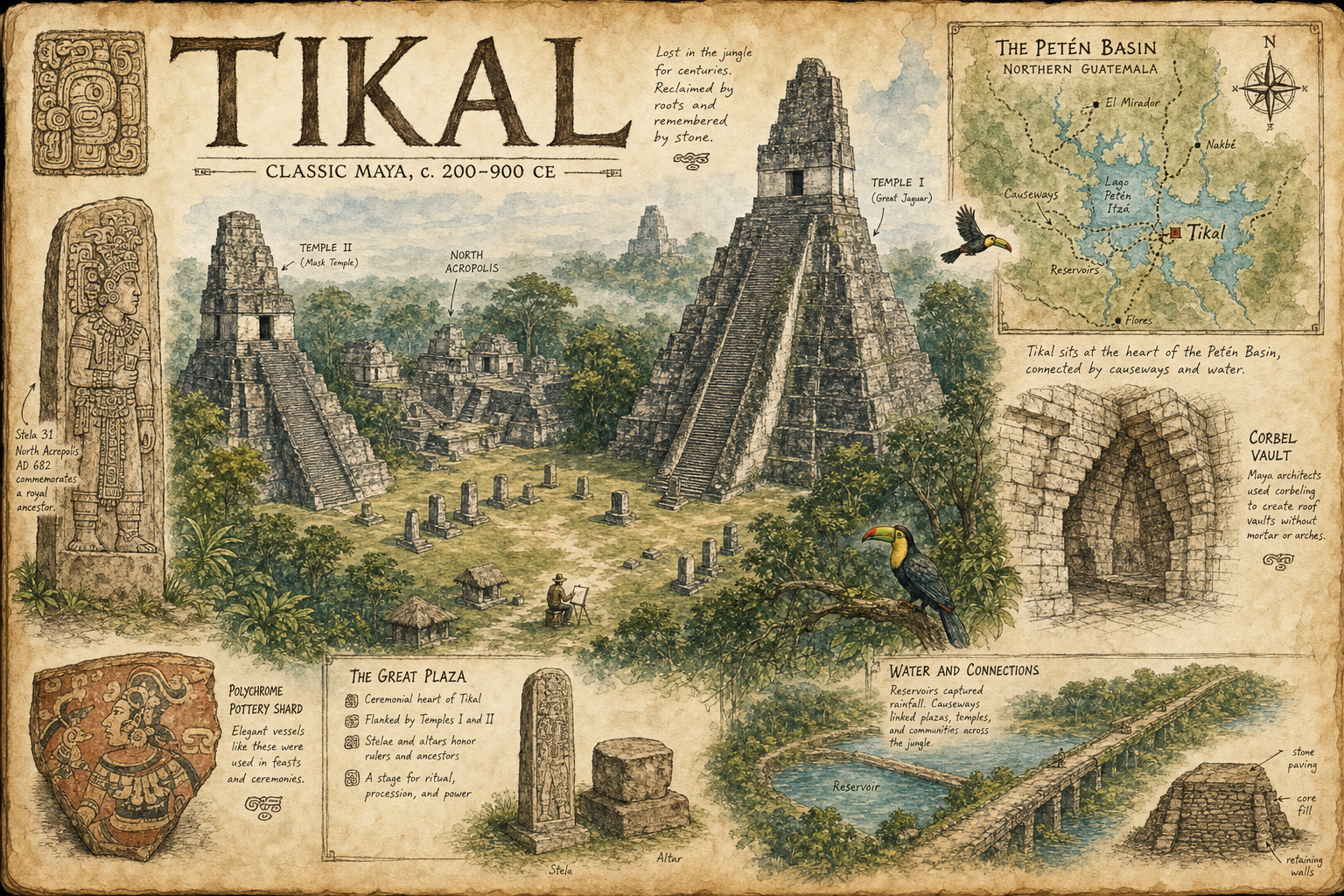
- Presentation: Overgrown ruins. Temple roof combs rising above rainforest canopy and the excavated Great Plaza make Tikal immediately recognizable while conveying its long abandonment and rediscovery.
- Generation date: 2026-08-01
- Model: built-in gpt-image
- Saved image:
My-Library/Images/Collections/Lost-Cities/Images/Lost-Cities_Tikal.png
History and rediscovery
Tikal grew into one of the most powerful cities of the ancient Maya, with its greatest monumental development during the Classic period. Its limestone ceremonial core included temples, palaces, ball courts, causeways, reservoirs, and carved monuments; political decline and population loss left the urban center to the forest after the ninth century. Local knowledge endured, while an official Guatemalan expedition reached and reported the ruins in 1848; later mapping, photography, excavation, and conservation revealed the city's extraordinary scale.
Selected visual details
- Temple I and Temple II face each other across the Great Plaza, creating Tikal's most recognizable architectural vista.
- Tall stepped limestone pyramids and prominent roof combs distinguish Tikal's skyline above the Petén canopy.
- The North Acropolis represents the city's layered ceremonial and dynastic core.
- Carved stelae and altars evoke the inscriptions that preserve Tikal's dynastic history and regional connections.
- Corbel-vault masonry and a polychrome pottery study ground the page in Maya architectural and material culture.
- Broad causeways and engineered reservoirs show that the metropolis was supported by sophisticated movement and water-management systems.
- Dense tropical forest, mist, toucans, and the Petén Basin map anchor the ruins in northern Guatemala.
Sources
- UNESCO World Heritage Centre, Tikal's Petén forest setting, Great Plaza, Lost World, twin-pyramid complexes, ball courts, irrigation works, monuments, and authenticity: https://whc.unesco.org/en/list/64/
- World History Encyclopedia, Great Plaza layout, royal palace, Temple I's nine levels, and burial context: https://www.worldhistory.org/Tikal/
- History, Tikal's Classic-period history, Great Plaza, Temple I, modern national park, and World Heritage designation: https://www.history.com/articles/tikal
- Proceedings of the National Academy of Sciences via PMC, Tikal's reservoirs, causeways, catchments, and long-term water management: https://pmc.ncbi.nlm.nih.gov/articles/PMC3411963/
Final prompt used
Use case: illustration-story. Asset type: Lost Cities collection entry. Create a polished cartoon-editorial archaeological sketchbook and travel-journal page about Tikal, shown as overgrown but majestic Classic Maya ruins emerging from the Petén rainforest. Match the sibling collection’s aged parchment, confident sepia ink linework, delicate watercolor washes, densely researched marginal studies, and magazine-quality finish. The central vista shows the Great Plaza with the steep nine-tier Temple I and facing Temple II, the North Acropolis, carved limestone stelae and altars, roof combs rising above kapok and ceiba canopy, mist, toucans, and a tiny generic field artist for scale. Include a corner hand-drawn map of northern Guatemala’s Petén Basin with jungle, causeways, reservoirs, compass rose, and a small city marker; marginal sketches of a carved stela, corbel-vault detail, Maya pottery shard, and reservoir/causeway engineering. Large correctly spelled hand-lettering: “TIKAL”. Smaller line exactly: “CLASSIC MAYA, c. 200–900 CE”. Warm wondrous rediscovery mood. Palette: aged parchment, sepia ink, limestone gray, deep jungle green, quetzal turquoise. Wide cohesive journal page, central architecture dominant. Generic stylized people only. Avoid modern objects, photorealistic people, generic Egyptian-style pyramids, long fake paragraphs, garbled lettering, cluttered sticker collage, logos, watermark, signature, or glossy photorealism.
More from Image Collections