Music Yearbooks — 1990
Bonnie Raitt's Nick of Time Grammy win.
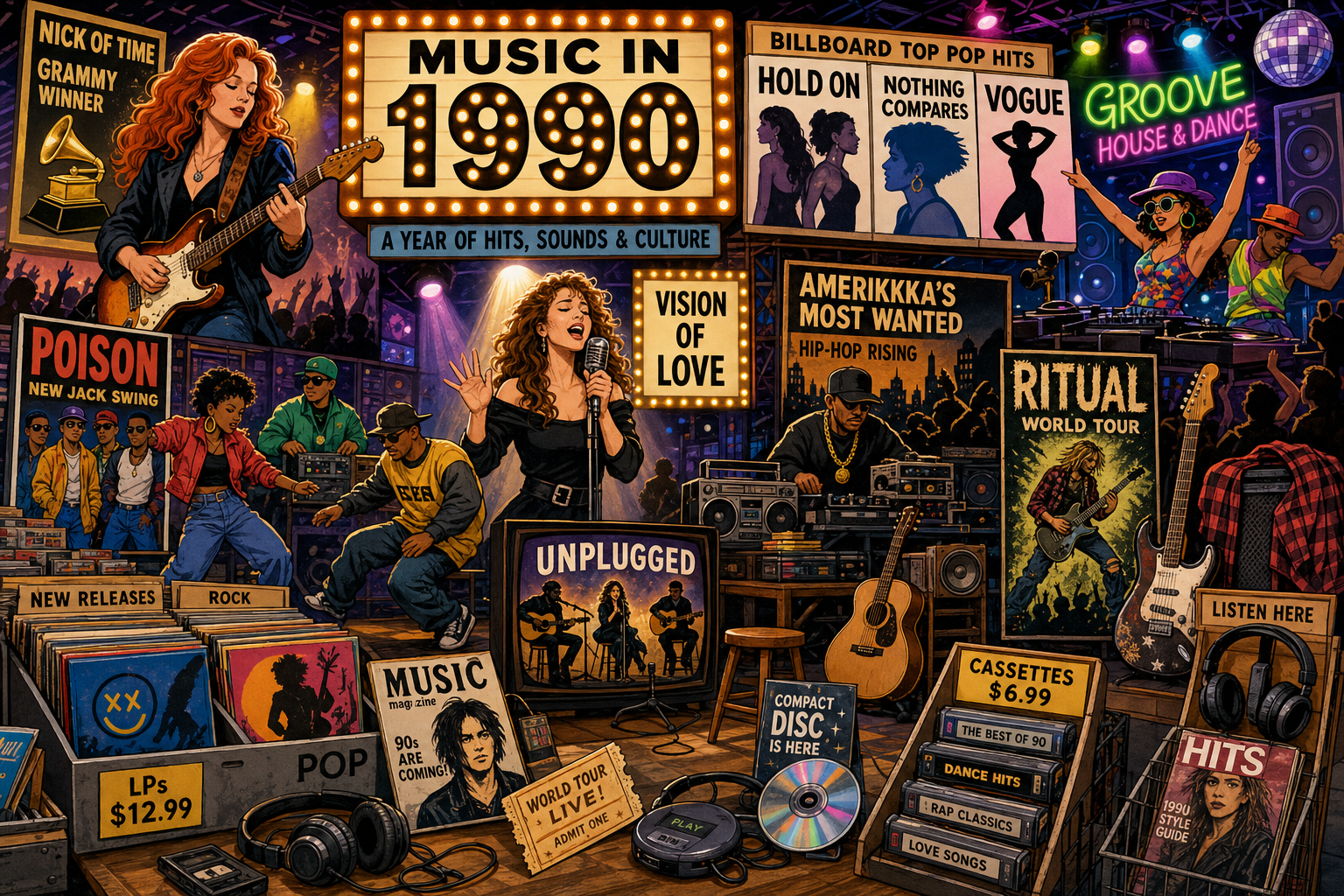
Music Yearbook: 1990
Year: 1990 Generation date: 2026-07-02 Model: built-in gpt-image (recovered from session transcript) Saved image path: My-Library/Images/Collections/Music-Yearbooks/Images/Music-Yearbook_1990.png
Selected Music Moments
- Bonnie Raitt's Nick of Time Grammy win.
- Category: Awards / album recognition
- Why selected: A roots-rock comeback became Album of the Year at the 32nd Grammy Awards.
- Visual depiction: Anonymous red-haired blues guitarist, trophy, and "NICK OF TIME" label.
- Rights/sensitivity notes: Stylized performer; no photorealistic likeness or exact album art.
- Source: https://www.grammy.com/awards/32nd-annual-grammy-awards/
- Billboard pop hits including "Hold On", "Nothing Compares 2 U", "Poison", "Vogue", and "Vision of Love".
- Category: Hit singles / charts
- Why selected: These songs defined mainstream radio and chart culture for 1990.
- Visual depiction: Readable generic chart cards and marquee text.
- Rights/sensitivity notes: Song-title labels only; no official music-video stills or artist likenesses.
- Source: https://en.wikipedia.org/wiki/Billboard_Year-End_Hot_100_singles_of_1990
- Mariah Carey's debut vocal breakthrough with "Vision of Love".
- Category: Debut / pop and R&B
- Why selected: The 1990 debut single introduced a defining pop vocal presence of the decade.
- Visual depiction: Anonymous spotlight singer and "VISION OF LOVE" sign.
- Rights/sensitivity notes: Fictionalized singer, no likeness.
- Source: https://en.wikipedia.org/wiki/Vision_of_Love
- New Jack Swing and Bell Biv DeVoe's "Poison".
- Category: Genre / R&B and hip-hop crossover
- Why selected: New Jack Swing's streetwise pop-R&B sound was a major early-1990s force.
- Visual depiction: Dancers, drum machines, street-soul poster, and "POISON" label.
- Rights/sensitivity notes: Generic dancers only.
- Source: https://en.wikipedia.org/wiki/Billboard_Year-End_Hot_100_singles_of_1990
- Deee-Lite and house/dance-pop's colorful crossover.
- Category: Dance / club culture
- Why selected: "Groove Is in the Heart" helped bring playful club aesthetics into pop visibility.
- Visual depiction: Club speakers, neon "GROOVE", colorful anonymous DJs.
- Rights/sensitivity notes: No exact video imagery or artist likenesses.
- Source: https://en.wikipedia.org/wiki/Groove_Is_in_the_Heart
- Golden-age hip-hop edge and politically charged rap albums.
- Category: Hip-hop / albums
- Why selected: 1990 hip-hop expanded mainstream and critical impact with harder, more political records.
- Visual depiction: Turntables, boomboxes, skyline flyer labeled "AMERIKKKA'S MOST WANTED".
- Rights/sensitivity notes: No exact album cover reproduction.
- Source: https://pitchfork.com/features/lists-and-guides/the-best-albums-of-the-1990s/
- Alternative rock moving toward the mainstream.
- Category: Alternative / rock scene
- Why selected: The early-1990s alternative wave was forming before its 1991 commercial explosion.
- Visual depiction: Distorted guitars, flannel fabric, "RITUAL" poster.
- Rights/sensitivity notes: Symbolic scene cues only.
- Source: https://pitchfork.com/features/lists-and-guides/the-best-albums-of-the-1990s/
- MTV Unplugged becoming a 1990s fixture.
- Category: Music television / live performance format
- Why selected: The acoustic television format caught on around 1990 and became a decade-defining music franchise.
- Visual depiction: TV screen, stools, acoustic guitars, "UNPLUGGED" label.
- Rights/sensitivity notes: Generic TV screen, no network logo.
- Source: https://www.ebsco.com/research-starters/arts-and-entertainment/mtv-unplugged-tv-series
- Cassette, CD, and record-store retail culture.
- Category: Music business / formats
- Why selected: 1990 sat at the transition from cassette and vinyl habits into CD-era retail.
- Visual depiction: Listening station, cassette bins, CD display, record-shop price cards.
- Rights/sensitivity notes: Generic media props.
- Source: https://www.riaa.com/u-s-sales-database/
Top Anchor Moments
- "MUSIC IN 1990" marquee with chart hit cards.
- Grammy-winning Nick of Time blues-rock comeback.
- Dance, new jack swing, hip-hop, alternative rock, and acoustic-TV format cues around one record-shop stage.
Final Prompt Used
Use case: illustration-story Asset type: year-by-year music yearbook collection image, 3:2 landscape PNG Primary request: Create a vibrant cartoon-editorial music-yearbook montage for the year 1990, showing the landmark albums, hit songs, dominant genres, awards, tours, and music-business moments that defined the year.
Scene/backdrop: a cohesive concert-poster-meets-record-shop montage. The scene should feel like one unified music world: a record-store stage with a bright marquee, anonymous performers, racks of vinyl and cassettes, a TV music-video corner, dance-floor lights, acoustic stools, and magazine-style posters integrated into the walls.
Subject: combine these selected moments into one unified illustrated montage: Bonnie Raitt's Grammy-winning roots-rock comeback represented by a red-haired anonymous blues guitarist and a trophy labeled "NICK OF TIME"; Billboard 1990 pop hits led by "HOLD ON", "NOTHING COMPARES", and "VOGUE" as readable generic chart cards; Mariah Carey's debut vocal breakthrough represented by a young anonymous singer under a spotlight labeled "VISION OF LOVE"; Bell Biv DeVoe and New Jack Swing represented by dancers, drum machines, and a "POISON" street-soul poster; Deee-Lite and house/dance-pop represented by colorful club speakers and a "GROOVE" neon sign; hip-hop's golden-age edge represented by turntables, boom boxes, and a bold generic rap flyer labeled "AMERIKKKA'S MOST WANTED" without exact cover art; alternative rock moving toward the mainstream represented by distorted guitars, flannel-pattern fabric, and a "RITUAL" tour poster; MTV Unplugged becoming a 1990s fixture represented by acoustic guitars, stools, and a TV screen labeled "UNPLUGGED"; cassette/CD retail culture represented by listening stations, price stickers, and magazine covers.
Year text requirement: include clear readable text in the image that says: "1990".
Optional title text: include a short readable title: "MUSIC IN 1990".
Style/medium: polished vibrant cartoon-editorial illustration, concert-poster energy, magazine-quality digital art. Stages, instruments, crowds, record sleeves, headphones, cassette/CD cues, award trophies, marquee text, genre-specific motifs, expressive anonymous performers, dynamic stage lighting.
Composition/framing: wide landscape image, one unified scene rather than separate panels. Use foreground performers/instruments/records, midground crowd and record-shop stage, and background genre/era context. Make the biggest 2-3 music moments most prominent, with smaller references integrated as posters, marquees, record sleeves, trophies, TV screens, ticket stubs, or stage props.
Lighting/mood: energetic, celebratory, nostalgic, and readable, with stage-light glow, dance-floor color, and clear visual hierarchy.
Color palette: varied and era-aware: late-80s neon brights meeting early-90s black-and-white chart graphics, denim blues, record-shop wood, chrome CD shine, and warm spotlight gold. Avoid a one-note palette.
Text constraints: short readable labels are allowed on posters, marquees, record sleeves, trophies, ticket stubs, or screens. Use 1-5 words per label. Keep text high-contrast, correctly spelled, and large enough to read. Do not use long captions, fake paragraphs, or a row of labels at the bottom.
Avoid: official label/network/platform/brand logos, exact album-art reproduction, photorealistic real-artist likenesses, copyrighted character likenesses, graphic depictions of tragedy, hateful imagery, cluttered sticker-collage layout, tiny unreadable labels, distorted lettering, fake full article text, and generic stock imagery.
More from Image Collections