Image Collections 2009-01-01
Science Breakthroughs — 2009
LCROSS lunar water discovery
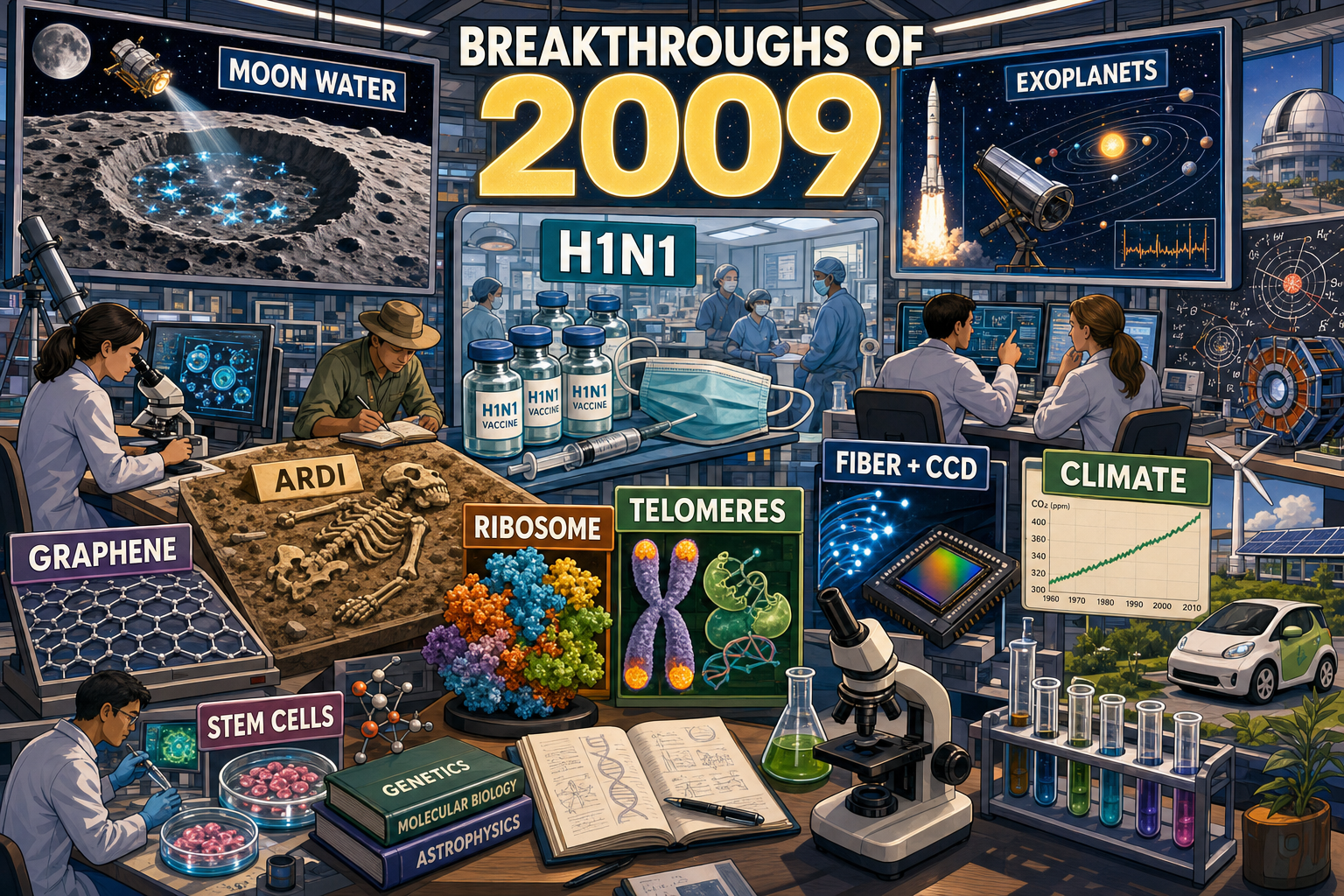
Science Breakthroughs: 2009
- Year: 2009
- Saved image path:
My-Library/Images/Collections/Science-Breakthroughs/Images/Science-Breakthroughs_2009.png - Model: built-in gpt-image (recovered from session transcript)
- Generation date: 2026-07-13
Selected Science Breakthroughs
- LCROSS lunar water discovery
- Field: Astronomy and planetary science
- Why selected: NASA announced LCROSS evidence for water in lunar impact ejecta in 2009.
- Visual depiction: Moon south-pole crater screen labeled
MOON WATER. - Rights/sensitivity notes: Generic spacecraft/screen depiction, no agency branding.
- Source: https://www.nasa.gov/general/what-is-lcross-the-lunar-crater-observation-and-sensing-satellite/
- Ardipithecus ramidus / Ardi
- Field: Paleoanthropology
- Why selected: A major hominin fossil analysis became one of the year's biggest science stories.
- Visual depiction: Non-human fossil skeleton cast on specimen table labeled
ARDI. - Rights/sensitivity notes: Fossil depiction, no living-person likeness.
- Source: https://www.pbs.org/newshour/science/science-july-dec09-yearinscience_12-31
- H1N1 vaccine and public health response
- Field: Medicine and public health
- Why selected: The 2009 H1N1 pandemic made vaccine research and public health central science stories.
- Visual depiction: Clean vials, masks, and lab bench labeled
H1N1. - Rights/sensitivity notes: Calm, non-graphic medical imagery.
- Source: https://www.cdc.gov/h1n1flu/vaccination/
- Kepler space telescope launch
- Field: Astronomy
- Why selected: Kepler opened a new era of exoplanet discovery after its 2009 launch.
- Visual depiction: Star-chart monitor labeled
EXOPLANETS. - Rights/sensitivity notes: Generic telescope diagram.
- Source: https://science.nasa.gov/mission/kepler/
- Graphene recognition
- Field: Materials science
- Why selected: Graphene's two-dimensional carbon structure was a highly visible materials-science breakthrough of the era.
- Visual depiction: Honeycomb sheet labeled
GRAPHENE. - Rights/sensitivity notes: Abstract material diagram.
- Source: https://www.nobelprize.org/prizes/physics/2010/popular-information/
- Ribosome structure Nobel chemistry
- Field: Chemistry and structural biology
- Why selected: The 2009 Chemistry Nobel recognized atomic-level ribosome structure and function.
- Visual depiction: Colorful molecule model labeled
RIBOSOME. - Rights/sensitivity notes: No laureate likenesses.
- Source: https://www.nobelprize.org/prizes/chemistry/2009/summary/
- Telomeres and telomerase Nobel medicine
- Field: Genetics and cell biology
- Why selected: The 2009 Medicine Nobel recognized chromosome-end protection and telomerase.
- Visual depiction: Chromosome-end diagram labeled
TELOMERES. - Rights/sensitivity notes: No laureate likenesses.
- Source: https://www.nobelprize.org/prizes/medicine/2009/summary/
- Fiber optics and CCD sensors Nobel physics
- Field: Physics and imaging
- Why selected: The 2009 Physics Nobel recognized fiber-optic communication and CCD imaging sensors.
- Visual depiction: Glowing fiber cable and imaging chip labeled
FIBER + CCD. - Rights/sensitivity notes: No laureate likenesses.
- Source: https://www.nobelprize.org/prizes/physics/2009/summary/
- Climate and clean-energy research
- Field: Climate and energy
- Why selected: Climate monitoring and clean-energy technology were prominent science-policy themes in 2009.
- Visual depiction: Solar prototype and CO2 graph labeled
CLIMATE. - Rights/sensitivity notes: Generic charts only.
- Source: https://www.pbs.org/newshour/science/science-july-dec09-yearinscience_12-31
- Stem-cell and regenerative medicine progress
- Field: Biology and medicine
- Why selected: Stem-cell research remained a major biomedical frontier of the year.
- Visual depiction: Petri dishes and microscope labeled
STEM CELLS. - Rights/sensitivity notes: Generic lab depiction.
- Source: https://www.nih.gov/news-events/news-releases/nih-guidelines-human-stem-cell-research
Top Anchor Breakthroughs
- Lunar water.
- Ardi fossil analysis.
- H1N1 public-health response and Kepler exoplanet search.
Final Prompt Used
Use case: illustration-story
Asset type: year-by-year science breakthroughs collection image
Primary request: Create a lively illustrated science-magazine montage for the year 2009, showing the medicine, physics, biology, genetics, energy, archaeology, and materials-science breakthroughs including the year's Nobel-worthy discoveries that defined science that year.

Scene/backdrop: a cohesive laboratory-and-discovery montage: a bright research world with lab benches, microscopes and telescopes, molecule/DNA model, lunar crater screen, fossil specimen table, clean-energy prototype corner, and hospital research room in the background. The scene should feel like one unified science world rather than disconnected stickers.

Subject: combine these selected breakthroughs into one unified illustrated montage: LCROSS lunar water discovery shown as a moon south-pole crater screen with blue water-ice glints labeled "MOON WATER"; Ardipithecus ramidus "Ardi" fossil analysis shown as a non-human fossil skeleton cast on a field table labeled "ARDI"; H1N1 pandemic vaccine/public-health response shown as clean vaccine vials and masks labeled "H1N1"; Kepler space telescope launch shown on a star-chart monitor labeled "EXOPLANETS"; graphene/two-dimensional carbon sheet shown as a honeycomb material sample labeled "GRAPHENE"; ribosome structure Nobel chemistry shown as a colorful molecular model labeled "RIBOSOME"; telomeres and telomerase Nobel medicine shown as chromosome ends and enzyme model labeled "TELOMERES"; fiber optics and CCD sensor Nobel physics shown as glowing fiber cable and digital imaging chip labeled "FIBER + CCD"; climate monitoring and clean-energy lab work shown as solar panel prototype and CO2 graph labeled "CLIMATE"; stem-cell/regenerative medicine progress shown as petri dishes and microscope labeled "STEM CELLS".

Year text requirement: include clear readable text in the image that says: "2009"

Optional title text: include a short readable title: "BREAKTHROUGHS OF 2009"

Style/medium: polished cartoon-editorial illustration in a popular-science-magazine style, stylized lab equipment, glowing screens, molecule and DNA models, star charts, expressive generic researcher figures, magazine-quality digital art.

Composition/framing: wide 3:2 landscape image, one unified scene rather than separate panels. Use foreground researchers, microscope, fossil table, and molecule models; midground lab benches, vaccine vials, graphene sample, and chromosome diagram; background moon crater screen, Kepler star chart, hospital-research room, clean-energy prototype, and observatory/collider-style diagrams. Make moon water, Ardi, and H1N1/Kepler most prominent, with smaller references integrated as chalkboard diagrams, screen readouts, specimen labels, wall charts, or poster insets.

Lighting/mood: bright, curious, and optimistic, with clean lab lighting, glowing screens and instruments, and clear visual hierarchy. Medical and pandemic content should be symbolic and calm, not frightening.

Color palette: varied and field-aware: clinical whites and teals for medicine, deep-space blues and purples for astronomy, DNA greens and molecular oranges for biology/chemistry, clean-energy yellows and greens, and earthy fossil tones for archaeology. Avoid a one-note palette.

Text constraints: short readable labels only: "2009", "BREAKTHROUGHS OF 2009", "MOON WATER", "ARDI", "H1N1", "EXOPLANETS", "GRAPHENE", "RIBOSOME", "TELOMERES", "FIBER + CCD", "CLIMATE". Keep text high-contrast, correctly spelled, and large enough to read. Do not use long captions, fake paragraphs, names of laureates, or a row of labels at the bottom.

Avoid: official logos, exact institutional branding, trademark-accurate equipment or product designs, photorealistic likenesses of real people including named scientists/laureates, graphic illness/injury/casualties, hateful symbols, cluttered sticker-collage layout, tiny unreadable labels, distorted lettering, fake full article text, and generic stock imagery.
More from Image Collections

Internet Culture Timeline — 2025
2025-01-01
Music Yearbooks — 2025
2025-01-01

News & Culture — 2025
2025-01-01

NFL Super Bowls — 2025
2025-01-01
Science Breakthroughs — 2025
2025-01-01
Transportation & Mobility — 2025
2025-01-01

Video Game History — 2025
2025-01-01
Internet Culture Timeline — 2024
2024-01-01
Music Yearbooks — 2024
2024-01-01
News & Culture — 2024
2024-01-01

NFL Super Bowls — 2024
2024-01-01
Science Breakthroughs — 2024
2024-01-01