Image Collections
Technology Milestones — 13 Optics
Era / approximate date: Early modern Europe, approximately 1590-1670 CE
Technology Milestones: Optics
- Milestone slug:
Optics - Milestone name: Telescope and microscope optics
- Era / approximate date: Early modern Europe, approximately 1590-1670 CE
- Likely setting depicted: Lens-maker's workshop and observation balcony with telescope, microscope, lens grinding, and scientific sketches
- Generation date: 2026-06-29
- Model: built-in gpt-image
- Saved image path:
My-Library/Images/Collections/Technology-Milestones/Images/Technology-Milestones_13-Optics.png
Why It Is A Milestone
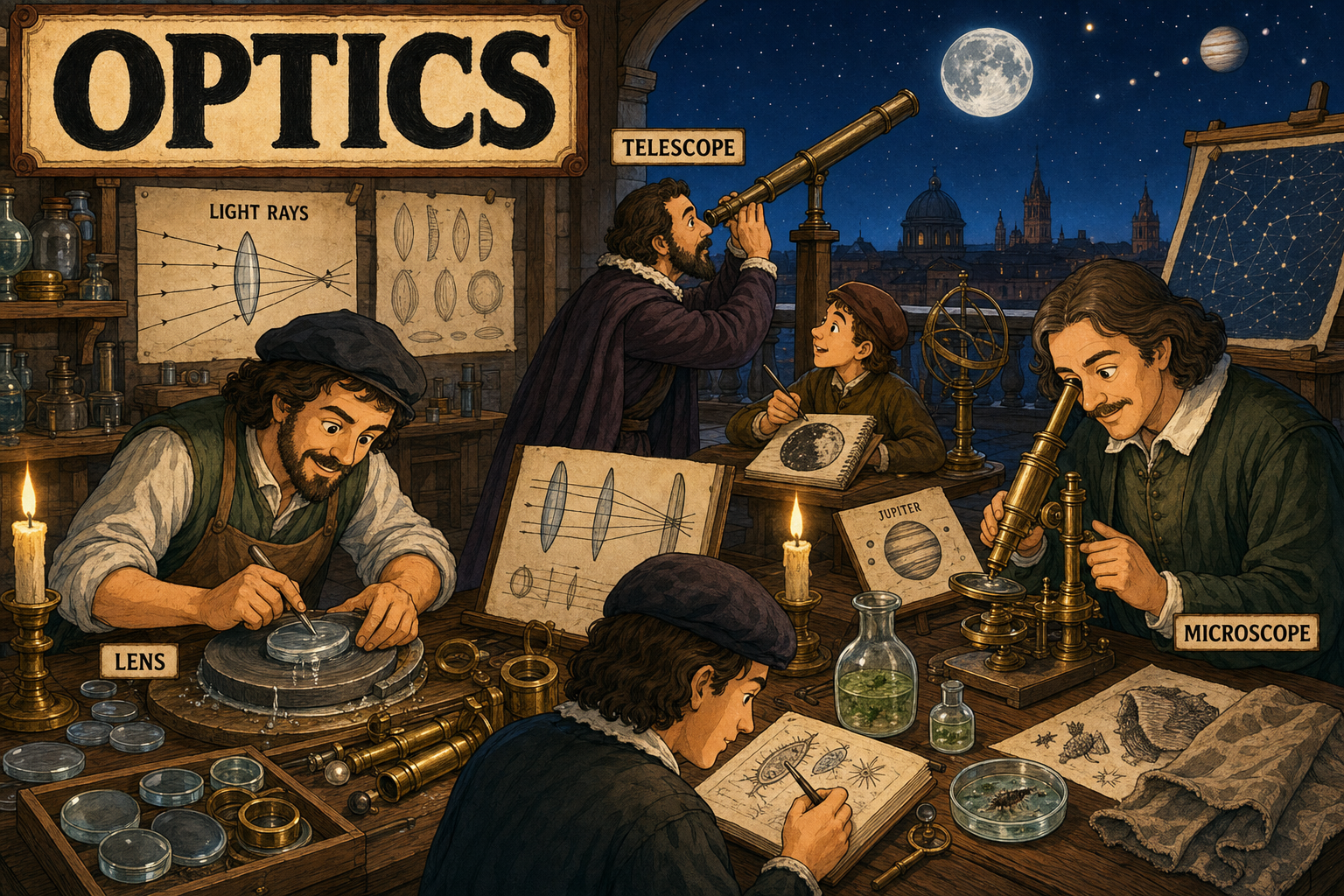
Early modern optical instruments extended human sight to scales that were previously inaccessible. Telescopes changed astronomy by revealing lunar detail and planetary moons, while microscopes opened the study of cells, microorganisms, textiles, insects, and materials. Together they reshaped science by making observation more powerful and reproducible.
Key Visual Elements
- A lens-maker grinding and polishing a convex lens.
- A refracting telescope aimed at the Moon and Jupiter.
- A microscope used to examine pond water and small specimens.
- Assistants sketching craters, moons, and tiny organisms.
- Ray diagrams and lens shapes explaining how optics work.
- Brass lens mounts, glass blanks, star charts, candles, and early-modern clothing.
- Readable embedded title:
OPTICS.
Sources
- https://www.britannica.com/science/optics
- https://www.britannica.com/science/telescope
- https://www.britannica.com/technology/microscope
- https://www.sciencemuseum.org.uk/objects-and-stories/physics/galileos-telescope
- https://www.sciencemuseum.org.uk/objects-and-stories/medicine/microscope
Final Prompt Used
Use case: illustration-story
Asset type: technology-milestone cartoon collection entry, 3:2 landscape, final image should be suitable for 1536x1024 gallery use.
Primary request: Create a clean, friendly cartoon editorial illustration for the Technology Milestones "Optics" entry, depicting telescope and microscope optics as breakthroughs that extended human sight, with people grinding lenses, observing the sky, and viewing microscopic life.
Historical setting: early 17th-century Europe, approximately 1590-1670 CE, combining a Dutch/Italian lens-maker's workshop and observation balcony. Show era-appropriate architecture, clothing, tools, materials, and props: wooden workbenches, glass lens blanks, grinding and polishing tools, brass lens mounts, parchment diagrams of light rays, a long refracting telescope tube, a simple compound microscope with sliding tubes, a small single-lens microscope, ink sketches of the Moon and Jupiter's moons, pond-water sample, cloth sample, candles, star chart, and early-modern robes, caps, and aprons.
Subject: combine these visual elements into one unified scene: an optician grinding a convex lens; an astronomer aiming a refracting telescope at the Moon and Jupiter in the evening sky; a natural philosopher viewing pond water through a microscope; assistants sketching craters, moons, and tiny organisms on parchment; ray diagrams and lens shapes linking the tools together; expressive figures showing wonder at seeing far-away and tiny worlds. Keep the human figures active, skilled, and central to the moment.
Embedded title text: include a short, bold, correctly spelled title: "OPTICS". The title must be readable at web thumbnail size.
Optional labels: a few short readable labels are allowed, such as "LENS", "TELESCOPE", "MICROSCOPE", and "LIGHT RAYS". No long captions, no fake paragraphs, no sequence numbers.
Style/medium: clean, friendly cartoon / editorial illustration, bold confident outlines, flat-to-soft cel shading, warm expressive characters, simple readable shapes, magazine-quality cartoon art. One unified scene, not a grid of panels or a sticker collage.
Composition/framing: wide landscape image with foreground lens grinding and microscope work, midground telescope observation, and background night sky/early-modern workshop context. Make optics recognizable at web thumbnail size through clear lenses, telescope tube, microscope, Moon sketch, ray diagram, and excited observers.
Lighting/mood: optimistic twilight with warm candlelight indoors and cool moonlight outdoors, conveying curiosity and discovery.
Color palette: varied and era-grounded with warm wood, brass, parchment cream, glass highlights, deep blue sky, candle gold, ink black, muted early-modern fabrics, and small bright celestial accents. Avoid a one-note palette.
Text constraints: embedded title and any labels must be short, high-contrast, and correctly spelled. No long captions, no modern signage that does not fit the era. Scientific sketches may be decorative but not fake paragraphs.
Avoid: photorealism, exact modern logos, exact brand or product trademarks, photorealistic real-person likenesses of Galileo or Leeuwenhoek, copyrighted characters, modern lab equipment, modern eyeglasses styles, digital displays, disconnected symbol collage, unreadable tiny labels, and generic stock clip-art look.
More from Image Collections

Internet Culture Timeline — 2025
2025-01-01
Music Yearbooks — 2025
2025-01-01

News & Culture — 2025
2025-01-01
NFL Super Bowls — 2025
2025-01-01
Science Breakthroughs — 2025
2025-01-01

Transportation & Mobility — 2025
2025-01-01

Video Game History — 2025
2025-01-01

Internet Culture Timeline — 2024
2024-01-01
Music Yearbooks — 2024
2024-01-01
News & Culture — 2024
2024-01-01
NFL Super Bowls — 2024
2024-01-01
Science Breakthroughs — 2024
2024-01-01