Image Collections
Technology Milestones — 12 Mechanical Clock
Era / approximate date: Late 13th to 14th century Europe, approximately 1280-1390 CE
Technology Milestones: Mechanical Clock
- Milestone slug:
Mechanical-Clock - Milestone name: Mechanical clocks and timekeeping
- Era / approximate date: Late 13th to 14th century Europe, approximately 1280-1390 CE
- Likely setting depicted: Medieval cathedral/monastery clock chamber with a public tower clock and town square
- Generation date: 2026-06-29
- Model: built-in gpt-image
- Saved image path:
My-Library/Images/Collections/Technology-Milestones/Images/Technology-Milestones_12-Mechanical-Clock.png
Why It Is A Milestone
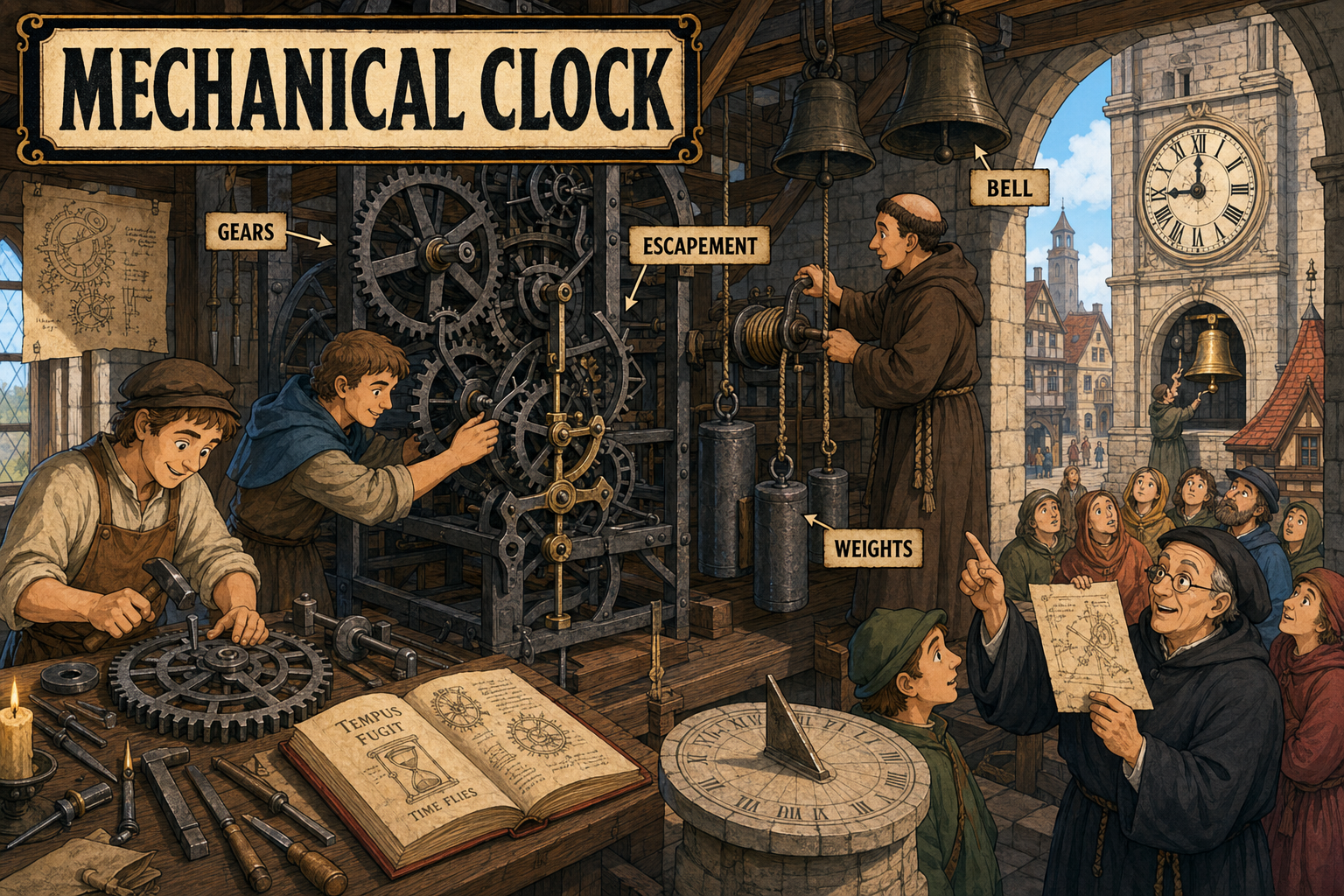
Mechanical clocks transformed timekeeping from natural observations and water clocks into machine-regulated public time. Weight-driven gear trains and escapements allowed towns, monasteries, universities, and workplaces to coordinate prayer, markets, labor, and daily schedules with increasing precision.
Key Visual Elements
- Clockmakers assembling large iron gears.
- A monk or caretaker winding hanging clock weights.
- Verge-and-foliot style escapement shown near the gear train.
- Bells and a tower clock face tying the mechanism to public time.
- Townspeople looking up as the clock announces time.
- A sundial shown as older timekeeping for comparison.
- Readable embedded title:
MECHANICAL CLOCK.
Sources
- https://www.britannica.com/technology/clock
- https://www.britannica.com/technology/escapement
- https://www.sciencemuseum.org.uk/objects-and-stories/measuring-time
- https://www.metmuseum.org/toah/hd/clck/hd_clck.htm
Final Prompt Used
Use case: illustration-story
Asset type: technology-milestone cartoon collection entry, 3:2 landscape, final image should be suitable for 1536x1024 gallery use.
Primary request: Create a clean, friendly cartoon editorial illustration for the Technology Milestones "Mechanical-Clock" entry, depicting medieval mechanical clocks and public timekeeping with people building, maintaining, and using a weight-driven tower clock.
Historical setting: late 13th to 14th century Europe, approximately 1280-1390 CE, in a cathedral or monastery clock chamber and town square. Show era-appropriate architecture, clothing, tools, materials, and props: stone cathedral walls, timber beams, monk/scholarly robes, artisan aprons, iron gears, verge-and-foliot escapement, hanging weights, ropes, winding crank, bells, simple clock face, sundial for comparison, candles, parchment notes, chisels, hammers, files, and wooden scaffolding.
Subject: combine these visual elements into one unified scene: clockmakers assembling large iron gears; a monk or caretaker winding heavy clock weights with a crank; the verge-and-foliot escapement ticking near the center of the mechanism; bells and a simple public clock face visible through an arch; townspeople below looking up as the clock announces prayer or market time; a small sundial nearby showing older timekeeping. Keep the human figures expressive, active, and central to the moment.
Embedded title text: include a short, bold, correctly spelled title: "MECHANICAL CLOCK". The title must be readable at web thumbnail size.
Optional labels: a few short readable labels are allowed, such as "GEARS", "WEIGHTS", "ESCAPEMENT", and "BELL". No long captions, no fake paragraphs, no sequence numbers.
Style/medium: clean, friendly cartoon / editorial illustration, bold confident outlines, flat-to-soft cel shading, warm expressive characters, simple readable shapes, magazine-quality cartoon art. One unified scene, not a grid of panels or a sticker collage.
Composition/framing: wide landscape image with foreground clockmakers and gears, midground weight-driven mechanism and bells, and background cathedral/town context. Make mechanical clocks recognizable at web thumbnail size through the iron gear train, hanging weights, escapement, clock face, and ringing bell.
Lighting/mood: bright optimistic workshop daylight with warm candle and window light, conveying precision, coordination, and a new shared sense of time.
Color palette: varied and era-grounded with iron gray, warm oak, stone cream, parchment tan, monk robes, muted medieval dyes, brass highlights, and blue daylight through windows. Avoid a one-note palette.
Text constraints: embedded title and any labels must be short, high-contrast, and correctly spelled. No long captions, no modern signage that does not fit the era.
Avoid: photorealism, exact modern logos, exact brand or product trademarks, photorealistic real-person likenesses, copyrighted characters, modern wristwatches, digital clocks, modern machine tools, disconnected symbol collage, unreadable tiny labels, and generic stock clip-art look.
More from Image Collections

Internet Culture Timeline — 2025
2025-01-01
Music Yearbooks — 2025
2025-01-01

News & Culture — 2025
2025-01-01

NFL Super Bowls — 2025
2025-01-01

Science Breakthroughs — 2025
2025-01-01
Transportation & Mobility — 2025
2025-01-01

Video Game History — 2025
2025-01-01

Internet Culture Timeline — 2024
2024-01-01
Music Yearbooks — 2024
2024-01-01
News & Culture — 2024
2024-01-01

NFL Super Bowls — 2024
2024-01-01
Science Breakthroughs — 2024
2024-01-01