Transportation & Mobility — 2002
Honda FCX fuel-cell vehicle delivery.
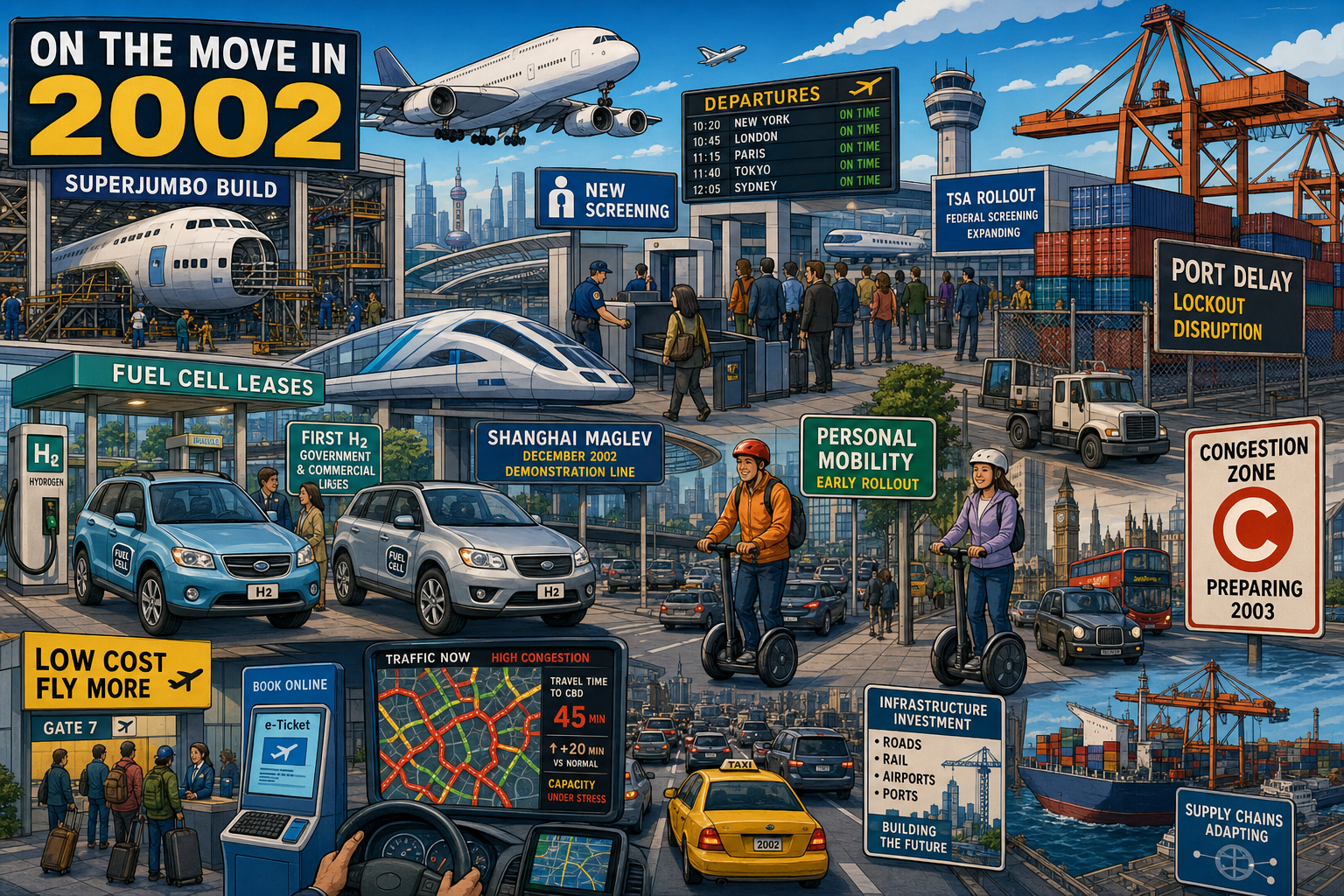
Transportation & Mobility: 2002
Year: 2002 Generation date: 2026-07-02 Model: built-in gpt-image (recovered from session transcript) Saved image path: My-Library/Images/Collections/Transportation-Mobility/Images/Transportation-Mobility_2002.png
Selected Transportation-And-Mobility Moments
- Honda FCX fuel-cell vehicle delivery.
- Category: Hydrogen / alternative powertrains
- Why selected: Honda delivered fuel-cell vehicles to public-sector users in Japan and Los Angeles in December 2002.
- Visual depiction: Generic hydrogen vehicle and pump labeled "FUEL CELL LEASES".
- Rights/sensitivity notes: No official logo or exact vehicle badging.
- Source: https://global.honda/en/newsroom/news/2002/4021203-fcx-eng.html
- Toyota FCHV commercialization step.
- Category: Hydrogen / alternative powertrains
- Why selected: Toyota began limited fuel-cell vehicle leasing in Japan in December 2002, part of the first wave of market-ready hydrogen vehicles.
- Visual depiction: Second generic compact SUV with hydrogen label.
- Rights/sensitivity notes: Generic vehicle shapes only.
- Source: https://newsroom.toyota.eu/2008-toyota-to-begin-leasing-advanced-Fuel-Cell-Hybrid-Vehicle/
- Shanghai Maglev demonstration line.
- Category: Rail / high-speed transit
- Why selected: The Shanghai Maglev line reached its December 31, 2002 demonstration/opening milestone, becoming a landmark commercial high-speed maglev project.
- Visual depiction: Elevated sleek maglev and station sign labeled "SHANGHAI MAGLEV".
- Rights/sensitivity notes: Generic train styling, no operator logos.
- Source: https://www.smtdc.com/en/gycf3.html
- TSA federal airport screening rollout.
- Category: Aviation security
- Why selected: 2002 was the year federalized U.S. airport passenger screening became a visible everyday travel change after the TSA's creation.
- Visual depiction: Airport checkpoint, luggage scanner, and sign labeled "NEW SCREENING".
- Rights/sensitivity notes: Symbolic checkpoint; no real travelers or sensitive security details.
- Source: https://www.tsa.gov/timeline
- Airbus A380 production begins.
- Category: Aviation / aircraft manufacturing
- Why selected: Manufacturing of the first A380 wing-box component began in January 2002, marking the superjumbo program's move into production.
- Visual depiction: Oversized double-deck aircraft section in a factory poster labeled "SUPERJUMBO BUILD".
- Rights/sensitivity notes: Generic aircraft, no livery or logo.
- Source: https://www.iise.org/Details.aspx?id=6398
- Segway personal transporter early rollout.
- Category: Micromobility / personal mobility
- Why selected: Early customer deliveries in 2002 made the self-balancing personal transporter one of the year's most visible mobility experiments.
- Visual depiction: Commuters riding generic two-wheeled self-balancing scooters.
- Rights/sensitivity notes: Generic personal transporters, no trademark marks.
- Source: https://www.thehenryford.org/collections/explore/artifact/343857
- 2002 West Coast port lockout.
- Category: Shipping / logistics disruption
- Why selected: The port lockout showed how labor, technology, and container logistics could disrupt national supply chains.
- Visual depiction: Stacked containers, idle cranes, and "PORT DELAY" sign.
- Rights/sensitivity notes: Symbolic disruption; no sensationalized conflict.
- Source: https://journals.sagepub.com/doi/10.1177/0891242404269500
- London congestion charge preparation.
- Category: Urban roads / congestion management
- Why selected: London's congestion-charge scheme was prepared and legally contested in 2002 before launching in February 2003.
- Visual depiction: City road sign labeled "CONGESTION ZONE" and "PREPARING 2003".
- Rights/sensitivity notes: Generic city sign, no official road-camera branding.
- Source: https://centreforpublicimpact.org/public-impact-fundamentals/londons-congestion-charge/
- Low-cost air travel and online booking growth.
- Category: Aviation / travel business
- Why selected: Early-2000s budget airlines and web booking were changing European and short-haul travel behavior.
- Visual depiction: Low-cost boarding gate and web-ticket kiosk.
- Rights/sensitivity notes: No airline logos.
- Source: https://www.wired.com/2002/07/ryanair-2
- Congestion and capacity stress.
- Category: Infrastructure / system capacity
- Why selected: 2002 transport planning emphasized congestion, capacity constraints, and demand management across roads, air, transit, and freight.
- Visual depiction: Red traffic dashboard and infrastructure-investment poster.
- Rights/sensitivity notes: Generic map and dashboard.
- Source: https://onlinepubs.trb.org/onlinepubs/trnews/2002_critical_issues_article.pdf
Top Anchor Moments
- Hydrogen fuel-cell vehicle leases.
- Shanghai Maglev demonstration line.
- TSA federal airport screening rollout.
Final Prompt Used
Use case: illustration-story Asset type: year-by-year transportation and mobility collection image, 3:2 landscape PNG Primary request: Create a lively illustrated transportation time-capsule montage for the year 2002, showing the electric and hydrogen vehicles, aviation-security changes, rail projects, micromobility experiments, shipping disruptions, and infrastructure changes that defined how people and goods moved that year.
Scene/backdrop: a cohesive city-street and transit-map montage: a busy illustrated boulevard with a stylized transit map, departure boards, a port and airport visible in the background, hydrogen fueling station, security checkpoint, cargo cranes, and infrastructure planning signs. The scene should feel like one unified transportation world rather than disconnected stickers.
Subject: combine these selected moments into one unified illustrated montage: first commercial/government hydrogen fuel-cell vehicle leases represented by two generic compact SUVs at a hydrogen pump labeled "FUEL CELL LEASES"; Honda FCX and Toyota FCHV milestones represented by generic hydrogen badges without logos; Shanghai Maglev's December 2002 demonstration/opening represented by a sleek elevated maglev train and station sign labeled "SHANGHAI MAGLEV"; TSA federal airport screening rollout represented by a non-branded airport checkpoint, luggage scanner, and departure board labeled "NEW SCREENING"; Airbus A380 production beginning represented by an oversized double-deck aircraft wing section in a factory poster labeled "SUPERJUMBO BUILD"; Segway personal transporter early customer rollout represented by commuters testing two-wheeled self-balancing scooters labeled "PERSONAL MOBILITY"; 2002 West Coast port lockout represented symbolically by stacked containers, idle cranes, and a sign labeled "PORT DELAY"; London congestion charge preparation represented by a central-city road sign labeled "CONGESTION ZONE"; budget airline growth and online booking represented by a generic low-cost boarding gate with a web-ticket kiosk; rising congestion and transport capacity stress represented by a dashboard map with red traffic lines.
Year text requirement: include clear readable text in the image that says: "2002".
Optional title text: include a short readable title: "ON THE MOVE IN 2002".
Style/medium: polished cartoon-editorial illustration, city-street and transit-map montage, stylized vehicles, route lines, station signs, departure boards, dashboards, expressive commuter figures, magazine-quality digital art.
Composition/framing: wide landscape image, one unified scene rather than separate panels. Use foreground vehicles, scooters, travelers, and road signage; midground streets, airport checkpoint, maglev station, and hydrogen pump; background skyline, port cranes, aircraft factory hangar, and transit-map context. Make hydrogen vehicles, airport security, and maglev rail the biggest 2-3 anchors, with smaller references integrated as map insets, departure-board rows, dashboard widgets, road signs, cargo labels, and station posters.
Lighting/mood: energetic, optimistic, and readable, with clear daylight, glowing screens and signals, and clear visual hierarchy.
Color palette: varied and era-aware: early-2000s asphalt grays and taxi yellows, hydrogen/EV teals and charging greens, transit-map brights, port-crane oranges, airport blues, and dashboard neutrals. Avoid a one-note palette.
Text constraints: short readable labels are allowed on road signs, departure boards, transit maps, station signs, dashboards, cargo containers, and posters. Use 1-5 words per label. Keep text high-contrast, correctly spelled, and large enough to read. Do not use long captions, fake paragraphs, or a row of labels at the bottom.
Avoid: official logos, exact vehicle badging, trademark-accurate vehicle or aircraft liveries, photorealistic likenesses of real people, graphic crash wreckage or casualties, hateful symbols, cluttered sticker-collage layout, tiny unreadable labels, distorted lettering, fake full article text, and generic stock imagery.
More from Image Collections