Science Breakthroughs — 2002
Solar neutrino problem resolved
Science Breakthroughs: 2002
- Year: 2002
- Saved image path:
My-Library/Images/Collections/Science-Breakthroughs/Images/Science-Breakthroughs_2002.png - Generation date: 2026-07-06
- Model: built-in gpt-image (recovered from session transcript)
Selected Science Breakthroughs
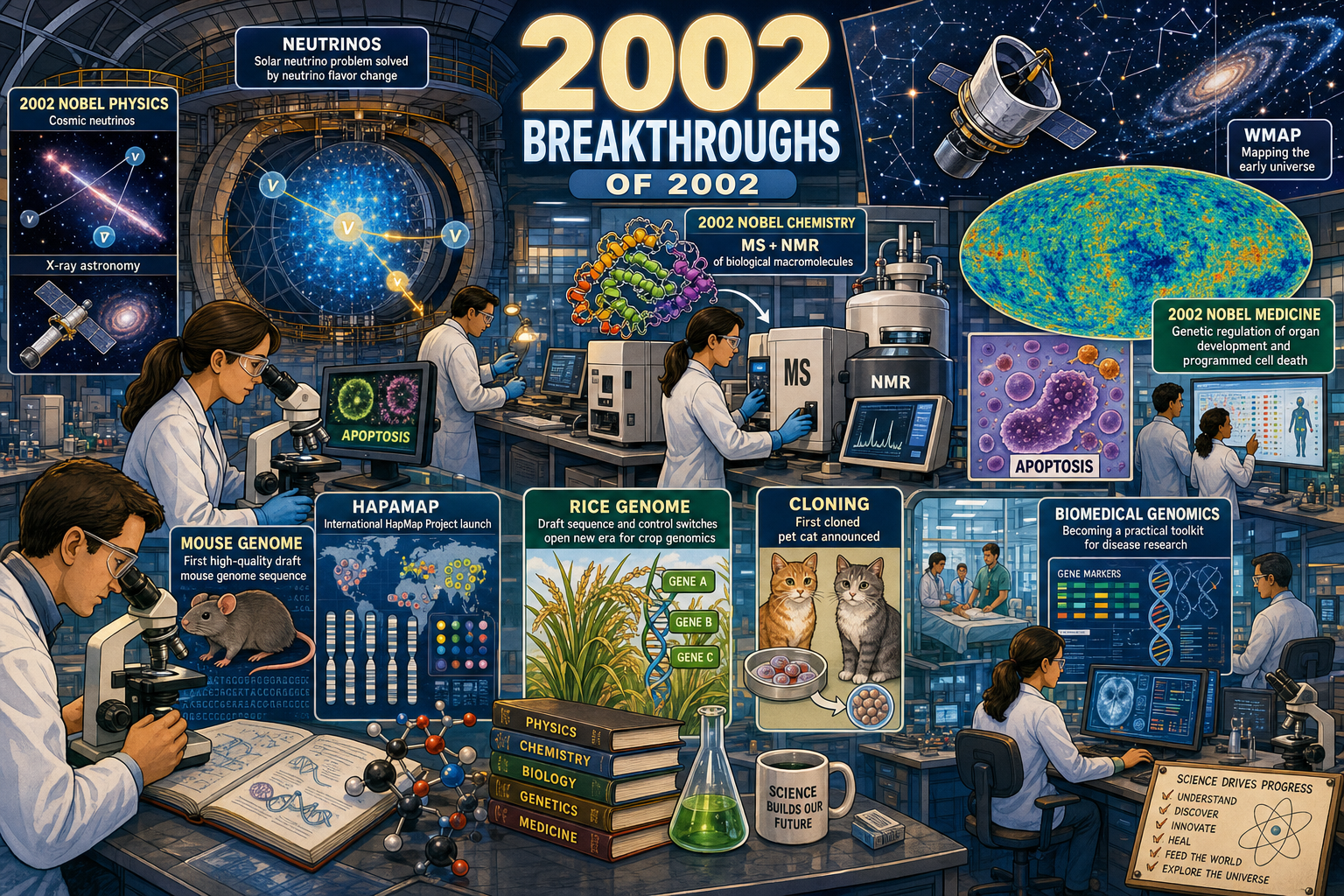
- Solar neutrino problem resolved
- Field: Physics / astronomy
- Why selected: 2002 results from the Sudbury Neutrino Observatory showed solar neutrinos change flavor, resolving a long-standing discrepancy.
- Visual depiction: Glowing neutrino particles changing color through a detector.
- Rights/sensitivity notes: Generic detector, no institutional logo.
- Source: https://www.eurekalert.org/news-releases/787932
- Science Breakthrough of the Year: neutrinos
- Field: Particle physics
- Why selected: Science highlighted neutrino results as a defining breakthrough of 2002.
- Visual depiction: Large lab cutaway labeled
NEUTRINOS. - Rights/sensitivity notes: Abstract particles and generic researchers.
- Source: https://www.science.org/content/article/breakthroughs-2002-neutrinos-nailed
- 2002 Nobel Physics: cosmic neutrinos and X-ray astronomy
- Field: Physics / astrophysics
- Why selected: The Physics Nobel recognized cosmic-neutrino detection and X-ray source discoveries.
- Visual depiction: Neutrino trails and an X-ray telescope star map.
- Rights/sensitivity notes: No laureate likenesses.
- Source: https://www.nobelprize.org/prizes/physics/2002/press-release/
- 2002 Nobel Chemistry: mass spectrometry and NMR
- Field: Chemistry / structural biology
- Why selected: The Chemistry Nobel recognized methods for identifying and determining structures of biological macromolecules.
- Visual depiction: Protein model entering instruments labeled
MSandNMR. - Rights/sensitivity notes: Generic instruments, no branded equipment.
- Source: https://www.nobelprize.org/prizes/chemistry/2002/press-release/
- 2002 Nobel Medicine: organ development and programmed cell death
- Field: Medicine / cell biology
- Why selected: The Medicine Nobel recognized genetic regulation of organ development and apoptosis.
- Visual depiction: Microscope view of cells labeled
APOPTOSIS. - Rights/sensitivity notes: No laureate likenesses; non-graphic cell imagery.
- Source: https://www.nobelprize.org/prizes/medicine/2002/press-release/
- Mouse genome draft
- Field: Genetics and biotech
- Why selected: The mouse genome sequence became a key comparative resource for understanding the human genome.
- Visual depiction: Mouse silhouette beside DNA and comparison charts.
- Rights/sensitivity notes: Symbolic animal depiction, no lab-animal distress.
- Source: https://www.genome.gov/25520486/online-education-kit-2002-mouse-genome-sequenced
- International HapMap Project launch
- Field: Genetics and medicine
- Why selected: HapMap aimed to map common human genetic variation to speed disease-gene discovery.
- Visual depiction: Chromosome maps with population dots labeled
HAPMAP. - Rights/sensitivity notes: Abstract genetics visualization.
- Source: https://www.genome.gov/11008393/news-release-archives-2002
- Rice genome and crop genomics
- Field: Biology / agriculture
- Why selected: Crop genome drafts highlighted genomics' importance for agriculture and global food research.
- Visual depiction: Rice plants with DNA tags and a crop-genome screen.
- Rights/sensitivity notes: Generic crop imagery.
- Source: https://www.sciencedaily.com/releases/2002/12/021223084005.htm
- WMAP early-universe mapping
- Field: Cosmology
- Why selected: WMAP observations produced a detailed map of cosmic microwave background patterns, transforming precision cosmology.
- Visual depiction: Oval cosmic microwave background map and star chart.
- Rights/sensitivity notes: No NASA logo.
- Source: https://science.nasa.gov/mission/wmap/wmap-overview/
- First cloned pet cat announced
- Field: Biology / cloning
- Why selected: The first cloned cat made animal cloning a widely discussed biotech milestone and raised questions about genetics versus appearance.
- Visual depiction: Two different-colored generic lab cats and a cloning diagram.
- Rights/sensitivity notes: Symbolic, non-distressing animal depiction.
- Source: https://www.txamfoundation.com/maroon/spring-2024/curiosity-cloned-the-cat.aspx
Final Prompt Used
Create a 1536x1024 polished cartoon-editorial popular-science-magazine montage for the year 2002, showing the medicine, physics, biology, genetics, energy, archaeology, materials-science, and Nobel-worthy discoveries that defined science that year. Scene/backdrop: a cohesive bright research world with lab benches, microscopes and telescopes, molecule and DNA models, a neutrino detector cross-section, a star chart on the wall, specimen tables, clean biomedical research rooms, and research screens. Subject: combine these selected breakthroughs into one unified illustrated montage: solar neutrino problem solved by neutrino flavor change at the Sudbury Neutrino Observatory represented by glowing particles moving through a detector, 2002 Nobel Physics for cosmic neutrinos and X-ray astronomy represented by neutrino trails and an X-ray telescope star map, 2002 Nobel Chemistry for mass spectrometry and NMR of biological macromolecules represented by a protein model entering instruments labeled MS and NMR, 2002 Nobel Medicine for genetic regulation of organ development and programmed cell death represented by a microscope view of cells labeled APOPTOSIS, first high-quality draft mouse genome sequence represented by a mouse silhouette beside DNA, International HapMap Project launch represented by chromosome maps and population dots, rice genome draft/control switches and crop genomics represented by rice plants with DNA tags, WMAP early-universe mapping represented by a cosmic microwave background oval map, first cloned pet cat announced in 2002 represented symbolically by two different-colored generic lab cats and a cloning diagram, and biomedical genomics becoming a practical disease-research toolkit represented by hospital-lab screens and gene markers. Include clear readable year text 2002 and optional title BREAKTHROUGHS OF 2002. Style/medium: polished cartoon-editorial illustration in a popular-science-magazine style, stylized lab equipment, glowing screens, molecule and DNA models, star charts, expressive generic researcher figures, magazine-quality digital art. Composition: wide landscape, one unified scene rather than panels; foreground researchers and microscopes, midground lab benches/specimen tables, background observatory chart, neutrino detector, and hospital-research context. Make neutrinos, genomics, and Nobel science most prominent; integrate smaller references as chalkboard diagrams, screen readouts, specimen labels, wall charts, and poster insets. Lighting/mood: bright, curious, optimistic, clean lab lighting with glowing instruments. Color palette: varied clinical whites and teals, deep-space blues and purples, DNA greens, molecular oranges, clean-energy yellows, and earthy crop/genome tones; avoid a one-note palette. Text constraints: short readable labels only: 2002, BREAKTHROUGHS, NEUTRINOS, MOUSE GENOME, HAPMAP, APOPTOSIS, MS + NMR, WMAP, RICE GENOME, CLONING. Avoid official logos, exact institutional branding, trademark-accurate equipment, photorealistic likenesses of real people including named scientists or laureates, graphic illness/injury/casualties, hateful symbols, cluttered sticker-collage layout, tiny unreadable labels, distorted lettering, fake full article text, and generic stock imagery.
More from Image Collections