Video Game History — 2008
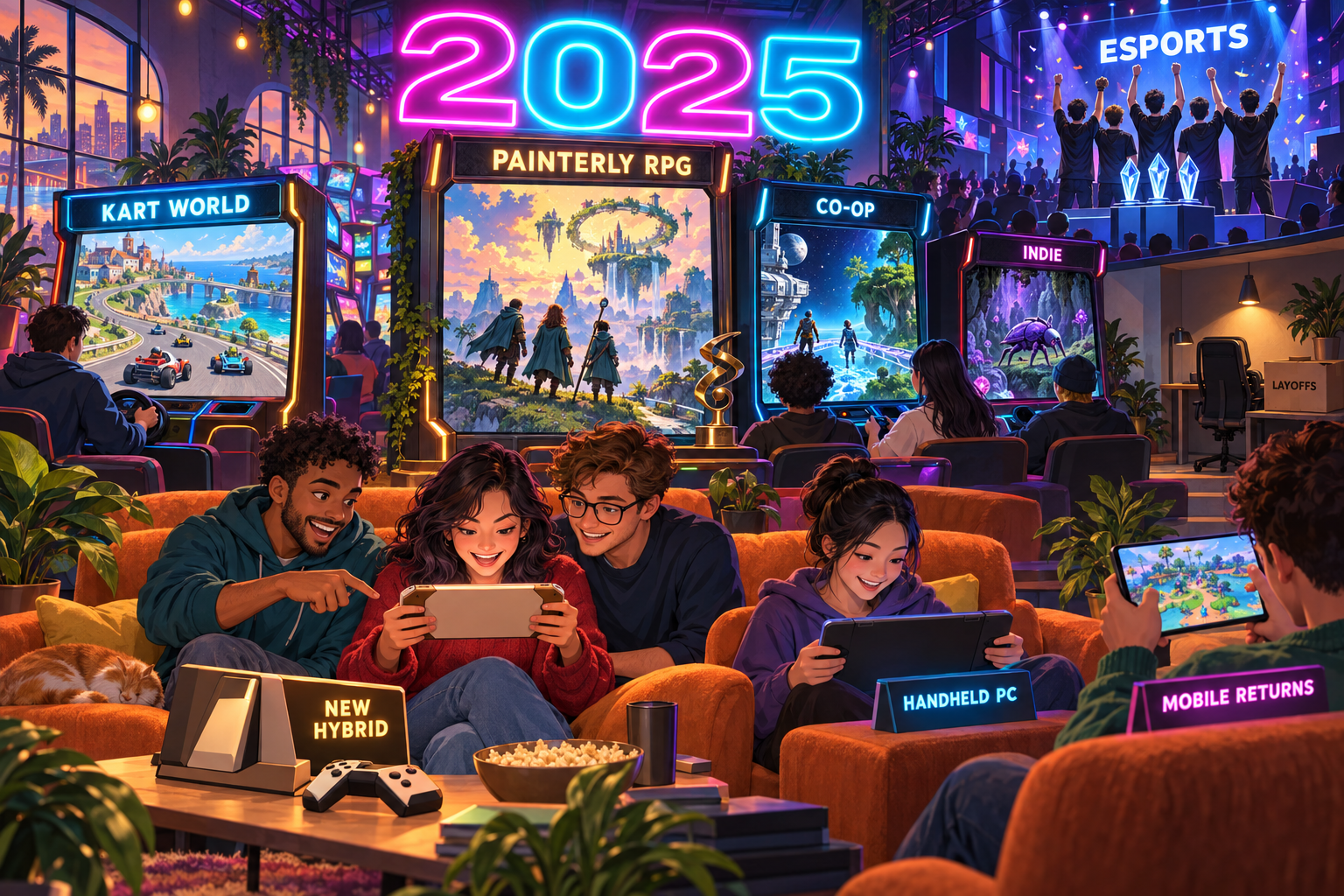
Motion and fitness play reached a broad family audience through Wii Fit and Mario Kart Wii; depicted through generic wand controllers, a balance board, and a racing wheel.
Video Game History: 2008
- Year: 2008
- Generation date: 2026-08-05
- Model: built-in gpt-image
- Saved image:
My-Library/Images/Collections/Video-Game-History/Images/Video-Game-History_2008.png
Selected moments
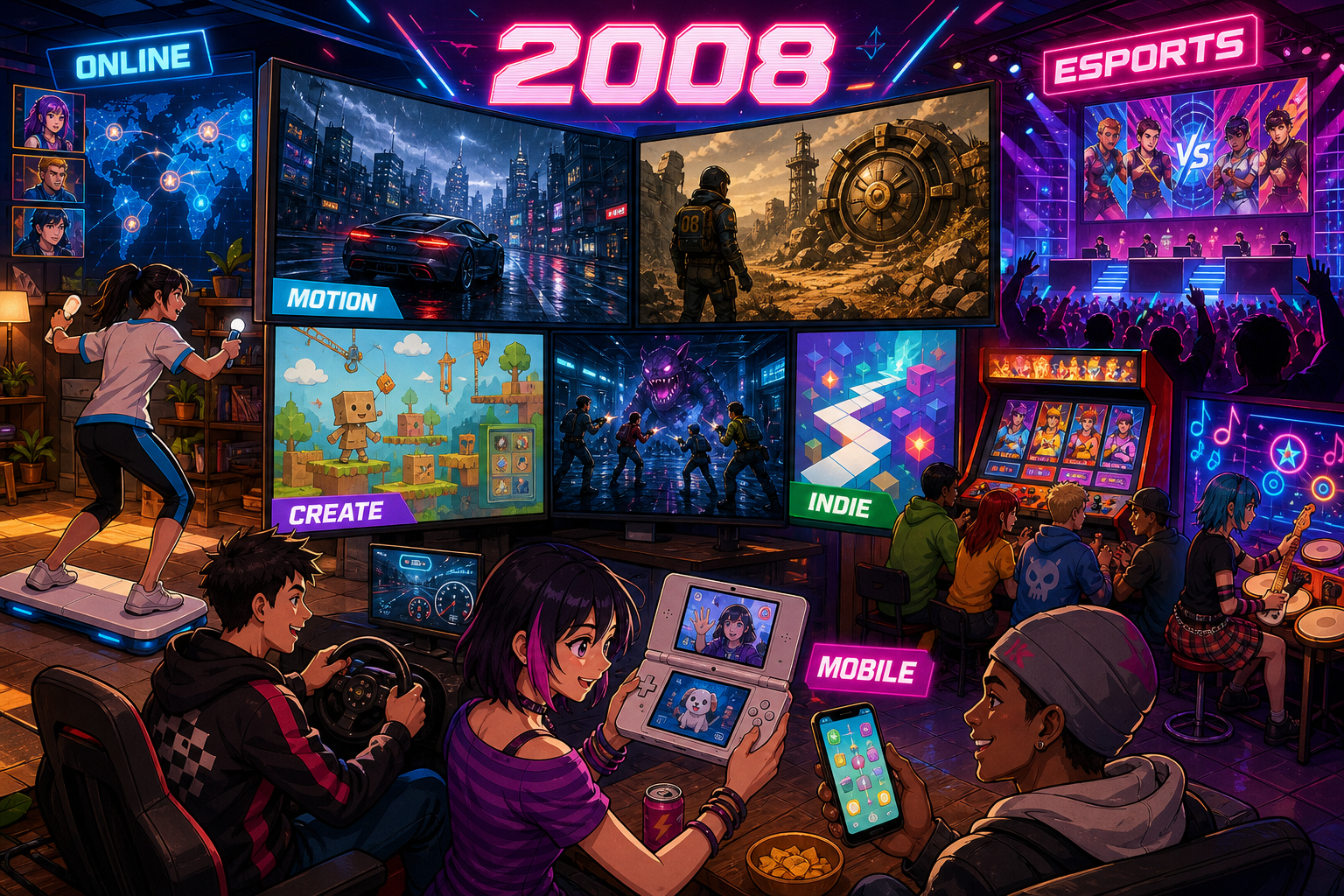
- Motion and fitness play reached a broad family audience through Wii Fit and Mario Kart Wii; depicted through generic wand controllers, a balance board, and a racing wheel.
- Nintendo introduced the DSi in Japan, extending the dual-screen handheld era with cameras and downloadable software; depicted as a generic camera-enabled two-screen portable.
- Apple's App Store opened in July and passed ten million downloads in its first weekend, beginning a major new mobile-game distribution channel; depicted as an unbranded phone with an invented touch puzzle.
- Grand Theft Auto IV made the dense open-world city a defining blockbuster form; evoked by an original rain-soaked urban driving scene.
- Fallout 3 brought open-world role-playing to a retro-futurist wasteland and won major year-end recognition; evoked by an original vault and desert explorer.
- LittleBigPlanet made user creation and sharing central to a console platformer; evoked by an original cardboard-and-cloth construction world.
- Left 4 Dead advanced cooperative online survival play; evoked by an original, bloodless four-player monster corridor.
- Braid and World of Goo helped establish downloadable independent games as critical landmarks; consolidated into an invented abstract puzzle path.
- Rhythm games remained a major social phenomenon through Rock Band 2 and Guitar Hero World Tour; depicted with generic plastic instruments.
- Online play and organized competition continued expanding across consoles and PC; represented by a connected-world display and a generic esports stage.
The visual anchors are motion/casual play, ambitious high-definition worlds, and the rise of user-created, downloadable, and mobile games. Together they balance hardware, handhelds, mobile, landmark releases, online play, indie distribution, and esports.
Sources
- Apple announcement of the App Store's July 2008 launch and first-weekend download milestone: https://www.apple.com/newsroom/2008/07/14iPhone-App-Store-Downloads-Top-10-Million-in-First-Weekend/
- Nintendo fiscal briefing on the 2008 releases of Wii Fit, Mario Kart Wii, and Super Smash Bros. Brawl: https://www.nintendo.co.jp/ir/en/events/090508/03.html
- Nintendo 2008 financial briefing on Wii Fit and Mario Kart Wii adoption: https://www.nintendo.co.jp/ir/en/events/080425/04.html
- Ars Technica contemporary coverage of Fallout 3, LittleBigPlanet, Wii Music, rhythm games, and the New Xbox Experience: https://arstechnica.com/gaming/2008/11/the-week-in-gaming-the-xbox-experience-fallout-3-and-guitar-hero/
- GameSpot's 2008 E3 awards report for Fallout 3, LittleBigPlanet, Spore, and Left 4 Dead: https://www.gamespot.com/articles/fallout-3-littlebigplanet-spore-score-e3-game-critics-awards/1100-6195454/
- 2008 release and industry chronology used as a cross-check: https://en.wikipedia.org/wiki/2008_in_video_games
Rights notes
Every character and on-screen world is original and fictionalized. The console, controllers, balance board, racing wheel, handheld, phone, arcade cabinets, stage equipment, and interfaces are generic. No official names or logos, trademark-accurate silhouettes, copyrighted mascots, actual screenshots, or real-person likenesses are used. Historical references are conveyed through broad mechanics, genres, settings, and technology cues. The intended text is limited to 2008, MOTION, ONLINE, INDIE, CREATE, MOBILE, and ESPORTS.
Final prompt used
Use case: illustration-story. Create a lively polished cartoon-editorial gaming-magazine montage for 2008, matching the collection's dense, neon-lit, anime-influenced digital illustration, crisp outlines, expressive diverse players, layered screens, and highly finished arcade-poster look. One unified wide landscape gaming room flows into a small esports stage: foreground friends use generic motion controllers with a balance-board fitness activity and racing wheel; a generic dual-screen handheld suggests the new camera-enabled portable generation; a sleek phone displays a simple invented touch game to mark the new app-store era. Large central monitors show ORIGINAL fictionalized scenes only: a rain-soaked open-world city drive, a retro-futurist post-apocalyptic vault wanderer, a cheerful cloth-and-cardboard platform-builder with creation tools, a cooperative monster-survival corridor, and a bright abstract indie puzzle path. Add a generic four-player party-fighter cabinet and plastic-instrument rhythm corner, without recognizable characters or branded hardware. Background online competitors and a cheering esports crowd. Make the biggest anchors motion/casual play, ambitious HD worlds, and user-created/indie games. Embed only these short, correctly spelled, high-contrast labels: “2008”, “MOTION”, “ONLINE”, “INDIE”, “CREATE”, “MOBILE”, “ESPORTS”. Neon magenta, electric cyan, deep violet, screen blue, and warm living-room amber. No exact copyrighted characters or mascots, no official logos, no trademark-accurate console, controller, handheld, or box designs, no recreation of a specific real game, no photorealistic real-person likenesses, no gore, no long captions, no tiny fake text, no sticker-grid layout.
More from Image Collections