Video Game History — 2012
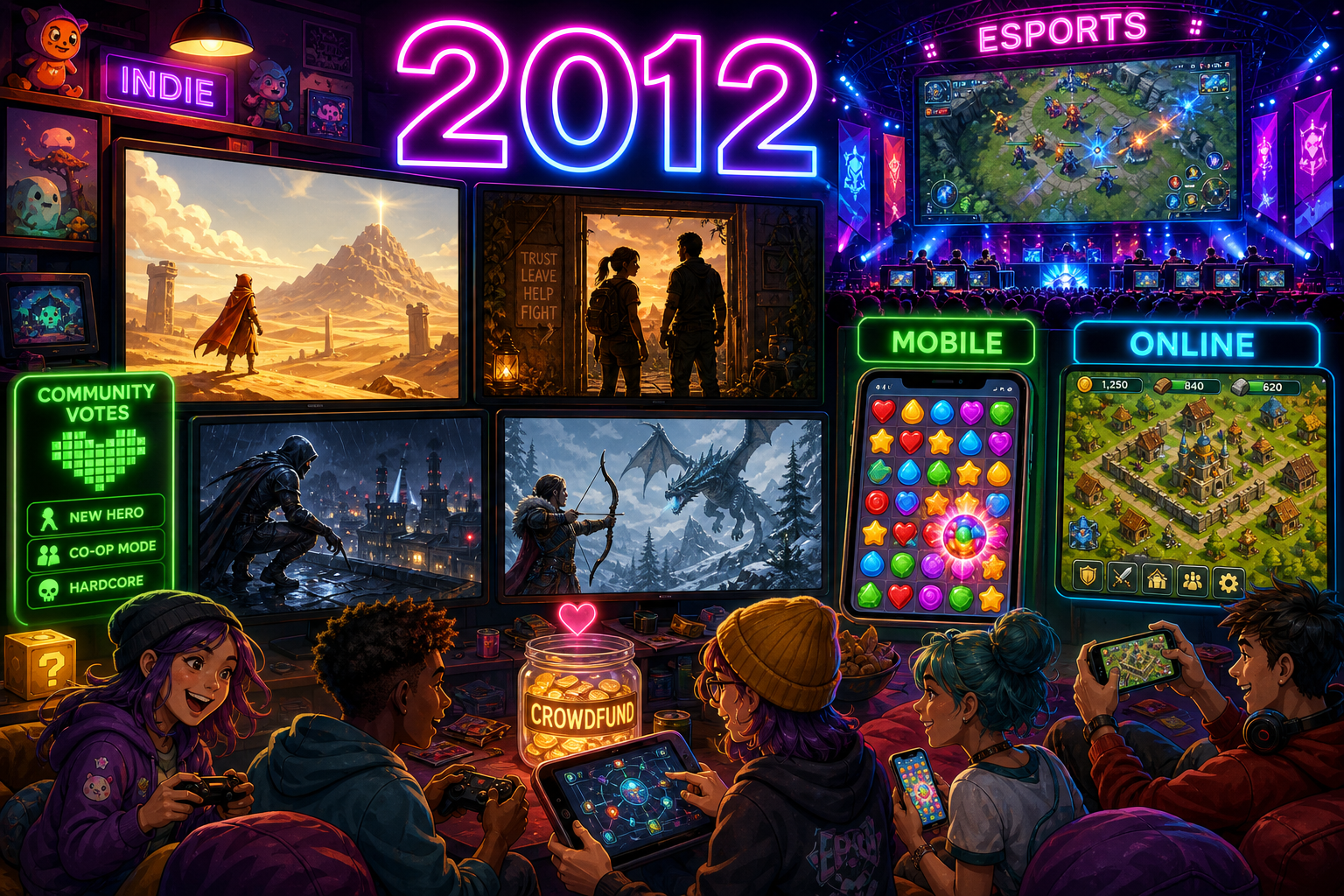
Wii U launched in 2012 as the first eighth-generation home console, with a touchscreen controller and expanded digital distribution; depicted as deliberately generic console-and-tablet hardware.
Video Game History: 2012
- Year: 2012
- Generation date: 2026-08-11
- Model: built-in gpt-image
- Saved image:
My-Library/Images/Collections/Video-Game-History/Images/Video-Game-History_2012.png
Selected moments
- Wii U launched in 2012 as the first eighth-generation home console, with a touchscreen controller and expanded digital distribution; depicted as deliberately generic console-and-tablet hardware.
- Journey became a landmark for artful independent games and won major awards; evoked by an original robed traveler crossing a luminous desert toward a mountain.
- Telltale's The Walking Dead won 2012 Game of the Year and advanced choice-driven episodic storytelling; evoked by two original survivor silhouettes confronting a doorway decision.
- Dishonored was a major stealth-action release; evoked by an original masked rooftop infiltrator in a rain-dark industrial city.
- Dragon's Dogma and the continuing open-world fantasy wave are represented by an original northern archer facing a dragon, without recreating any character or scene.
- Candy Crush Saga and Clash of Clans exemplified 2012's mobile and free-to-play surge; depicted through an original candy-matching puzzle and generic clan-building village on unbranded phones.
- The League of Legends Season Two World Championship marked the rapidly growing scale of international esports; depicted as a generic arena with an invented top-down fantasy battle.
- Steam Greenlight launched in August, using community voting to select games for distribution; depicted as a generic
COMMUNITY VOTESpanel. - Double Fine's record-setting Kickstarter campaign made crowdfunding a defining alternative for game development; depicted as a glowing
CROWDFUNDcoin jar. - BioWare's response to the Mass Effect 3 ending controversy highlighted the growing power of player feedback over narrative releases; represented abstractly through the choice-driven scene rather than copyrighted science-fiction characters.
The three visual anchors are the touchscreen-console generational shift, the indie and narrative breakthroughs, and the mobile/esports surge. Supporting cues add stealth, fantasy, community distribution, crowdfunding, and player-feedback culture.
Sources
- Nintendo corporate release, Wii U launch date in Japan: https://www.nintendo.co.jp/corporate/release/en/2012/120913.html
- Nintendo UK, Wii U launch and digital storefront details: https://www.nintendo.com/en-gb/News/2012/Nintendo-innovates-home-console-gaming-as-Wii-U-launches-this-Friday-678577.html
- Peabody Awards, Journey and its influence: https://peabodyawards.com/award-profile/journey-2012/
- Academy of Interactive Arts & Sciences, 16th D.I.C.E. Awards winners: https://www.interactive.org/images/press_release/16th-dice-award-winners_final-2-7-13.pdf
- Engadget, 2012 Video Game Awards winners: https://www.engadget.com/2012-12-07-spike-vga-2012-winners-walking-dead-takes-goty-journey-floats.html
- Supercell, Clash of Clans global launch in August 2012: https://supercell.com/en/about-us/
- King, European mobile-games report discussing Candy Crush Saga and the 2012 mobile market: https://www.king.com/media/1vmkqpyv/eng-mobile-matters-the-impact-of-mobile-games-for-europe.pdf
- Riot Games, League of Legends esports fact sheet and 2012 World Championship timeline: https://www.riotgames.com/darkroom/original/7e0d059326dd396aa8613bb29e13cdbd%3A594648e0d75079bdffa12e1299809a95/leauge-esports-fact-sheet.pdf
- Valve, Steam Greenlight launch announcement: https://store.steampowered.com/news/posts/?enddate=1354291679&feed=steam_press
- BioWare, official response and Extended Cut announcement: https://blog.bioware.com/2012/04/05/mass-effect-3-extended-cut/
- 2012 releases cross-check: https://en.wikipedia.org/wiki/2012_in_video_games
Rights notes
Every character and on-screen world is original and fictionalized. The desert traveler, survivors, rooftop infiltrator, fantasy archer, dragon, mobile puzzles, village, and esports battlefield do not reproduce game characters or screenshots. Consoles, controllers, phones, and stage equipment are generic and unbranded. No official logos, game titles, trademark-accurate hardware or box designs, or real-person likenesses appear. Intended text is limited to 2012, INDIE, ESPORTS, MOBILE, ONLINE, COMMUNITY VOTES, and CROWDFUND, plus small generic interface terms.
Final prompt used
Use case: illustration-story. Asset type: year-by-year video game history collection image. Create a polished cartoon-editorial gaming-magazine montage for 2012, matching the sibling entries’ dense, high-finish neon arcade-poster look. Place a huge, perfectly readable neon “2012” at top center in one unified deep arcade/living-room scene. Foreground: diverse expressive players use generic controllers, a non-trademarked tablet-screen controller, and generic phones. Midground glowing screens show original fictionalized scenes: a quiet robed traveler crossing a luminous desert toward a mountain; a tense choice-driven survivor drama with two original silhouettes at a doorway; an original stealth assassin on a rain-dark industrial rooftop; a mythic northern archer facing a dragon; a colorful candy-matching phone puzzle and a tiny generic clan-building strategy village. Background: a packed esports stage showing an invented top-down fantasy battle. Integrate a community-voting green-light panel and a crowdfunding coin jar. Short correctly spelled neon labels only: “MOBILE”, “INDIE”, “ONLINE”, “ESPORTS”, “CROWDFUND”. Bright magenta, cyan, electric blue, violet, candy colors, and warm amber; glowing screens, strong foreground-to-background depth, playful energetic mood, magazine-quality digital art. All characters and game scenes must be original and fictionalized; all consoles, controllers, handhelds, phones, cabinets and screens generic and deliberately unlike trademarked designs. No exact copyrighted characters or mascots, official logos, game titles, trademark-accurate hardware or boxes, photorealistic real-person likenesses, graphic gore, fake paragraphs, misspelled labels, disconnected sticker panels, watermarks, signatures, or borders.
More from Image Collections