Vibe Coders
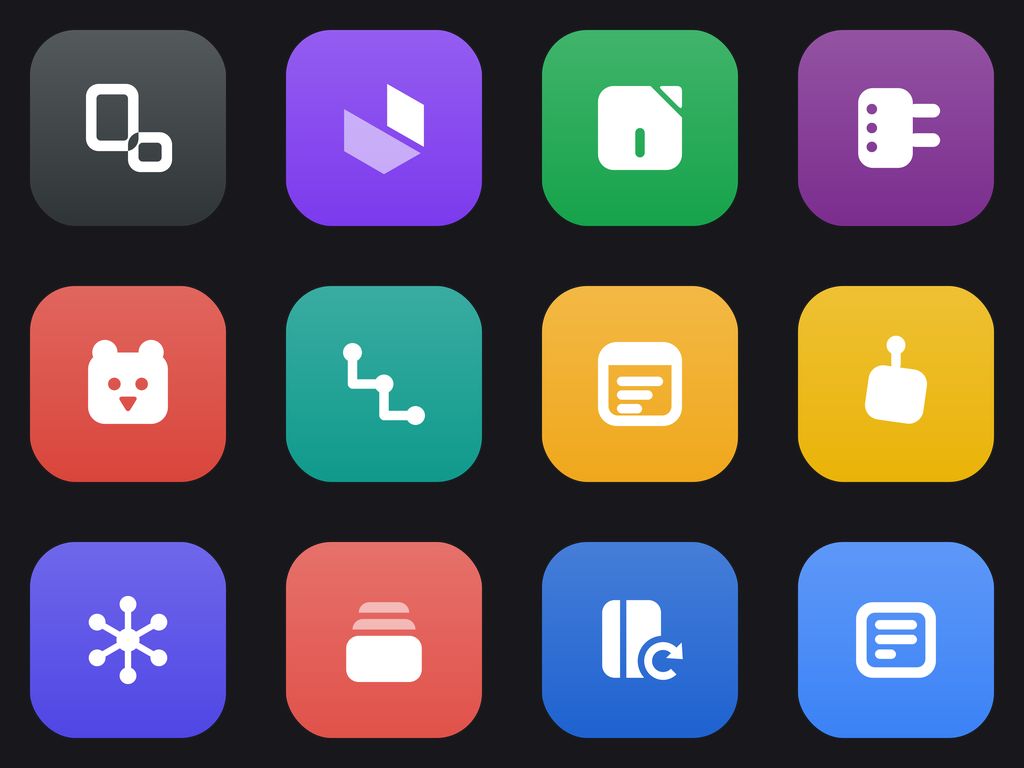
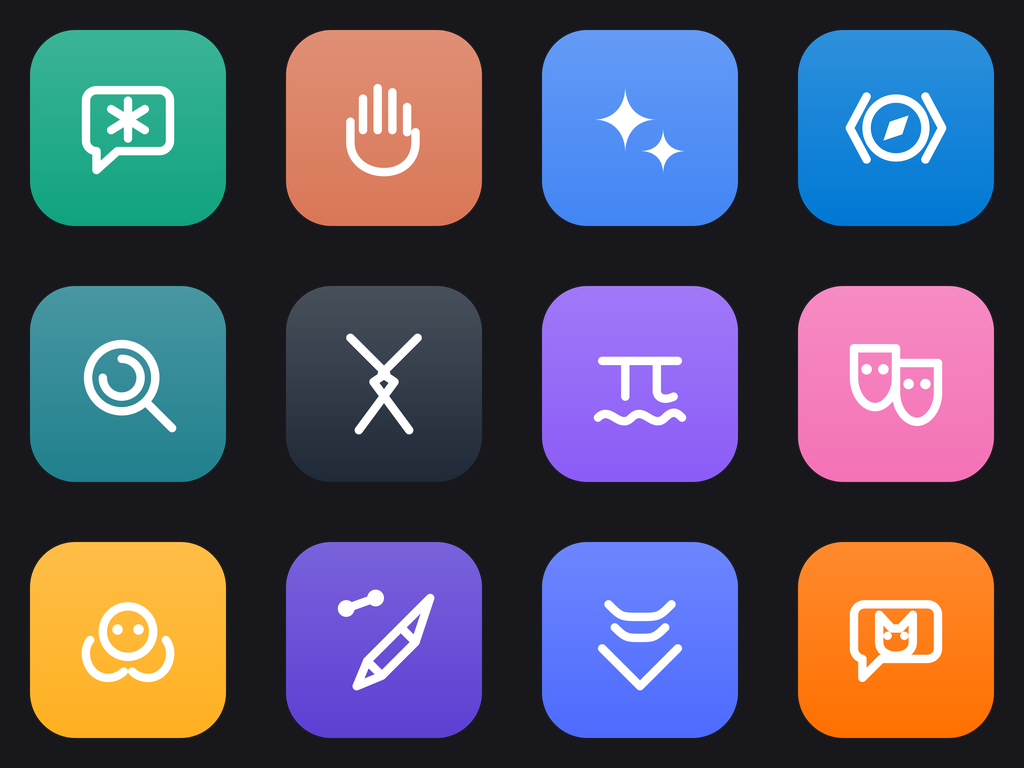
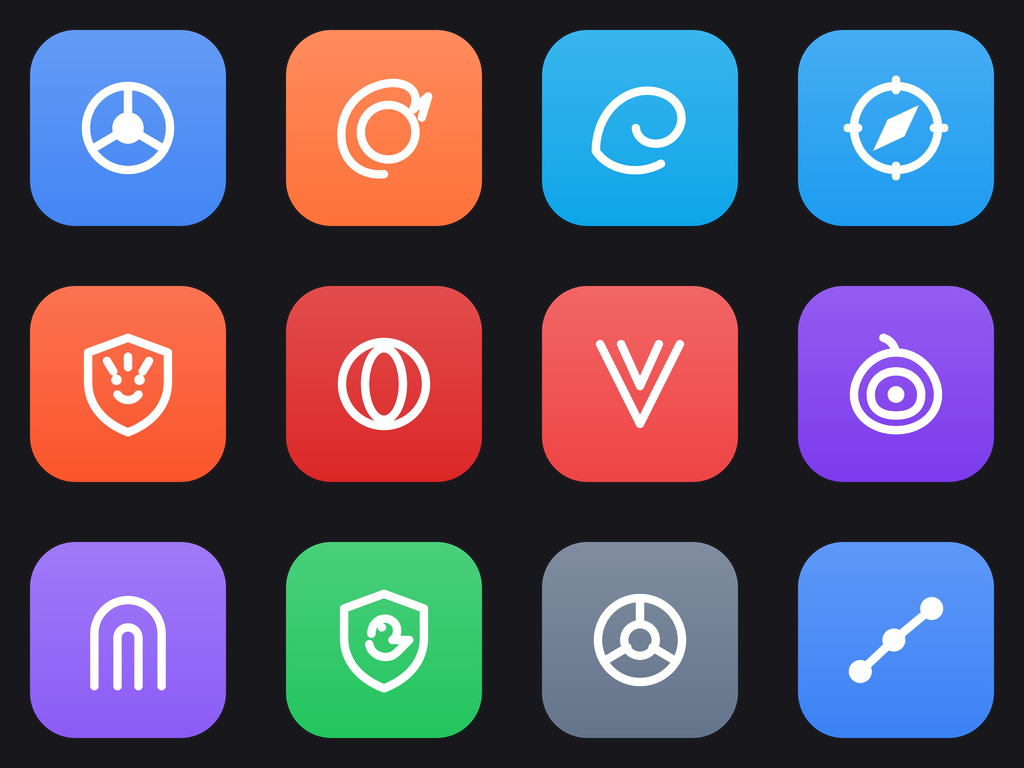
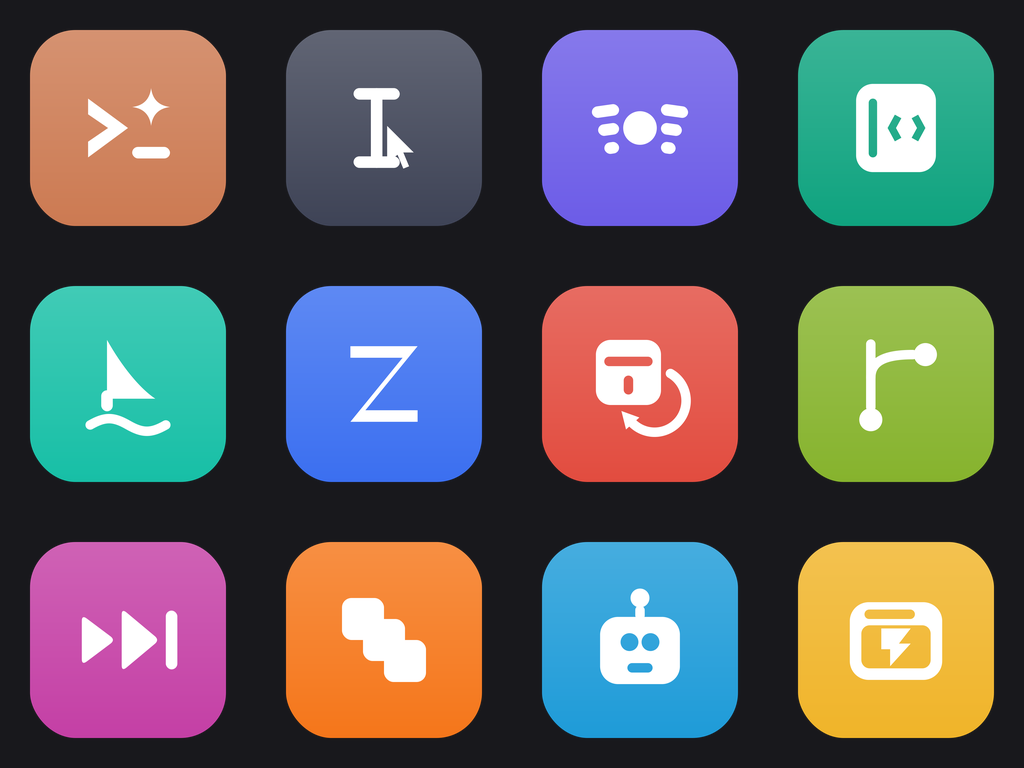
Twelve AI coding tools rendered as flat-vector squircle tiles, each with an original single-weight white symbol on a saturated brand-keyed ground. Built for Windows desktop shortcuts, launcher grids, docs and web UI, where the whole set has to read as one family at 32px and still hold up at 512px. Every mark is drawn fresh from the product's idea rather than copied from its logo.
Vibe Coders
Vibe Coders covers the tools people actually keep open while they write software with a model in the loop — the terminal agents, the AI-native editors, the autocomplete layers and the autonomous builders. Each member gets its own squircle tile in a colour that matches how you already think of it, and one white symbol built from the same geometric vocabulary as the other eleven: chevrons, bars, brackets, windows and wings, all at a single optical weight. Ship it as an icon grid, a shortcut pack, or a row of headers in a comparison article.
Format: SVG + ICO + PNG. Every icon ships as vector source in Icons/SVG/, a transparent 1024x1024 PNG in Icons/PNG/, and a multi-size Windows .ico (16-256 px) in Icons/ICO/.
Using them: drop an .ico onto a folder via Properties → Customize → Change Icon, or onto a shortcut via Properties → Shortcut → Change Icon. The SVGs are the source art for web, docs, and app UI — they stay sharp at any size; the PNGs are there for anything that can't take a vector.
Container: squircle-tile — a rounded-square (squircle) app tile with a large corner radius. Every icon in the pack shares it at the same scale.
Icons in this pack
- Claude Code: A terminal caret with a spark beside it — a command line that thinks.
 (.svg · .ico)
 - Cursor: The text insertion beam itself, the editor reduced to its blinking core.
 (.svg · .ico)
 - GitHub Copilot: A pilot's wing badge — the assistant flying alongside you.
 (.svg · .ico)
 - Codex: A closed codex with brackets on the cover — a book of code.
 (.svg · .ico)
 - Windsurf: A sail over water — riding the flow instead of steering it.
 (.svg · .ico)
 - Zed: A closed zigzag — the fast, sharp-cornered editor.
 (.svg · .ico)
 - Cline: A terminal window caught mid-loop — an agent that keeps running on its own.
 (.svg · .ico)
 - Aider: A branch splitting off a trunk — the pair programmer that commits with you.
 (.svg · .ico)
 - Continue: A fast-forward mark — autocomplete that keeps carrying the line.
 (.svg · .ico)
 - Replit Agent: Three stacked blocks descending — a workspace assembling itself in the browser.
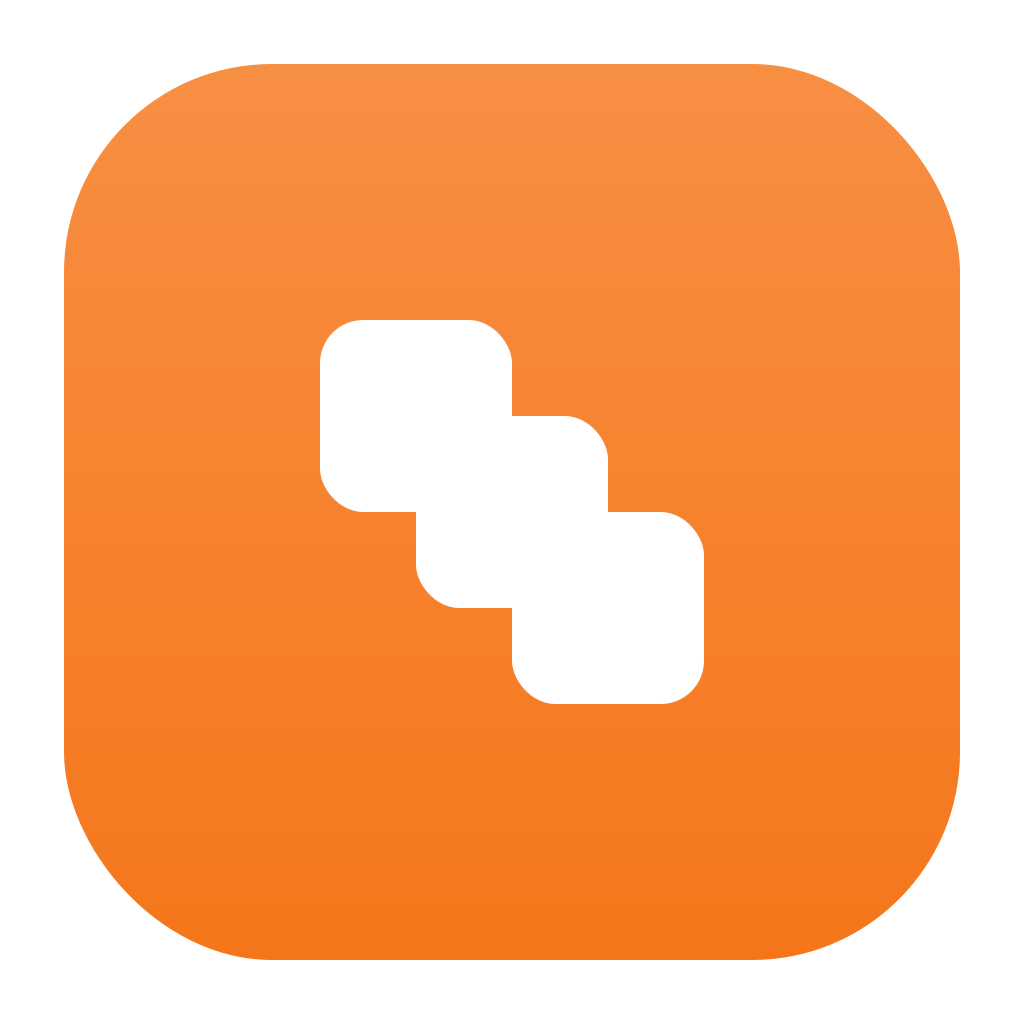 (.svg · .ico)
 - Devin: A small antenna-topped head — the autonomous engineer working unattended.
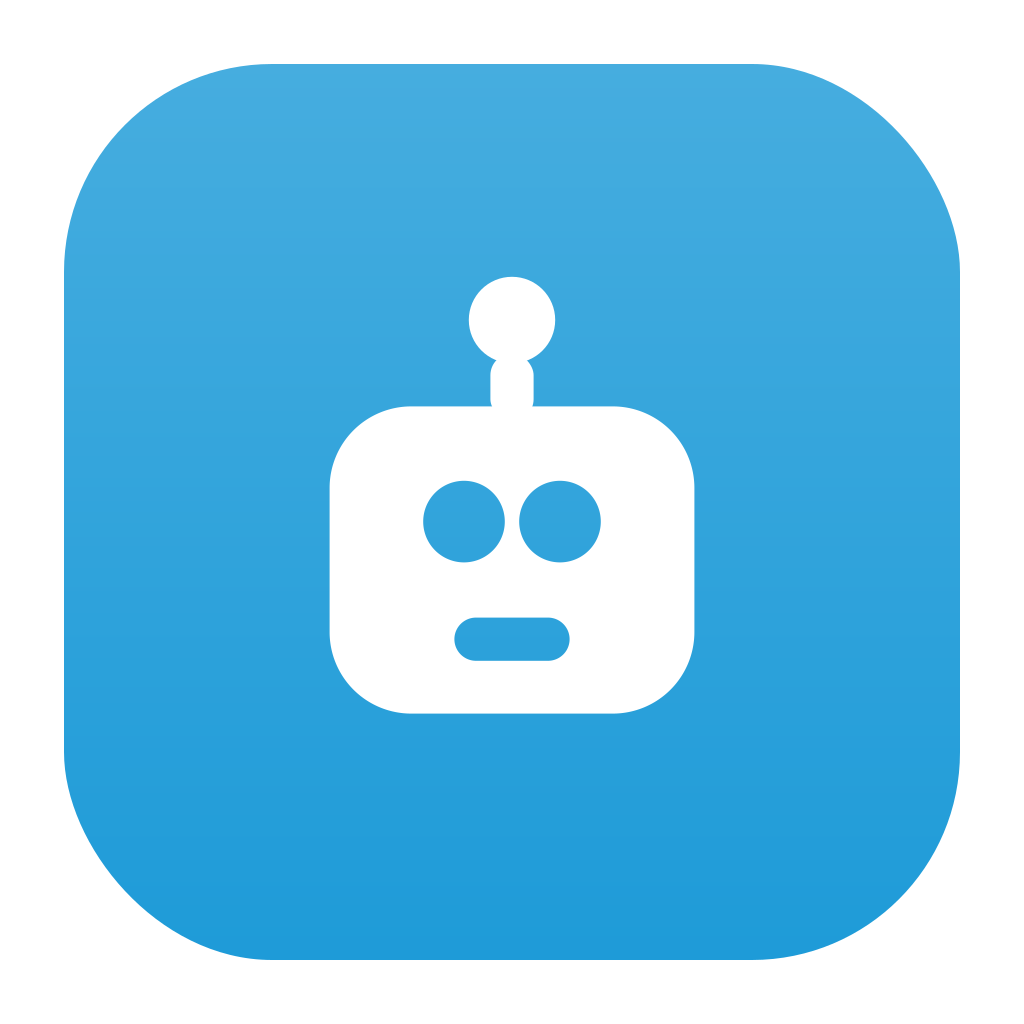 (.svg · .ico)
 - Bolt: A lightning strike inside a browser frame — a full app from one prompt.
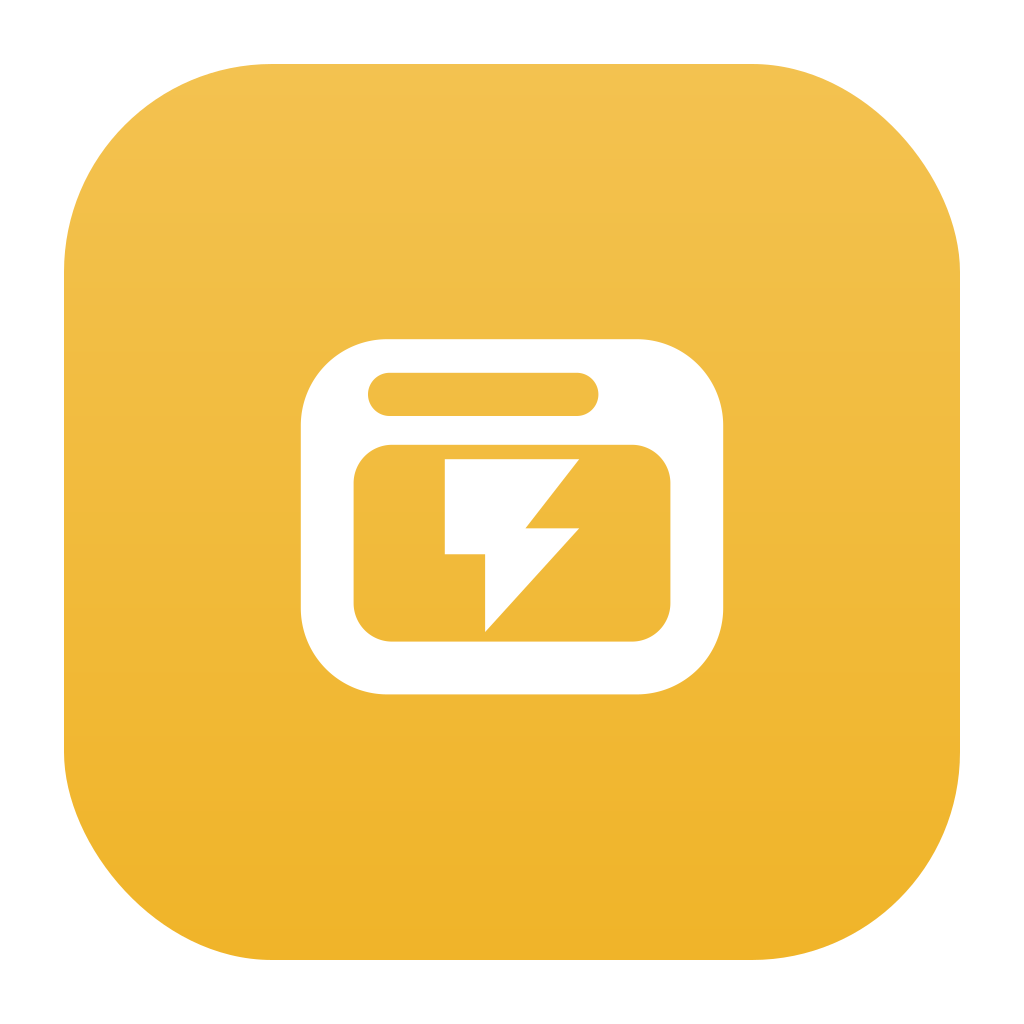 (.svg · .ico)








Prompt
Generation Prompts
- Concept model:
claude --print— claude-opus-4-8 - Glyph model:
claude --print— claude-opus-4-8 (SVG drawn directly, not an image model) - Format: SVG + ICO + PNG —
.svg(source) +.ico(Windows multi-size) +.png(1024x1024 RGBA) - Rasterizer: cairosvg, each
.icoentry rendered from the vector at its own size - Container: drawn by the generator, not the model — identical across the pack by construction
Pack Prompt
You are a senior icon designer producing a commercial icon pack for Windows desktop and web use — the kind sold on Iconfinder or posted on DeviantArt, not a stock-illustration set.
Design a cohesive pack of 12 icons on the theme: AI Coding Tools — Claude Code, Cursor, Copilot, Codex, Windsurf, Zed — squircle tiles.
This step is the concept only. You are not drawing anything yet — a second pass draws each symbol as SVG, and the container shape, the tile gradient, and the final document are generated by code. Your job is to decide what the pack is, who its twelve members are, and what colours it uses.
What a pack is
A pack is one category of similar, nameable things, drawn in one shared visual system. Think "Brave, Chrome, Edge, Firefox, Opera, Safari, Vivaldi" — or "Box, Dropbox, Google Drive, iCloud, Mega, OneDrive" — or "Photoshop, Illustrator, Figma, Canva, Affinity Designer". Twelve members of the same family, each instantly identifiable, all cut from the same cloth.
Name the real things. If the theme is browsers, name the actual browsers. If it is AI coding tools, name Claude Code, Cursor, Copilot, Codex. If it is cloud storage, name the real services. A pack of abstract inventions ("Chroma Bell", "Nebula Cloud", "Prism Home") is a failure — that is not what this is for.
But design an original mark for each. Do NOT reproduce a company's trademarked logo. Take the product's idea — what it does, its colour, its silhouette — and draw a fresh symbol for it in the pack's style. A Dropbox icon is a box or a stack of blue facets; a terminal tool is a prompt caret; a vector editor is a pen nib on a path. The set should feel recognizable at a glance without copying anyone's artwork.
If a theme genuinely has no real-world members (e.g. "Website Page Icons — Cart, Checkout, Orders"), then the 12 members are the concrete pages or functions themselves, still named plainly.
The shared visual system
Pick ONE container shape for the whole pack. The renderer draws it for you, identically on all twelve — you only choose which one fits the theme:
container |
Use it for |
|---|---|
squircle-tile |
app icons, browsers, mobile/desktop apps, AI tools |
folder-tab |
anything described as a folder pack — Windows folder icons |
circle-badge |
social, profile, status, round-dock sets |
rounded-square |
system/utility/taskbar icons, settings panels |
drive-block |
storage, backup, drives, sync services |
bare-glyph |
page/UI icons meant to sit inline in a web layout |
Colour
The pack is two-tone by design, and that is what makes it read as a set:
- Each icon gets its own
tile_color— the container behind it. This is where a member's identity lives: Firefox orange, Dropbox blue, Spotify green. Pick a saturated, distinguishable hex per icon; no two should be near-identical, and all twelve should look like one palette family rather than a random assortment. - The whole pack shares ONE
glyph_color— the symbol drawn on top of every tile. Almost always#FFFFFF; use a very dark neutral (e.g.#1A1A22) only if the pack's tiles are all pale. - For a
bare-glyphpack there is no tile, sotile_colorbecomes the symbol's own colour andglyph_coloris ignored.
Every colour must be a plain 6-digit hex string like #3B82F6.
Describing each symbol
Each icon's glyph_brief is an instruction to whoever draws it, in flat geometric terms — what shapes, in what arrangement. "A rounded upward chevron over a horizontal baseline bar" is useful; "a beautiful modern representation of growth" is not. Keep every brief phrased the same way and at the same level of detail, so the twelve come out at one optical weight.
Two hard constraints on what you may ask for, because the drawing pass is validated against them:
- No lettering. The renderer has no fonts. If a member is best known by a letter, describe the letterform as geometry ("two vertical bars joined by a crossbar") or pick a non-letter symbol instead.
- One colour per symbol. The symbol is drawn in the pack's single
glyph_color, with transparency as the only available second shade. Do not ask for a multi-colour symbol.
Return a JSON object
"title"— a catchy name for the pack."slug"— a kebab-case slug."description"— 2-3 sentences on the pack's style and what it is for."introduction"— a short intro paragraph for the pack's documentation."metadata":"style"— the visual style in a few words (e.g. "Flat vector, solid fills, single-weight symbols")."container"— exactly one of:squircle-tile,folder-tab,circle-badge,rounded-square,drive-block,bare-glyph."glyph_color"— the one hex colour every symbol is drawn in."palette"— the tile colour family in a phrase (e.g. "saturated brand hues, one per member")."keywords"— a list of 5 keywords.
"icons"— a list of 12 objects, each with:"name"— the thing itself, named plainly ("Firefox", "Google Drive", "Checkout")."concept"— one line on what the symbol shows and why it reads as that thing."glyph_brief"— the flat geometric description of this one symbol, per the section above."tile_color"— this icon's container hex.
"caption"— a short notification caption (e.g. "12 flat-vector browser icons in SVG, ICO and PNG.").
Return the JSON object and nothing else.
Drawing Contract (the glyph call)
You are drawing the SYMBOLS for a cohesive icon pack as SVG.

Pack: Vibe Coders
Theme: AI Coding Tools — Claude Code, Cursor, Copilot, Codex, Windsurf, Zed — squircle tiles
Style: Flat vector, solid fills, single-weight geometric symbols, no outlines
Container: every icon is placed by our renderer inside a rounded-square (squircle) app tile with a large corner radius. YOU DO NOT DRAW THE CONTAINER, the tile, the background, or any border — those already exist. Draw only the symbol that sits inside.

## Rules — these are enforced by a validator, not by review

1. Draw each symbol in a plain square coordinate box from 0,0 to 100,100. Use the whole box; our renderer scales and centers it into the container for you.
2. Output BARE SVG shape elements only: `<path>`, `<circle>`, `<rect>`, `<ellipse>`, `<polygon>`, `<polyline>`, `<line>`, `<g>`. No `<svg>` wrapper, no XML declaration, no comments, no markdown fences.
3. **No `<text>` or `<tspan>`, ever.** The rasterizer has no fonts — a text element renders as nothing. If an icon needs a letterform, draw the letter as filled `<path>`/`<rect>` geometry.
4. No `<image>`, `<script>`, `<style>`, `<foreignObject>`, and no `href`/`src` pointing anywhere external. Nothing may be fetched at render time.
5. Colour: the symbol's default fill is already set to `#FFFFFF` by the renderer, so plain shapes need no fill attribute. You MAY set `fill="#FFFFFF"` explicitly, or use `fill-opacity` between 0.35 and 0.75 for a secondary shade. Do not introduce any other colour — one symbol colour plus its own transparency is what makes the pack read as a set.
6. Prefer solid filled shapes over strokes. If you do stroke, use `stroke="#FFFFFF"` with `stroke-width` between 6 and 9, plus `stroke-linecap="round"` and `stroke-linejoin="round"` — and use the SAME stroke width on every icon in the pack.
7. One optical weight across all twelve. Same visual density, same corner treatment, same level of detail. This is the single most important property of the set.

## Output format

For each icon, one delimiter line then its markup, nothing else:

=== ICON: <slug> ===
<path d="..."/>

Emit all 12 icons, in the order listed, using exactly the slugs given.

## The icons

- `claude-code` — **Claude Code**: A bold right-pointing chevron made of two thick tapered strokes meeting at a point, centred left; a small four-pointed star with concave sides sits at its upper right, and a short horizontal bar sits at its lower right.
- `cursor` — **Cursor**: A tall solid vertical bar with short horizontal caps at its top and bottom, centred; a small solid arrow-pointer triangle with a squared tail overlaps its lower right corner.
- `github-copilot` — **GitHub Copilot**: A solid circle at centre, flanked by two mirrored wings, each built from three tapered horizontal bars stacked with a slight downward rake and decreasing in length outward.
- `codex` — **Codex**: A solid rounded rectangle in portrait orientation with a narrow knocked-out vertical spine bar near its left edge; a knocked-out less-than and greater-than bracket pair sits centred on the larger panel.
- `windsurf` — **Windsurf**: A solid curved triangular sail with a concave trailing edge, rising from a short vertical mast bar; below it, one horizontal wave bar with rounded ends and a shallow S-curve.
- `zed` — **Zed**: Two thick horizontal bars of equal length, one at the top and one at the bottom, joined by a thick diagonal bar running from the right end of the top bar to the left end of the bottom bar, forming one continuous closed zigzag.
- `cline` — **Cline**: A solid rounded square with a knocked-out horizontal bar across its top edge and a knocked-out short vertical caret slot at its centre; a circular arrow loop with an open gap and a triangular arrowhead wraps its lower right corner.
- `aider` — **Aider**: A vertical bar with rounded ends running top to bottom, with a solid circle at its lower end; a curved stroke diverges from its midpoint to the upper right and terminates in a second solid circle of equal size.
- `continue` — **Continue**: Two solid right-pointing triangles with slightly rounded corners set side by side, the right one marginally larger, followed by a short vertical bar with rounded ends at the far right.
- `replit-agent` — **Replit Agent**: Three solid rounded squares of equal size arranged in a descending diagonal staircase from upper left to lower right, each offset from the previous by half a square width and half a square height.
- `devin` — **Devin**: A solid rounded square with two knocked-out circles set side by side in its upper half and a knocked-out short horizontal bar with rounded ends in its lower half; a thin vertical stem topped by a small solid circle rises from its top edge.
- `bolt` — **Bolt**: A rounded rectangle frame in landscape orientation with a knocked-out horizontal bar across its top; centred inside it, a solid four-segment zigzag lightning bolt with angled ends, wider at the top and tapering to a point at the bottom.
More from Icon Packs