Driveblock — Cloud Storage Icons
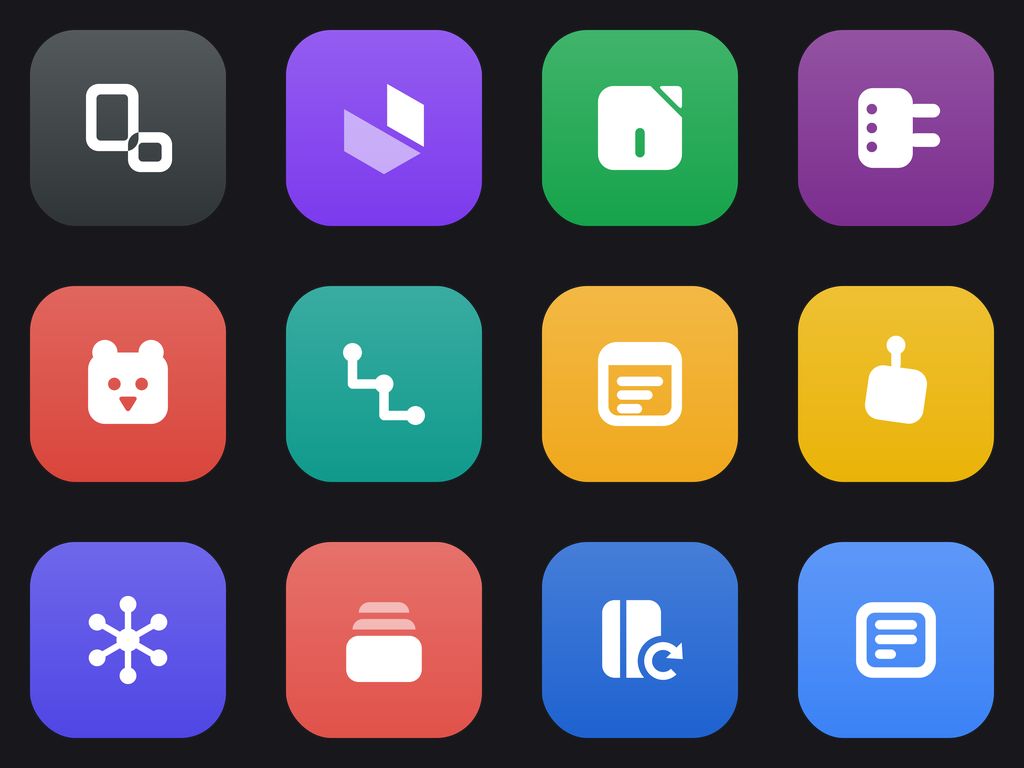
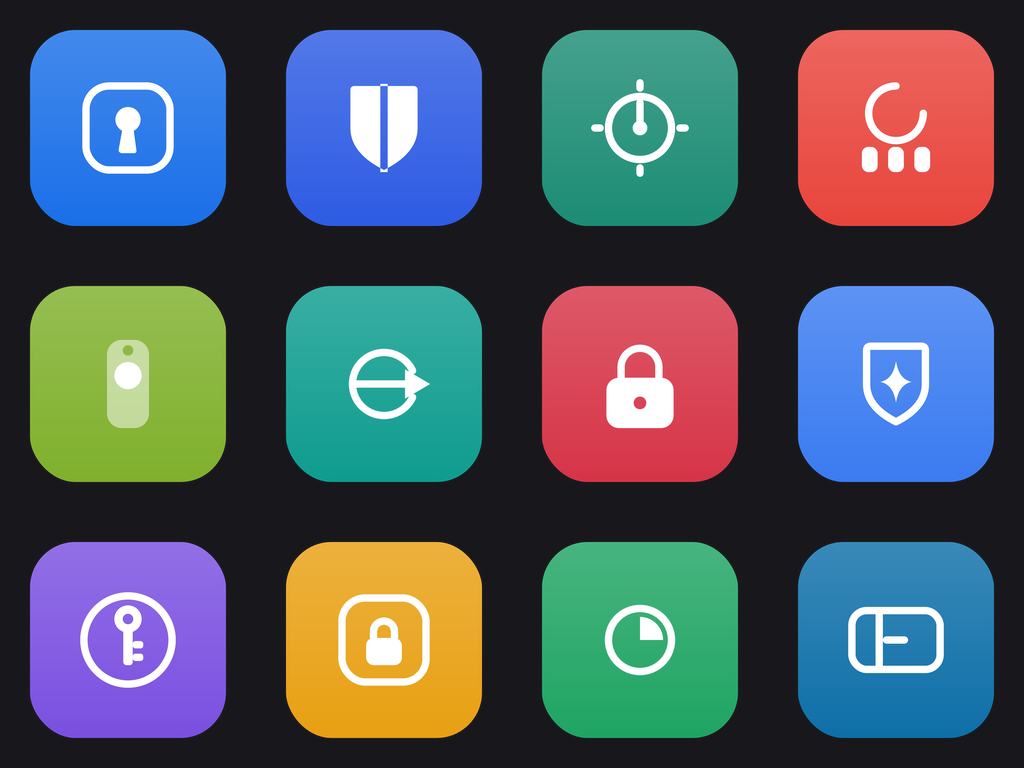
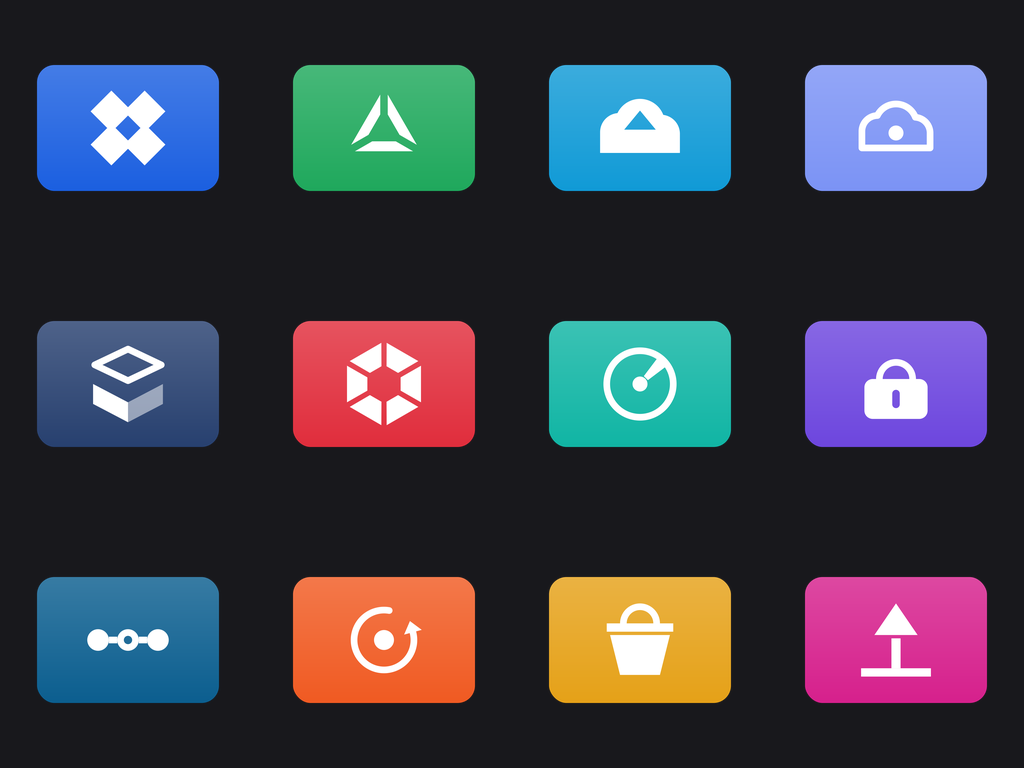
Twelve flat-vector icons for the cloud storage services people actually sync to, each sitting on a solid drive-block tile in its own saturated hue. Every symbol is an original single-weight mark — no borrowed logo artwork — cut at one optical weight so the set reads as a family from 256px down to 16px. Built for Windows desktop shortcuts, sync-client trays, dashboards and web UI.
Driveblock — Cloud Storage Icons
Cloud storage all looks the same in a file manager: a folder, a folder, another folder. Driveblock gives each service its own block — a solid drive-shaped tile in a distinct saturated colour, carrying one white geometric symbol drawn fresh for this pack. Dropbox gets a cluster of four diamonds, Box an isometric open cube, Amazon S3 a literal bucket, Proton Drive a padlock. Twelve services, one shared geometry, one white glyph colour throughout, so a row of them reads as a single system rather than a scrapbook of brand marks.
Format: SVG + ICO + PNG. Every icon ships as vector source in Icons/SVG/, a transparent 1024x1024 PNG in Icons/PNG/, and a multi-size Windows .ico (16-256 px) in Icons/ICO/.
Using them: drop an .ico onto a folder via Properties → Customize → Change Icon, or onto a shortcut via Properties → Shortcut → Change Icon. The SVGs are the source art for web, docs, and app UI — they stay sharp at any size; the PNGs are there for anything that can't take a vector.
Container: drive-block — a front-facing hard-drive / device block with a consistent silhouette. Every icon in the pack shares it at the same scale.
Icons in this pack
- Dropbox: Four faceted diamonds folded around a hollow centre — the stacked-box silhouette the service is known for, rebuilt from scratch.
 (.svg · .ico)
 - Google Drive: A three-bar triangle, echoing the folded triangular form of the service without reproducing its colour bands.
 (.svg · .ico)
 - OneDrive: A flat-bottomed cloud with an upload arrow cut out of it — the office sync client in one shape.
 (.svg · .ico)
 - iCloud: An outlined cloud holding a single solid dot — the light, device-bound personal cloud.
 (.svg · .ico)
 - Box: An open isometric cube — the container metaphor the product is named after.
 (.svg · .ico)
 - MEGA: A radial burst of six wedges around a hollow core, reading as scale and encrypted volume.
 (.svg · .ico)
 - pCloud: A hard-drive platter and arm — the permanent, physical-feeling storage the service sells.
 (.svg · .ico)
 - Proton Drive: A closed padlock — encryption first, storage second.
 (.svg · .ico)
 - Nextcloud: Three linked nodes — self-hosted storage running across your own machines.
 (.svg · .ico)
 - Backblaze: A looping restore arrow — continuous backup and rollback.
 (.svg · .ico)
 - Amazon S3: A storage bucket, taken straight from the service's own unit of storage.
 (.svg · .ico)
 - Jottacloud: An arrow lifting off a baseline — unlimited upload as the headline feature.
 (.svg · .ico)










Prompt
Generation Prompts
- Concept model:
claude --print— claude-opus-4-8 - Glyph model:
claude --print— claude-opus-4-8 (SVG drawn directly, not an image model) - Format: SVG + ICO + PNG —
.svg(source) +.ico(Windows multi-size) +.png(1024x1024 RGBA) - Rasterizer: cairosvg, each
.icoentry rendered from the vector at its own size - Container: drawn by the generator, not the model — identical across the pack by construction
Pack Prompt
You are a senior icon designer producing a commercial icon pack for Windows desktop and web use — the kind sold on Iconfinder or posted on DeviantArt, not a stock-illustration set.
Design a cohesive pack of 12 icons on the theme: Cloud Storage Services — Dropbox, Drive, OneDrive, iCloud, Box, Mega — drive blocks.
This step is the concept only. You are not drawing anything yet — a second pass draws each symbol as SVG, and the container shape, the tile gradient, and the final document are generated by code. Your job is to decide what the pack is, who its twelve members are, and what colours it uses.
What a pack is
A pack is one category of similar, nameable things, drawn in one shared visual system. Think "Brave, Chrome, Edge, Firefox, Opera, Safari, Vivaldi" — or "Box, Dropbox, Google Drive, iCloud, Mega, OneDrive" — or "Photoshop, Illustrator, Figma, Canva, Affinity Designer". Twelve members of the same family, each instantly identifiable, all cut from the same cloth.
Name the real things. If the theme is browsers, name the actual browsers. If it is AI coding tools, name Claude Code, Cursor, Copilot, Codex. If it is cloud storage, name the real services. A pack of abstract inventions ("Chroma Bell", "Nebula Cloud", "Prism Home") is a failure — that is not what this is for.
But design an original mark for each. Do NOT reproduce a company's trademarked logo. Take the product's idea — what it does, its colour, its silhouette — and draw a fresh symbol for it in the pack's style. A Dropbox icon is a box or a stack of blue facets; a terminal tool is a prompt caret; a vector editor is a pen nib on a path. The set should feel recognizable at a glance without copying anyone's artwork.
If a theme genuinely has no real-world members (e.g. "Website Page Icons — Cart, Checkout, Orders"), then the 12 members are the concrete pages or functions themselves, still named plainly.
The shared visual system
Pick ONE container shape for the whole pack. The renderer draws it for you, identically on all twelve — you only choose which one fits the theme:
container |
Use it for |
|---|---|
squircle-tile |
app icons, browsers, mobile/desktop apps, AI tools |
folder-tab |
anything described as a folder pack — Windows folder icons |
circle-badge |
social, profile, status, round-dock sets |
rounded-square |
system/utility/taskbar icons, settings panels |
drive-block |
storage, backup, drives, sync services |
bare-glyph |
page/UI icons meant to sit inline in a web layout |
Colour
The pack is two-tone by design, and that is what makes it read as a set:
- Each icon gets its own
tile_color— the container behind it. This is where a member's identity lives: Firefox orange, Dropbox blue, Spotify green. Pick a saturated, distinguishable hex per icon; no two should be near-identical, and all twelve should look like one palette family rather than a random assortment. - The whole pack shares ONE
glyph_color— the symbol drawn on top of every tile. Almost always#FFFFFF; use a very dark neutral (e.g.#1A1A22) only if the pack's tiles are all pale. - For a
bare-glyphpack there is no tile, sotile_colorbecomes the symbol's own colour andglyph_coloris ignored.
Every colour must be a plain 6-digit hex string like #3B82F6.
Describing each symbol
Each icon's glyph_brief is an instruction to whoever draws it, in flat geometric terms — what shapes, in what arrangement. "A rounded upward chevron over a horizontal baseline bar" is useful; "a beautiful modern representation of growth" is not. Keep every brief phrased the same way and at the same level of detail, so the twelve come out at one optical weight.
Two hard constraints on what you may ask for, because the drawing pass is validated against them:
- No lettering. The renderer has no fonts. If a member is best known by a letter, describe the letterform as geometry ("two vertical bars joined by a crossbar") or pick a non-letter symbol instead.
- One colour per symbol. The symbol is drawn in the pack's single
glyph_color, with transparency as the only available second shade. Do not ask for a multi-colour symbol.
Return a JSON object
"title"— a catchy name for the pack."slug"— a kebab-case slug."description"— 2-3 sentences on the pack's style and what it is for."introduction"— a short intro paragraph for the pack's documentation."metadata":"style"— the visual style in a few words (e.g. "Flat vector, solid fills, single-weight symbols")."container"— exactly one of:squircle-tile,folder-tab,circle-badge,rounded-square,drive-block,bare-glyph."glyph_color"— the one hex colour every symbol is drawn in."palette"— the tile colour family in a phrase (e.g. "saturated brand hues, one per member")."keywords"— a list of 5 keywords.
"icons"— a list of 12 objects, each with:"name"— the thing itself, named plainly ("Firefox", "Google Drive", "Checkout")."concept"— one line on what the symbol shows and why it reads as that thing."glyph_brief"— the flat geometric description of this one symbol, per the section above."tile_color"— this icon's container hex.
"caption"— a short notification caption (e.g. "12 flat-vector browser icons in SVG, ICO and PNG.").
Return the JSON object and nothing else.
Drawing Contract (the glyph call)
You are drawing the SYMBOLS for a cohesive icon pack as SVG.

Pack: Driveblock — Cloud Storage Icons
Theme: Cloud Storage Services — Dropbox, Drive, OneDrive, iCloud, Box, Mega — drive blocks
Style: Flat vector, solid fills, single-weight geometric symbols
Container: every icon is placed by our renderer inside a front-facing hard-drive / device block with a consistent silhouette. YOU DO NOT DRAW THE CONTAINER, the tile, the background, or any border — those already exist. Draw only the symbol that sits inside.

## Rules — these are enforced by a validator, not by review

1. Draw each symbol in a plain square coordinate box from 0,0 to 100,100. Use the whole box; our renderer scales and centers it into the container for you.
2. Output BARE SVG shape elements only: `<path>`, `<circle>`, `<rect>`, `<ellipse>`, `<polygon>`, `<polyline>`, `<line>`, `<g>`. No `<svg>` wrapper, no XML declaration, no comments, no markdown fences.
3. **No `<text>` or `<tspan>`, ever.** The rasterizer has no fonts — a text element renders as nothing. If an icon needs a letterform, draw the letter as filled `<path>`/`<rect>` geometry.
4. No `<image>`, `<script>`, `<style>`, `<foreignObject>`, and no `href`/`src` pointing anywhere external. Nothing may be fetched at render time.
5. Colour: the symbol's default fill is already set to `#FFFFFF` by the renderer, so plain shapes need no fill attribute. You MAY set `fill="#FFFFFF"` explicitly, or use `fill-opacity` between 0.35 and 0.75 for a secondary shade. Do not introduce any other colour — one symbol colour plus its own transparency is what makes the pack read as a set.
6. Prefer solid filled shapes over strokes. If you do stroke, use `stroke="#FFFFFF"` with `stroke-width` between 6 and 9, plus `stroke-linecap="round"` and `stroke-linejoin="round"` — and use the SAME stroke width on every icon in the pack.
7. One optical weight across all twelve. Same visual density, same corner treatment, same level of detail. This is the single most important property of the set.

## Output format

For each icon, one delimiter line then its markup, nothing else:

=== ICON: <slug> ===
<path d="..."/>

Emit all 12 icons, in the order listed, using exactly the slugs given.

## The icons

- `dropbox` — **Dropbox**: Four identical diamonds arranged two above and two below, their inner corners meeting around a small square gap at the exact centre.
- `google-drive` — **Google Drive**: An equilateral triangle built from three equal-width straight bars, each bar cut short so a small notch of empty space sits at every corner.
- `onedrive` — **OneDrive**: A wide cloud silhouette formed from three overlapping circles resting on a horizontal bar, with a triangular arrowhead pointing up knocked out of its centre.
- `icloud` — **iCloud**: A rounded cloud silhouette drawn as a single-weight open outline, with one small solid disc centred inside the hollow.
- `box` — **Box**: An open-topped cube in isometric projection: a rhombus lid outline above two parallelogram side faces, the right face at reduced opacity.
- `mega` — **MEGA**: Six identical trapezoid segments arranged evenly in a ring, their narrow ends facing a hollow hexagonal gap at the centre.
- `pcloud` — **pCloud**: A large ring with a small solid disc at its centre, crossed by a tapered bar running from the upper-right edge inward to that disc.
- `proton-drive` — **Proton Drive**: A rounded-rectangle padlock body with a semicircular shackle arc rising from its top edge, and a short vertical slot centred in the body.
- `nextcloud` — **Nextcloud**: Three equal circles in a horizontal row joined by two short connecting bars, the outer two solid and the centre one hollow.
- `backblaze` — **Backblaze**: A thick ring broken at the upper right and ending in a triangular arrowhead, with a solid disc centred inside the ring.
- `amazon-s3` — **Amazon S3**: A downward-tapering trapezoid with a narrow horizontal band across its top edge and a thin semicircular handle arc above it.
- `jottacloud` — **Jottacloud**: A triangular arrowhead pointing up above a narrow vertical bar, both rising from a wide horizontal baseline bar.
More from Icon Packs