Falafel
Falafel began in Egypt, where the fava-bean version is called ta'ameya, and spread across the eastern Mediterranean.
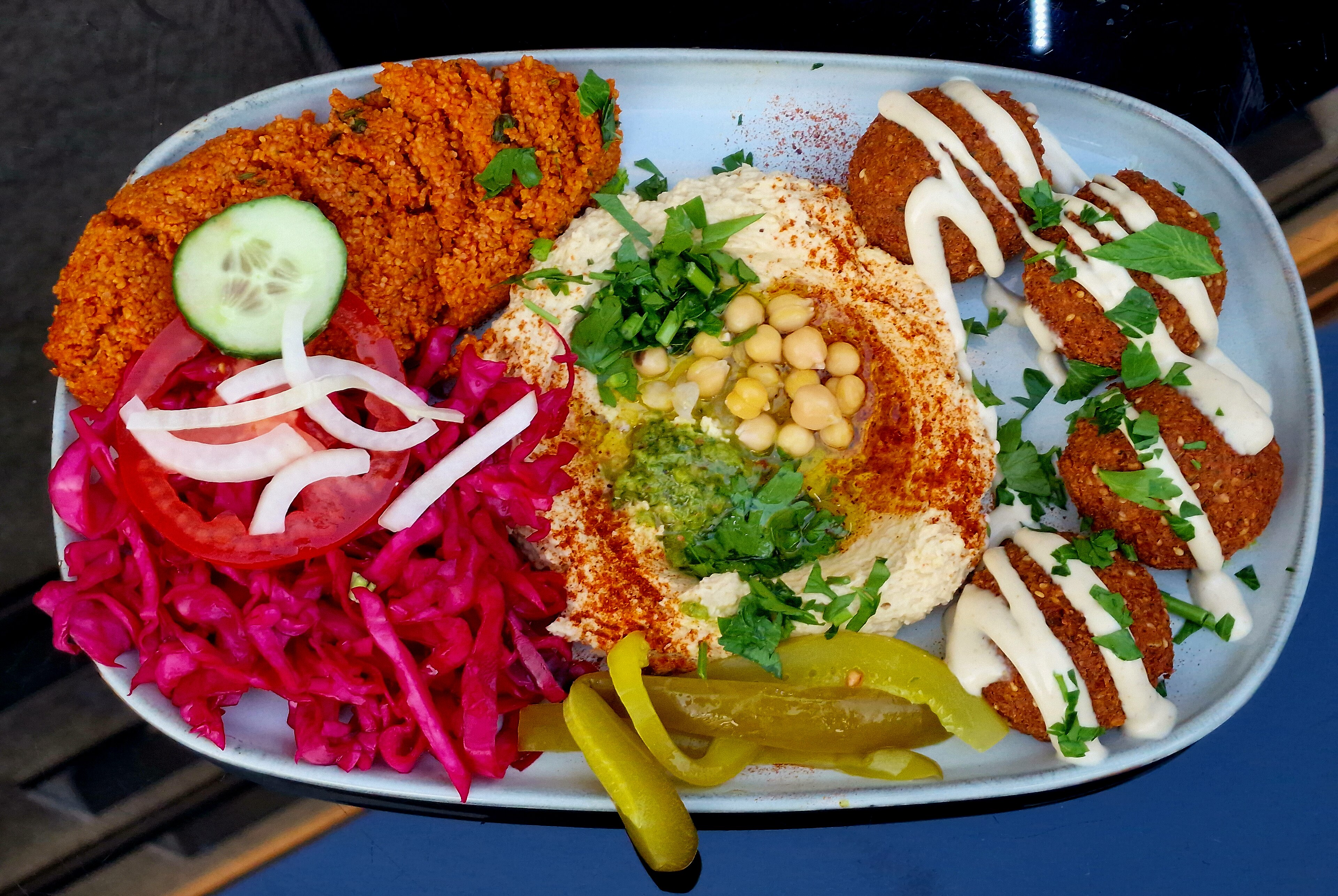
Falafel
Alt text: A finished falafel platter with crisp brown falafel, hummus, tahini sauce, pickled vegetables, cucumber, herbs, and a pepper.
Cultural Context
Falafel began in Egypt, where the fava-bean version is called ta'ameya, and spread across the eastern Mediterranean. Chickpea falafel is now everyday street food in the Levant, usually tucked into pita with tahini, pickles, tomato, and cucumber. Good falafel has a craggy brown shell and a moist, green, herb-packed center.
Ingredients
Falafel
- 250 g (8¾ oz / 1¼ cups) dried chickpeas, rinsed
- Cold water, for soaking
- 80 g (3 oz / ½ medium) yellow onion, roughly chopped
- 2 garlic cloves, roughly chopped
- 30 g (1 packed cup) flat-leaf parsley leaves and tender stems
- 20 g (¾ packed cup) cilantro leaves and tender stems
- 1 tsp ground cumin
- 1 tsp ground coriander
- ¼ tsp ground cayenne pepper
- ¾ tsp fine sea salt
- ½ tsp baking powder
- 15 g (2 tbsp) all-purpose flour
- 45 ml (3 tbsp) cold water
- 2 tsp sesame seeds
- 750 ml (25 fl oz / 3 cups) sunflower or other neutral high-heat oil, for frying
Tahini Sauce and Serving
- 120 g (4¼ oz / ½ cup) tahini
- 60 ml (2 fl oz / ¼ cup) fresh lemon juice
- 1 small garlic clove, finely grated
- ¼ tsp fine sea salt
- 90-120 ml (3-4 fl oz / ⅜-½ cup) ice water
- 4 pita breads, warmed
- 150 g (5 oz / 1 cup) diced tomato
- 130 g (4½ oz / 1 cup) diced cucumber
- 120 g (4¼ oz / ½ cup) drained pickled turnips or cucumber pickles
Substitutions:
- Sunflower oil → canola, grapeseed, or another neutral oil with a high smoke point
- All-purpose flour → chickpea flour for a gluten-free falafel; serve with gluten-free flatbread
- Cilantro → an equal amount of parsley for diners who dislike cilantro
Equipment
- Large bowl
- Food processor
- Deep, heavy-based saucepan or Dutch oven
- Deep-fry thermometer
- Slotted spoon or spider
- Wire rack set over a sheet pan
Instructions
Preparation (Active time: 30 min)
Soak the chickpeas: Put the dried chickpeas in a large bowl and cover with at least 8 cm (3 inches) of cold water. Soak at room temperature for 12 hours; they should more than double in size but remain uncooked. Drain thoroughly, spread on a clean towel, and pat dry.
Grind the mixture: Add the drained chickpeas, onion, garlic, parsley, and cilantro to a food processor. Pulse in 1-second bursts, scraping the bowl as needed, until the mixture resembles coarse couscous and holds together when squeezed. Do not puree it into hummus.
Season and chill: Add the cumin, coriander, cayenne, salt, baking powder, flour, and 45 ml (3 tbsp) cold water. Pulse just until evenly mixed. Transfer to a bowl, cover, and refrigerate for 1 hour so the mixture hydrates and firms.
Make the tahini sauce: Whisk the tahini, lemon juice, garlic, and salt in a bowl. The mixture will tighten at first. Whisk in 90 ml (⅜ cup) ice water a little at a time, adding up to 30 ml (2 tbsp) more as needed, until the sauce is smooth and pours in a thick ribbon. Refrigerate until serving.
Cooking (Active time: 10 min)
Heat the oil: Pour the oil into a deep, heavy saucepan; it should reach about 7 cm (2¾ inches) up the side while leaving plenty of headroom. Attach a thermometer and heat over medium to 350°F (177°C). Keep the pot handle turned inward and have a lid nearby. Never leave hot oil unattended or add wet food to it.
Shape and test: Form one firmly packed 25 g (1½ tbsp) portion into a small ball or thick patty, then press a few sesame seeds onto the surface. Fry this tester for 4 minutes. It should hold together, turn deep golden brown, and be dry and cooked through at the center. If it breaks, mix 1 additional tbsp flour into the remaining mixture; if it browns too quickly, lower the oil temperature.
Fry in batches: Shape and seed the remaining mixture. Fry 5 falafel at a time for 4 minutes, turning once, and adjust the heat to keep the oil between 340°F and 350°F (171-177°C). Transfer each batch to the wire rack. Let the oil return to 350°F (177°C) before adding the next batch.
Assembly & Finishing
Prepare the table: Warm the pita and set out the tahini sauce, tomato, cucumber, and pickles while the last batch fries.
Fill and serve: Split each pita and fill with 5 hot falafel. Add tomato, cucumber, and pickles, then spoon over the tahini sauce. Serve immediately while the crust is crisp.
Food Safety & Storage
- Hot-oil safety: Keep water away from the fryer, never fill the pot more than halfway, and never use water on an oil fire. Turn off the heat and cover the pot with its lid if the oil smokes or ignites.
- Storage: Refrigerate cooked falafel and tahini sauce in separate airtight containers within 2 hours. Keep falafel for up to 4 days and tahini sauce for up to 5 days.
- Freezing: Freeze shaped, uncooked falafel on a tray, then transfer to an airtight container for up to 1 month. Fry from frozen at 340°F (171°C), adding 1-2 minutes and checking that the center is fully cooked.
- Reheating: Reheat cooked falafel on a rack in a 375°F (191°C) oven for 8-10 minutes, until the center reaches 165°F (74°C).
Serving Suggestions
- Serve in pita with tahini, chopped tomato and cucumber, and sharp pickles
- Add hummus, shredded cabbage, or amba for a larger mezze-style plate
- Traditional serving style: Eat the falafel hot from the fryer, either loose on a platter or packed into bread
Scaling Notes
Half recipe (½×): Use a small food processor and a narrower saucepan so the oil remains deep enough. The soaking and chilling times do not change.
Double recipe (2×): Process the mixture in two batches and fry in the same 5-piece batches. Do not double the oil in one pot; extra crowding causes dangerous bubbling and greasy falafel.
Chef's Notes
- Sourcing: Use dried chickpeas, not canned or cooked chickpeas. Their raw starch gives falafel its light, cohesive interior; cooked chickpeas make a soft mixture that tends to break in the oil.
- Make-ahead: Soak the chickpeas the night before. The ground mixture can be refrigerated for up to 24 hours, or shaped and frozen before frying.
- Variations: Egyptian ta'ameya uses split fava beans and often has an even greener interior. Across the Levant, the herb and spice balance changes by shop and household.
- Common pitfalls: Dry the soaked chickpeas well, keep the mixture coarse, pack each ball firmly, and control the oil temperature. Cool oil makes greasy falafel; overheated oil burns the crust before the middle cooks.
Nutrition Information (Optional)
Per serving, including pita, tahini sauce, vegetables, and an estimated 1 tbsp absorbed frying oil: approximately 780 kcal
- Protein: 24g | Fat: 38g | Carbohydrates: 89g | Fiber: 17g
Sources
- Recipe basis: Ottolenghi - Falafel
- Technique and serving comparison: The Mediterranean Dish - Authentic Falafel
- Technique comparison: Serious Eats - Homemade Falafel
- Image source: Wikimedia Commons - Falafel Plate at The Hummusapiens

Version History:
- v1 (2026-07-25): Initial recipe by @Codex
Credits:
- Recipe development: @Codex, synthesized from the sources above
- Testing: @Codex
- Verification: @Coordinator
- Photography: Anagoria, "Falafel Plate," 2024, CC BY-SA 4.0
- Food safety guidance: USDA storage and reheating standards; National Fire Protection Association kitchen-fire guidance
Recipe Location: /Recipes/mediterranean/mediterranean_falafel_v1.md
Images Location: /Images/falafel/
More from Recipes