Redline
Design brief
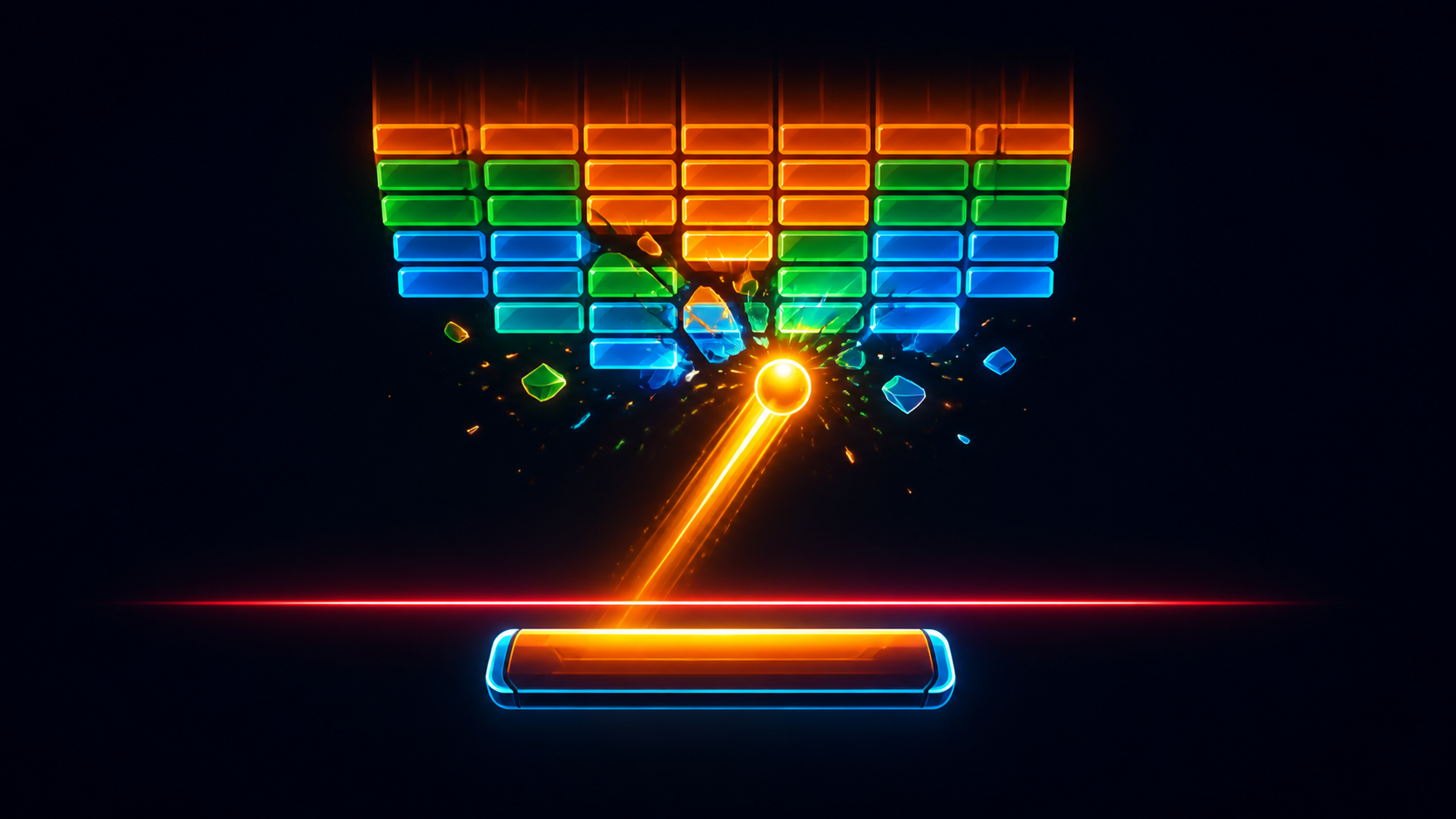
A brick-breaker where the ball has a temperature, and only a catch on the paddle's red edges keeps it hot enough to break anything.
Date: 2026-11-04 Genre: brick-breaker Status: Playable build
Concept
Redline takes the thing every brick-breaker player does by instinct, catching the ball dead center because it's safe, and makes it the wrong move. The ball cools over time and cools faster on the middle of the paddle, and a cold ball bounces off bricks like a marble. To break anything you have to catch it out on the red tips, which is exactly where you were about to miss. The whole game lives in that flinch.
How to play
Clear every brick on the field. The paddle follows the mouse or a dragged finger, or moves with the arrow keys and A/D. Click, tap or press Space to launch. The heat meter across the top tells you what the ball can break right now: cold bounces off everything, warm breaks the plain teal bricks, hot also breaks the steel ones with the double outline, white-hot breaks the riveted armored ones too. You lose a ball when it drops past the paddle, and the run ends when the third one goes. R restarts, P pauses, M mutes. The game over screen has a restart button for phones.
Core mechanics
- A paddle catch changes the ball's heat by where it lands. The middle 30% cools it by up to 0.35, the outer 70% heats it, and the very tip adds 1.4 on a 3-point scale, enough to jump two tiers in one catch.
- Heat drains on its own, 0.10 per second on level 1, and every brick broken costs another 0.12. A single tip catch is good for roughly a dozen bricks before the ball drops back to cold.
- Hotter is faster. Ball speed rises 10% per heat point, so a white-hot ball moves about 30% faster than a cold one, which means the ball you want most is also the one that's hardest to keep.
- Ice bricks (pale blue, translucent) break on any warm hit but pull 0.7 heat out of the ball. Reading which bricks to avoid is part of lining up a shot.
- A catch on the last fifth of either tip pays an edge bonus that grows with each consecutive tip catch. One center catch resets the streak.
Progression & scoring
Pressure arrives one kind at a time, with a plateau after each step. Level 1 is four rows of soft bricks at base speed, 330 px/s on the 540 by 800 field, and exists to teach the catch. Level 2 puts steel bricks in the top two rows, so warm is no longer enough. Level 3 scatters ice. Level 4 is the first speed step, 10% over base, plus a shorter paddle (it loses 6 px per level from here, floor 80 from a 110 start). Level 5 adds an armored row that needs white heat. From level 6 the speed multiplier climbs 5% per level and caps at 1.5x, heat drain climbs 0.02 per level to a cap of 0.25 per second, and rows grow by one every second level to a cap of eight. Layouts rotate between a full wall, a wall with gaps checkered into its bottom rows, and a pyramid.
A brick scores 10 times its hardness times the heat tier it broke at (warm 1x, hot 2x, white 3x), so a white-hot ball through armor is 90 points against 10 for a warm ball on soft. Edge catches add 25, 50, 75, then 100 per consecutive catch. A clear pays 200 times the level number, and every third level hands back a life, up to five. When four bricks are left they go soft and blink and heat stops draining, so the end of a level is a short hunt rather than a stall. Best score lives in local storage.
Look & feel
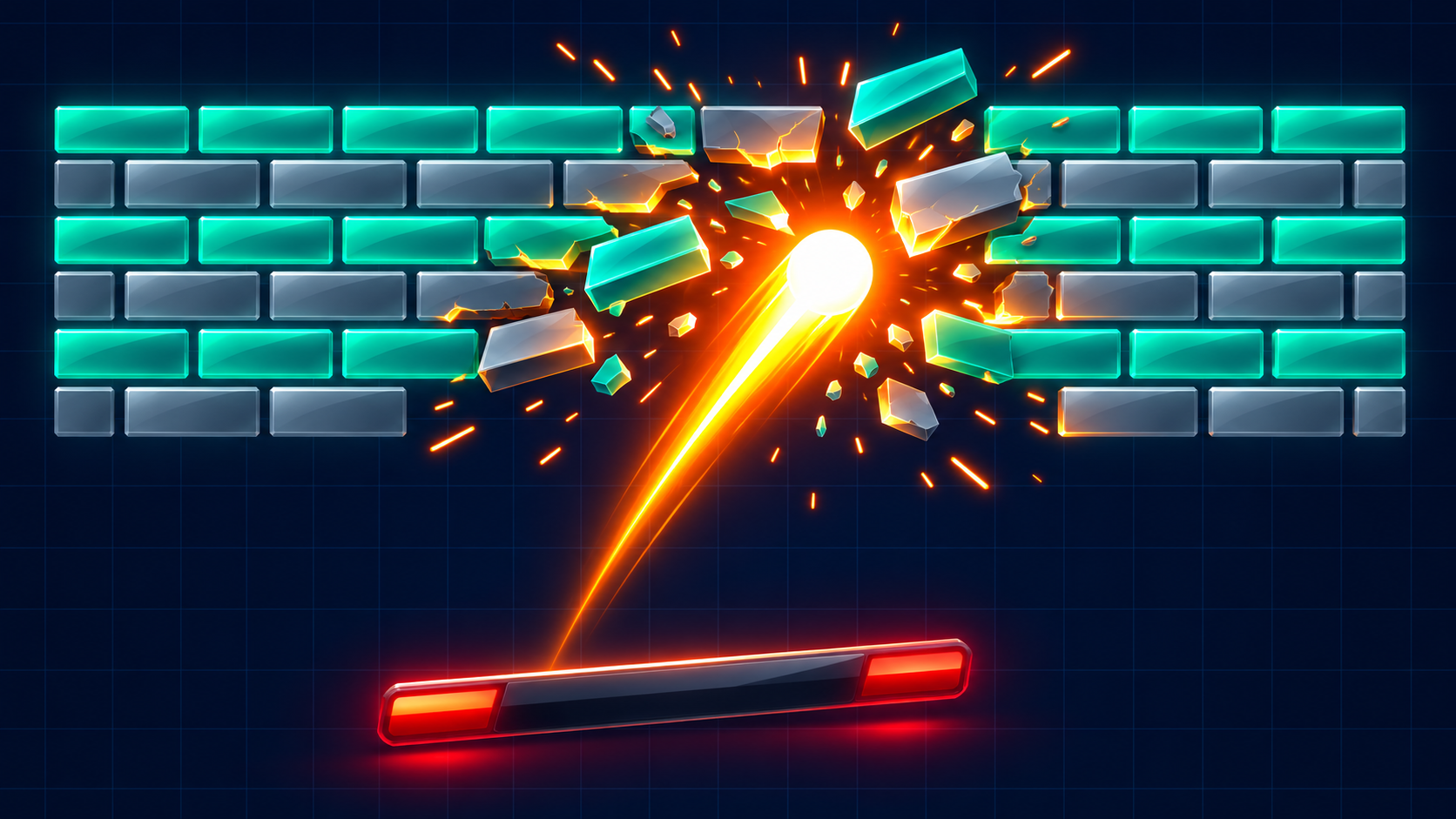
Canvas only, no dependencies. A deep navy field with a faint grid, teal soft bricks, steel with a double outline, dark riveted armor, and glassy pale blue ice. The paddle is dark steel with the outer 30% lit signal red on both ends, so the target zone is never in doubt. The ball is the hottest thing on screen and says so: ice blue when cold, orange when warm, yellow when hot, white with a longer tail when white-hot. The meter at the top is the same gradient with tier ticks. Every break throws pooled particle squares, armored breaks and lost balls shake the screen, and floating labels call out EDGE, COOLED, ICE and tier changes as they happen. Sound is WebAudio oscillators unlocked on the first input: a bounce blip that rises in pitch with heat, a chirp per break, a dull clink when the ball is too cold, a sawtooth sweep for an edge catch, and a short arpeggio on a clear.
What makes it fun
- The scary catch is the good catch. Every return is a small bet on how far out you dare let the ball land, and the payoff is visible on the meter the instant it hits.
- Heat is a budget you can feel draining. A white-hot streak through the top rows is a rush with a clock on it, and the question is always whether to spend the last of it on one more brick or set up the next edge catch.
- Steel and armored bricks turn the wall into a plan instead of a pile. You clear the soft bricks to open lanes, then bank heat for a run at the rows that need it.
- The ramp adds a new kind of problem each level (which bricks, then ice, then speed, then armor) rather than just a faster ball, so a run that ends at level 5 ended on a different mistake than one that ended at level 2.