Lost Cities of Antiquity — Carthage
Phoenician settlers from Tyre founded Carthage on the Gulf of Tunis in the ninth century BCE.
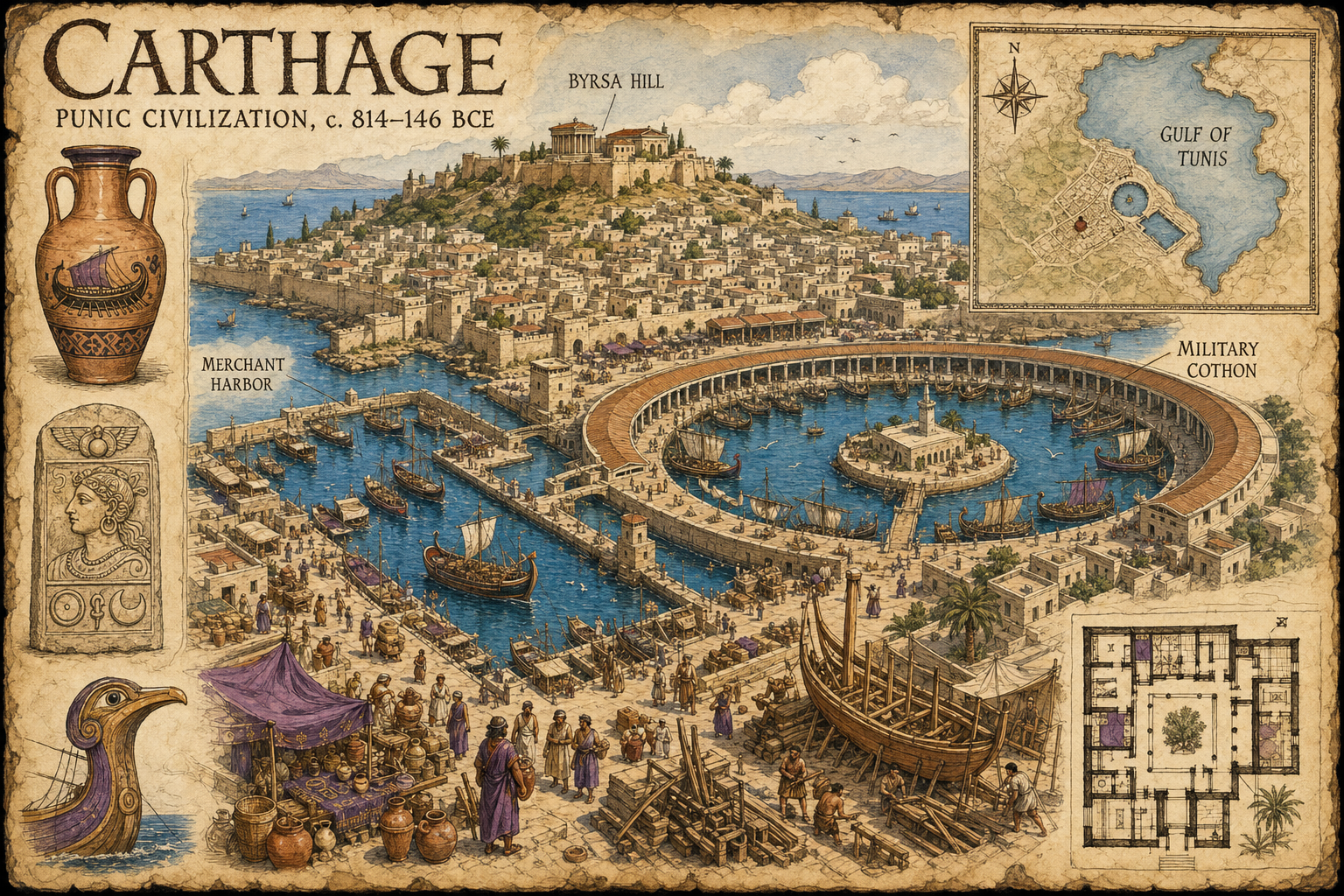
Lost Cities: Carthage
- Entry slug: Carthage
- Lost city: Carthage
- Civilization / era: Punic civilization, c. 814–146 BCE
- Modern-day setting: Gulf of Tunis, Tunisia
- Presentation: Original splendor. The twin Punic harbors and living maritime city communicate Carthage's engineering and commercial power more distinctly than its fragmentary modern remains.
- Generation date: 2026-08-04
- Model: built-in gpt-image
- Saved image:
My-Library/Images/Collections/Lost-Cities/Images/Lost-Cities_Carthage.png
History and rediscovery
Phoenician settlers from Tyre founded Carthage on the Gulf of Tunis in the ninth century BCE. From the sixth century BCE it became the center of a far-reaching Mediterranean trading empire, until Rome destroyed the Punic city in 146 BCE and later established a Roman city over its remains. Carthage was never wholly absent from local or literary memory; systematic archaeological work expanded from the nineteenth century, and the international UNESCO campaign launched in 1972 helped excavate, study, and protect the scattered Punic and Roman site.
Selected visual details
- The linked rectangular merchant harbor and circular military cothon anchor the reconstruction because they express Carthage's maritime trade and naval engineering.
- The circular harbor's central admiralty island and ring of covered shipsheds provide Carthage's most visually distinctive architectural form.
- Byrsa Hill rises behind the ports as the defended acropolis and organizing landmark of the city.
- Dense pale-stone courtyard houses, workshops, warehouses, quays, and markets evoke the Punic urban fabric and daily mercantile life.
- Merchant vessels, war galleys, cedar shipbuilding, amphorae, and purple textiles visualize the city's Mediterranean networks without centering warfare.
- A Gulf of Tunis map inset ties the peninsula, hill, and twin harbors to the real North African setting.
Sources
- UNESCO World Heritage Centre, foundation, maritime empire, destruction and Roman refoundation, site components, and the international safeguarding campaign: https://whc.unesco.org/en/list/37
- Cambridge University Press, archaeological evidence for the circular harbor's island, timber and stone shipsheds, and naval installations: https://www.cambridge.org/core/journals/antiquaries-journal/article/abs/excavations-at-carthage-1975-second-interim-report/C818394F06BFC5016721425ADEA05CA8
- Cambridge University Press, excavated remains on the admiralty island and Punic harbor sequence: https://www.cambridge.org/core/journals/antiquaries-journal/article/abs/excavations-at-carthage-1974-first-interim-report/E955851339EC46416D438AB19B114980
- World History Encyclopedia image record, surviving Punic residential remains on Byrsa Hill: https://www.worldhistory.org/image/21014/byrsa-punic-houses-carthage/
Final prompt used
Use case: illustration-story. Asset type: Lost Cities of Antiquity collection entry. Create a polished cartoon-editorial archaeological sketchbook / travel-journal page for CARTHAGE, matching the collection's established aged parchment, sepia ink linework, delicate watercolor washes, dark weathered page edge, large disciplined serif hand lettering, dense museum-quality field sketches, and one dominant central historical vista.
Show Punic Carthage in its original splendor around the 3rd century BCE on the Gulf of Tunis. The central vista is dominated by its extraordinary double harbor: a rectangular merchant basin crowded with stylized Phoenician trading ships leading by canal into the circular military cothon, with a central admiralty island and a rhythmic ring of colonnaded covered shipsheds. Behind it, the fortified Byrsa Hill rises over tightly packed pale-stone courtyard houses, workshops, markets, quays, warehouses, and city walls; generic Punic sailors, traders, shipwrights, and citizens are active throughout. Blue Mediterranean water, ochre limestone, terracotta roofs, purple-dyed textiles, cedar hulls, and olive green accents create a warm varied palette.
At upper left, include large correctly spelled hand-lettered text exactly: "CARTHAGE". Directly below it, include the smaller line exactly: "PUNIC CIVILIZATION, c. 814–146 BCE". Add a hand-drawn map inset in one corner showing the Gulf of Tunis peninsula, North African coastline, Byrsa Hill, and the twin harbors, with a compass rose and a small city marker. Margin studies should include a merchant amphora, a stylized Punic stele motif, a ship prow, and a courtyard-house plan. Only a few short, correctly spelled labels: "BYRSA HILL", "MERCHANT HARBOR", "MILITARY COTHON", and "GULF OF TUNIS". No long prose blocks and no fake paragraphs.
Wide 3:2 landscape journal spread, one cohesive page rather than disconnected stickers. The harbor and Byrsa Hill must remain recognizable at thumbnail size. Golden Mediterranean expedition light, wondrous and scholarly mood, stylized rather than photorealistic. Avoid Roman imperial monuments as the central identity, modern Tunis, invented monumental fantasy, exact museum-artifact reproductions as photographs, photorealistic named people, gore, distorted lettering, logos, watermarks, UI, or modern objects.
More from Image Collections