Lost Cities of Antiquity — Great Zimbabwe
Great Zimbabwe was the major stone-built capital of a Shona civilization and an important inland trading center, flourishing especially between the eleventh and fifteenth centuries.
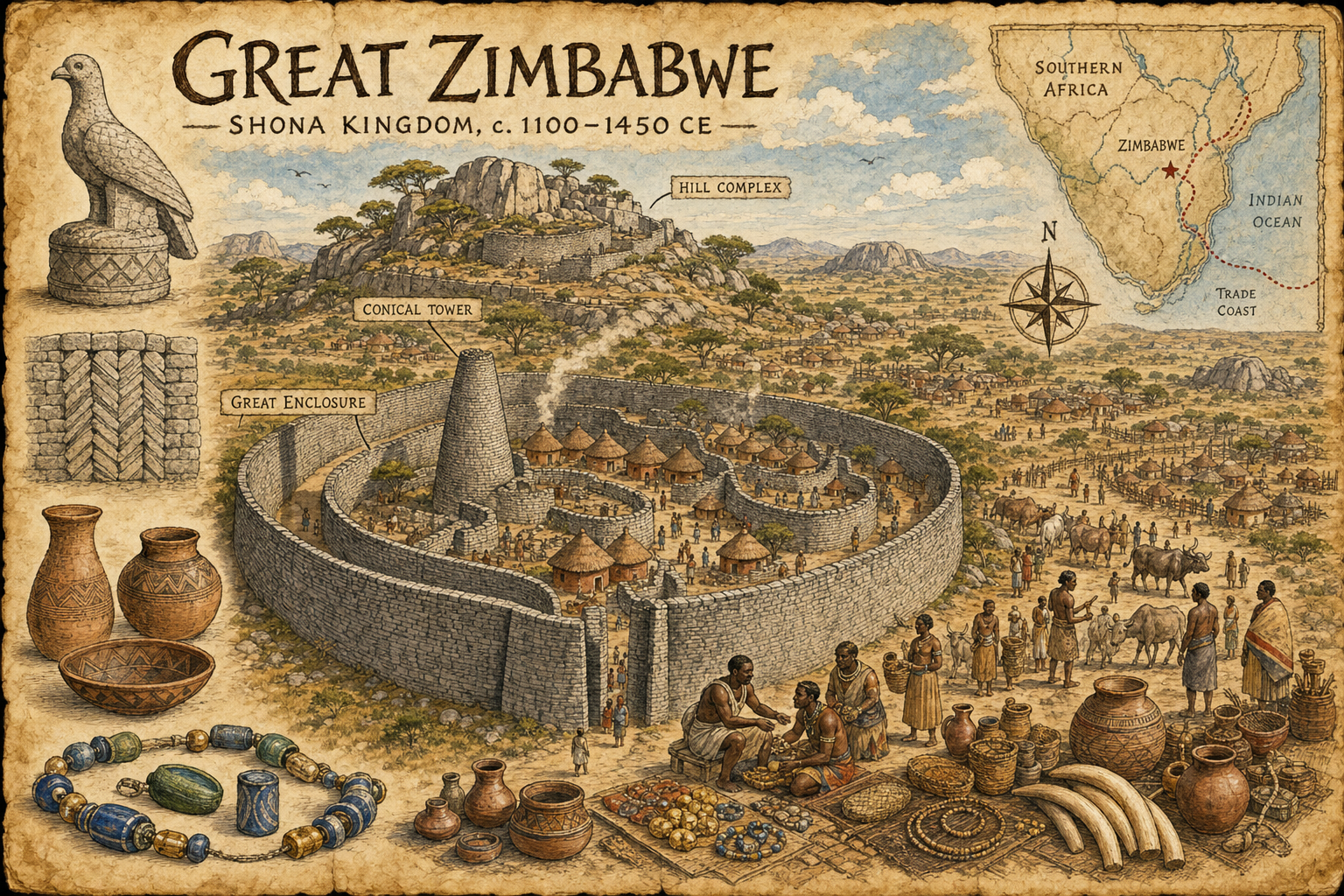
Lost Cities: Great Zimbabwe
- Entry slug: Great-Zimbabwe
- Lost city: Great Zimbabwe
- Civilization / era: Shona Kingdom, c. 1100–1450 CE
- Modern-day setting: Masvingo Province, Zimbabwe
- Presentation: Original splendor. The living Great Enclosure, Hill Complex, and valley settlement show the scale, skilled dry-stone engineering, trade wealth, and Shona authorship more clearly than a generic ruin scene.
- Generation date: 2026-08-05
- Model: built-in gpt-image
- Saved image:
My-Library/Images/Collections/Lost-Cities/Images/Lost-Cities_Great-Zimbabwe.png
History and rediscovery
Great Zimbabwe was the major stone-built capital of a Shona civilization and an important inland trading center, flourishing especially between the eleventh and fifteenth centuries. Its wealth connected plateau gold and ivory to the Indian Ocean trade, while its monumental granite architecture was constructed without mortar. The city declined and dispersed as political, environmental, resource, and trade patterns shifted; local knowledge of the site persisted, although colonial writers and excavators notoriously denied its African authorship before archaeology established its Shona origin.
Selected visual details
- The elliptical Great Enclosure dominates because its high coursed-granite wall is the site's most imposing and recognizable structure.
- The narrow parallel passage and conical tower show the enclosure's distinctive internal architecture.
- The granite Hill Complex rises behind as the royal and ritual acropolis, linking the page's central vista to the site's three-part layout.
- Daga clay-and-thatch dwellings inside stone family enclosures depict Great Zimbabwe as a living city rather than empty masonry.
- The soapstone Zimbabwe Bird, chevron wall pattern, pottery, cattle, gold, ivory, and imported glass beads represent ritual art, local life, and long-distance trade.
- A southeastern Africa map connects the inland city toward the Indian Ocean coast and locates it amid granite kopjes and dry savanna vegetation.
Sources
- UNESCO World Heritage Centre, chronology, Shona authorship, Hill Ruins, Great Enclosure, Valley Ruins, conical tower, daga dwellings, and Zimbabwe Birds: https://whc.unesco.org/en/list/364
- The Metropolitan Museum of Art, monumental scale, Great Enclosure dimensions, soapstone birds, and trade context: https://www.metmuseum.org/de/essays/great-zimbabwe-11th-15th-century
- World History Encyclopedia, dry-stone granite construction, Shona kingdom, citadel, trade, architecture, and art: https://www.worldhistory.org/Great_Zimbabwe/
- Smarthistory, the three architectural zones and soapstone bird sculpture: https://smarthistory.org/great-zimbabwe/
Final prompt used
Create a polished cartoon-editorial archaeological sketchbook / travel-journal spread about Great Zimbabwe, shown in its original splendor around the 14th century. One cohesive wide aged-parchment page with a large central ink-and-watercolor vista: the elliptical Great Enclosure built from precisely coursed dry-stone granite without mortar, its towering curved outer wall, narrow parallel passage, tall conical tower, daga clay-and-thatch dwellings within, the granite Hill Complex rising behind, and Valley settlements amid golden southern-African grassland, granite kopjes, msasa trees, and a warm blue sky. Populate the living city with small generic Shona builders, traders, cattle, pottery, woven goods, and gold-and-ivory trade activity, all stylized and respectful. Margins include a hand-drawn southeastern Africa map corner with compass rose and a small inland city marker connected toward the Indian Ocean trade coast, plus small studies of a soapstone Zimbabwe Bird, chevron stonework, pottery, and glass trade beads. Include large, correctly spelled hand-lettered title “GREAT ZIMBABWE” and smaller line “SHONA KINGDOM, c. 1100–1450 CE”; optional short labels only: “GREAT ENCLOSURE”, “CONICAL TOWER”, “HILL COMPLEX”. Match a warm expedition-journal collection: confident sepia ink linework, transparent watercolor washes, weathered paper texture, museum-quality historical illustration, detailed but readable at thumbnail size. Palette: parchment cream, granite gray, savanna ochre, msasa green, muted red clay, and trade-bead blue. Avoid photorealism, modern objects, named real-person likenesses, generic Greco-Roman ruins, long captions, fake paragraphs, tiny distorted lettering, gore, and sticker-collage layout.
More from Image Collections