Lost Cities of Antiquity — Hanging Gardens of Babylon
Greek and Roman authors described a remarkable series of elevated, irrigated gardens associated by later tradition with Nebuchadnezzar II's sixth-century BCE Babylon.
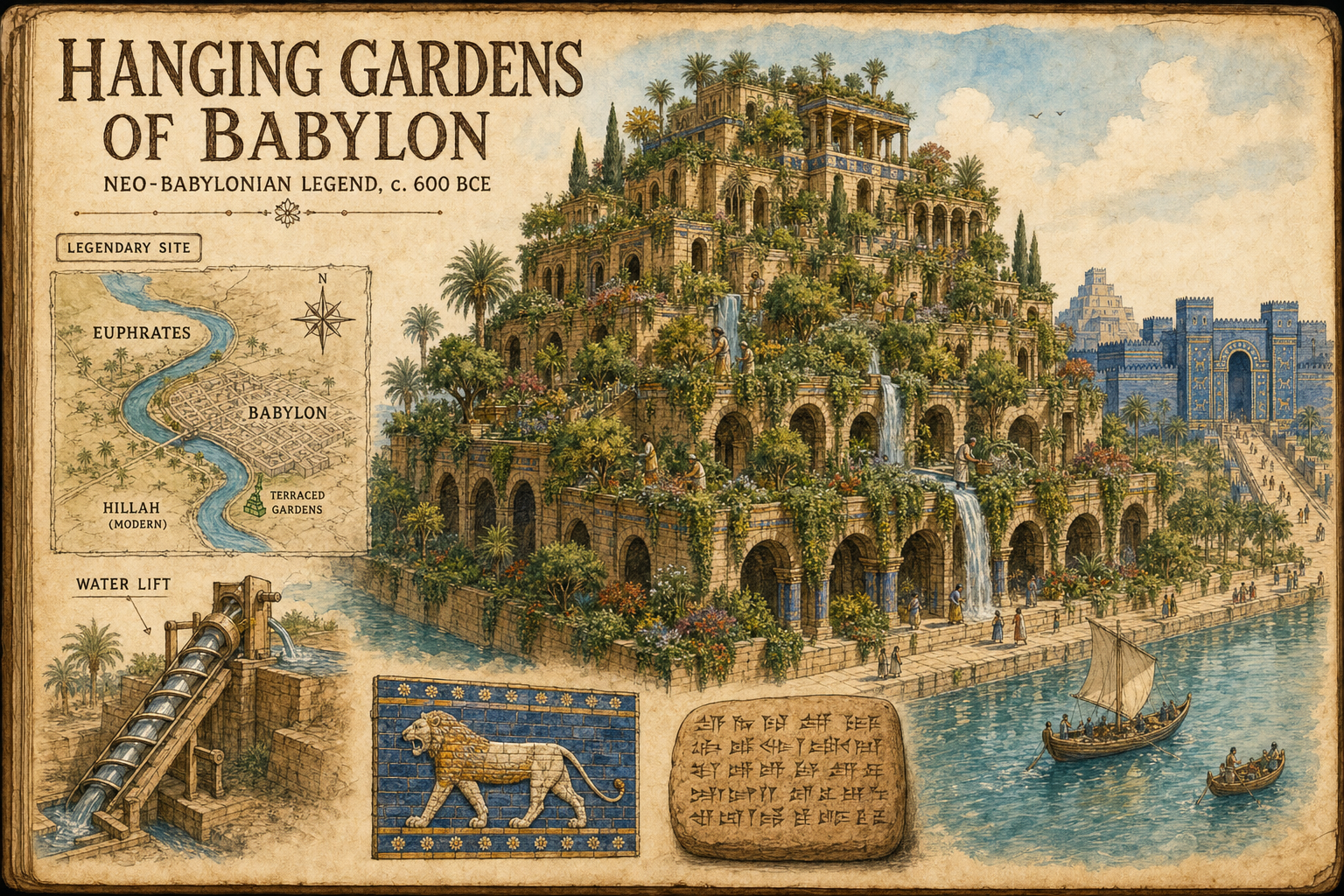
Lost Cities: Hanging Gardens of Babylon
- Entry slug: Hanging-Gardens-of-Babylon
- Lost city: Hanging Gardens of Babylon
- Civilization / era: Neo-Babylonian legend, c. 600 BCE
- Modern-day setting: Traditionally placed at Babylon near Hillah, Babil Governorate, Iraq; physical location unconfirmed
- Presentation: Original splendor, framed explicitly as a legendary site. The famous image of a lush artificial mountain above the Euphrates is more recognizable and evocative than nonexistent confirmed ruins, while the lettering and metadata preserve the site's archaeological uncertainty.
- Generation date: 2026-08-01
- Model: built-in gpt-image
- Saved image:
My-Library/Images/Collections/Lost-Cities/Images/Lost-Cities_Hanging-Gardens-of-Babylon.png
History and rediscovery
Greek and Roman authors described a remarkable series of elevated, irrigated gardens associated by later tradition with Nebuchadnezzar II's sixth-century BCE Babylon. Accounts evoke high terraces planted with large trees and a mechanism lifting water from the Euphrates, but no contemporary Babylonian text or definitive archaeological remain identifies the Gardens. The site therefore has no conventional rediscovery: modern excavations clarified Babylon's palaces, walls, Processional Way, and Ishtar Gate while leaving the Gardens' existence and location unresolved; an alternative scholarly proposal places the tradition at Sennacherib's Nineveh.
Selected visual details
- A mountain-like ascent of high planted terraces reflects the central feature preserved in classical descriptions.
- Vaulted substructures, columned galleries, dense shade, and deep soil communicate the engineering needed to support mature trees.
- Channels, cascades, and a water-lifting screw beside the Euphrates make the irrigation problem visually legible.
- Palms, cypresses, vines, figs, flowers, and tightly clustered trees create the improbable green abundance that made the story wondrous to ancient visitors.
- Blue glazed-brick city walls and a distant Processional Way ground the romanticized scene in securely attested Neo-Babylonian materials and architecture.
- The map shows the Euphrates, Babylon, and modern Hillah while labeling the garden marker as legendary rather than confirmed.
- A compass rose, water-lift study, glazed-brick lion study, and cuneiform tablet sketch reinforce the archaeological journal format.
These details were selected to make the legendary Gardens recognizable while distinguishing researched Babylonian context from the unverified reconstruction.
Sources
- World History Encyclopedia, classical descriptions, irrigation, terraces, and evidentiary uncertainty: https://www.worldhistory.org/Hanging_Gardens_of_Babylon/
- UNESCO World Heritage Centre, Babylon's Neo-Babylonian urbanism, monuments, palaces, and defensive architecture: https://whc.unesco.org/en/list/278/
- The Metropolitan Museum of Art, Babylon under Nebuchadnezzar II and the Processional Way and Ishtar Gate: https://www.metmuseum.org/de/essays/babylon
- The Metropolitan Museum of Art, glazed-brick color, materials, and Processional Way lion panels: https://www.metmuseum.org/art/collection/search/322585
Final prompt used
Use case: illustration-story. Asset type: Lost Cities collection entry. Create a polished cartoon-editorial archaeological sketchbook / travel-journal page for the legendary Hanging Gardens of Babylon, matching the neighboring Petra, Machu Picchu, and Troy entries: aged parchment, fine sepia ink linework, detailed watercolor washes, orderly field-note margins, museum-quality finish. One unified wide landscape journal page dominated by a romanticized original-splendor reconstruction circa 600 BCE beside the Euphrates near ancient Babylon: immense ascending mud-brick and stone terraces like a green mountain; shaded vaulted substructures and columned galleries; date palms, cypresses, vines, figs and flowering plants spilling over each level; channels and cascades carrying lifted river water; workers tending trees; distant brilliant blue glazed-brick Babylonian walls and Processional Way, with generic stylized figures for scale. Include a hand-drawn map corner showing the Euphrates curving past Babylon near modern Hillah with a small garden marker, plus a compass rose, irrigation-screw study, glazed-brick lion motif study, and cuneiform tablet sketch. Warm expedition light, parchment tan and sepia, lush emerald, lapis blue, river turquoise, desert ochre. Exact large readable hand-lettered title: “HANGING GARDENS OF BABYLON”. Exact smaller readable line: “NEO-BABYLONIAN LEGEND, c. 600 BCE”. Short readable labels only: “EUPHRATES”, “TERRACED GARDENS”, “WATER LIFT”. Preserve scholarly uncertainty through a small exact label “LEGENDARY SITE”; do not present a named ruler’s portrait. Stylized, not photorealistic. Avoid modern objects, identifiable real people, exact museum-artifact copies, rigid comic panels, disconnected stickers, tiny fake paragraphs, misspelled or distorted required lettering, gore, logos, watermarks, signatures, and generic ruins.
More from Image Collections