Lost Cities of Antiquity — Machu Picchu
Machu Picchu was built in the 15th century at the height of the Inca Empire, probably as a royal estate and ceremonial center.
Lost Cities: Machu Picchu
- Entry slug: Machu-Picchu
- Lost city: Machu Picchu
- Civilization / era: Inca Empire, 15th century CE
- Modern-day setting: Cusco Region, Peru
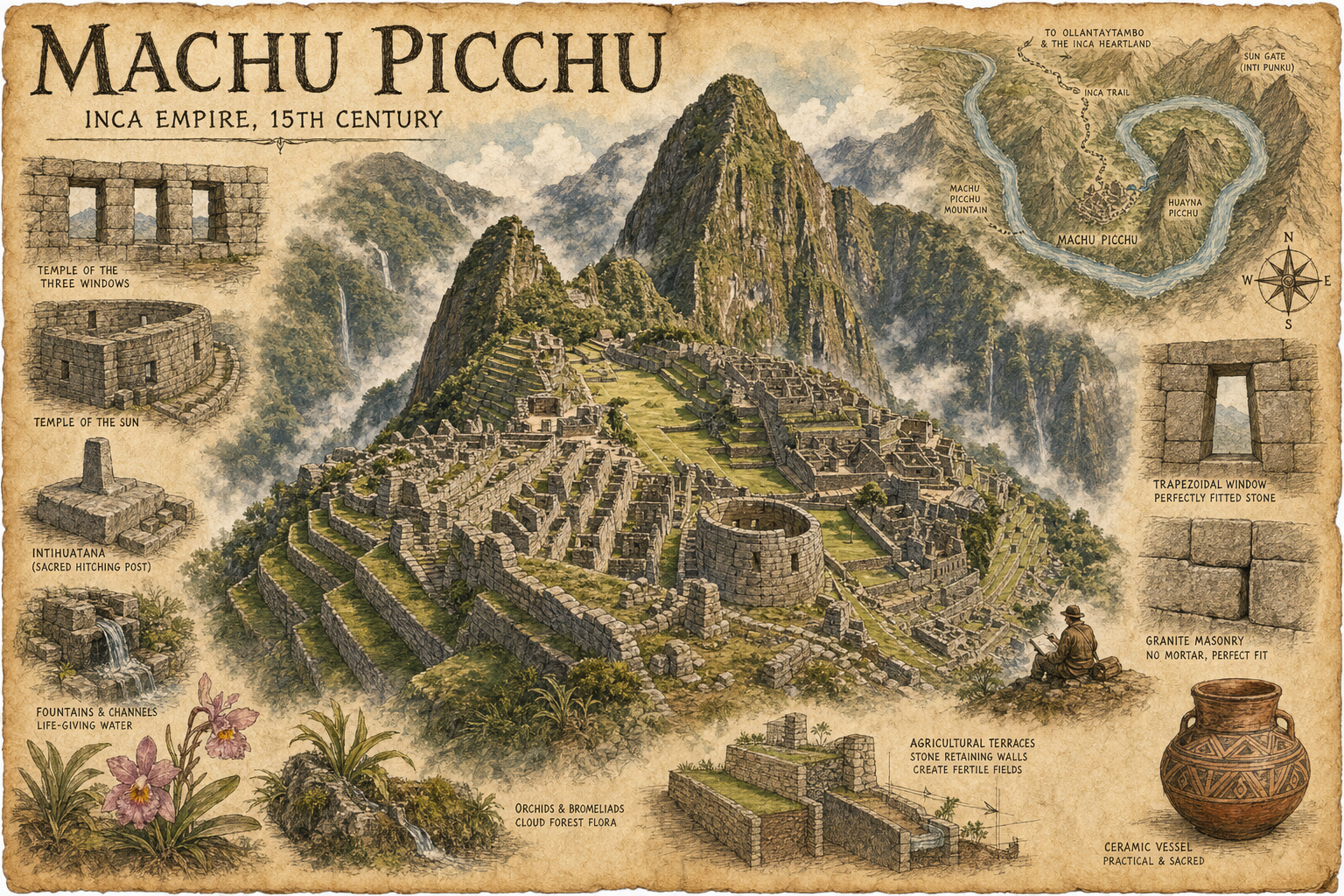
- Presentation: Overgrown ruins. The surviving terraces and roofless granite architecture framed by Huayna Picchu and cloud forest are the site's most recognizable form and best fit the collection's rediscovery-journal treatment.
- Generation date: 2026-07-27
- Model: built-in gpt-image
- Saved image:
My-Library/Images/Collections/Lost-Cities/Images/Lost-Cities_Machu-Picchu.png
History and rediscovery
Machu Picchu was built in the 15th century at the height of the Inca Empire, probably as a royal estate and ceremonial center. Its precisely fitted granite architecture, terraces, ramps, stairways, and waterworks make the settlement a major achievement of Inca urbanism and engineering. The site was later abandoned, but it was never unknown to local residents; Hiram Bingham's locally guided 1911 visit and subsequent publications brought it to wide international attention.
Selected visual details
- Huayna Picchu rising behind the city establishes the instantly recognizable mountain profile.
- Agricultural terraces descending the steep saddle show how Inca builders integrated settlement and landscape.
- Precisely fitted pale granite walls, trapezoidal openings, stairways, and roofless compounds distinguish Inca masonry from generic ruins.
- The semicircular Temple of the Sun, Intihuatana ritual stone, and Temple of the Three Windows provide the page's principal architectural studies.
- Channels and fountains represent the site's integrated water engineering.
- Cloud-forest mist, orchids, moss, and the Urubamba River's horseshoe bend ground the city where the Andes meet the upper Amazon basin.
- A route-and-river map, compass rose, granite-joint study, vessel, and terrace cross-section reinforce the expedition-journal format.
These details were selected because together they communicate Machu Picchu's architecture, sacred landscape, engineering, and rediscovery setting at a glance.
Sources
- UNESCO World Heritage Centre, Historic Sanctuary of Machu Picchu: https://whc.unesco.org/en/list/274
- Peru Ministry of Culture, Machupicchu archaeological park: https://www.culturacusco.gob.pe/parques-arqueologicos/machupicchu/
- National Geographic, Machu Picchu history and international rediscovery: https://www.nationalgeographic.com/history/article/machu-picchu-mystery
- National Geographic, Bingham expedition account and architectural details: https://www.nationalgeographic.com/magazine/article/machu-picchu-peru-inca-hiram-bingham-discovery
- World History Encyclopedia, Machu Picchu overview: https://www.worldhistory.org/Machu_Picchu/
Final prompt used
Use case: illustration-story. Asset type: Lost Cities collection entry. Create a polished cartoon-editorial archaeological sketchbook / travel-journal page for Machu Picchu, matching the established collection's aged parchment, fine sepia ink linework, watercolor washes, dense researched marginal studies, and magazine-quality finish. One large central vista shows the 15th-century Inca sanctuary as mist-softened overgrown ruins on the high saddle between Machu Picchu and steep Huayna Picchu, where the Andes meet lush upper-Amazon cloud forest. Anchor the vista with precisely fitted pale granite masonry and agricultural terraces descending the slopes, the semicircular Temple of the Sun, the Intihuatana ritual stone, and the Temple of the Three Windows. Include stone stairways, channels and fountains integrated into the mountain, roofless trapezoidal doorways, orchids and moss, and a tiny generic expedition sketcher at the edge. In one corner, draw a coherent hand-map of the Urubamba River's horseshoe bend, mountain ridges, Inca trail, and a small city marker; add a compass rose and restrained field sketches of a trapezoidal window, granite joint, ceramic vessel, and terrace cross-section. Required large, correctly spelled hand-lettering: “MACHU PICCHU”. Required smaller line: “INCA EMPIRE, 15TH CENTURY”. Wide landscape journal page, central city dominant, cohesive rather than sticker collage. Warm wondrous rediscovery atmosphere; palette of aged parchment, sepia ink, granite gray, cloud-forest green, and muted Andean blue. Generic stylized people only. Avoid photorealism, modern objects, identifiable real people, fake paragraphs, excessive tiny text, distorted required lettering, generic Greco-Roman ruins, graphic violence, logos, watermarks, and borders beyond the natural parchment edge.
More from Image Collections