Lost Cities of Antiquity — Mesa Verde
Ancestral Pueblo people lived in the Mesa Verde region for more than seven centuries, developing from mesa-top farming villages into masonry pueblos and, especially from about 1180 to 1300 CE, the…
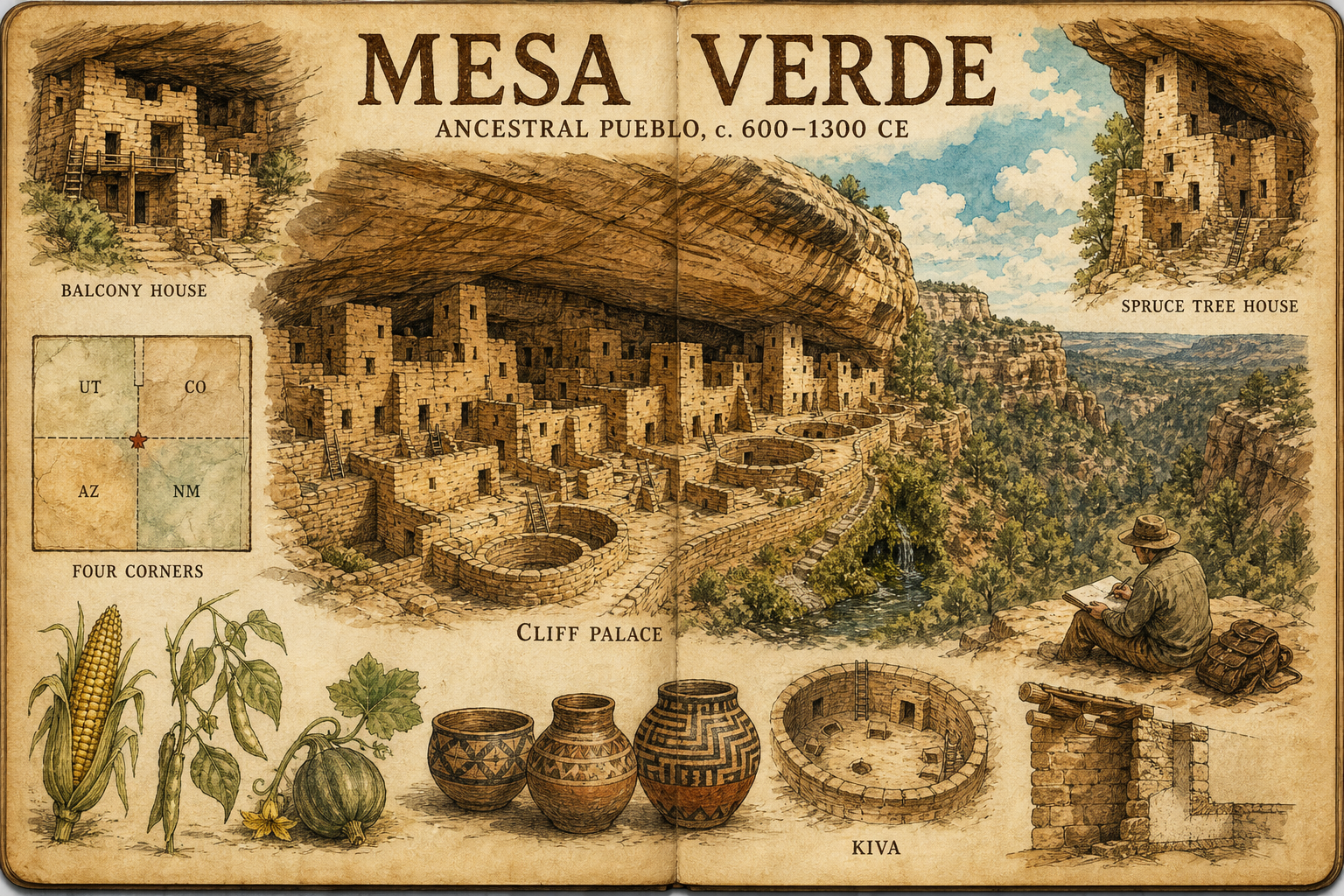
Lost Cities: Mesa Verde
- Entry slug: Mesa-Verde
- Lost city: Mesa Verde
- Civilization / era: Ancestral Pueblo, c. 600–1300 CE
- Modern-day setting: Colorado, United States
- Presentation: Overgrown ruins. The preserved villages beneath sandstone alcoves, framed by pinyon-juniper mesa and canyon, make Mesa Verde immediately recognizable and respectfully emphasize continuity with present-day Pueblo peoples.
- Generation date: 2026-08-05
- Model: built-in gpt-image
- Saved image:
My-Library/Images/Collections/Lost-Cities/Images/Lost-Cities_Mesa-Verde.png
History and rediscovery
Ancestral Pueblo people lived in the Mesa Verde region for more than seven centuries, developing from mesa-top farming villages into masonry pueblos and, especially from about 1180 to 1300 CE, the celebrated cliff dwellings. Communities migrated south by the end of the thirteenth century amid environmental and social pressures; their descendants include living Pueblo communities. Local Indigenous knowledge never vanished, while wider U.S. attention intensified after Richard Wetherill and Charles Mason encountered Cliff Palace and Spruce Tree House in 1888; preservation campaigning led to Mesa Verde National Park in 1906.
Selected visual details
- Cliff Palace dominates because its roughly 150 rooms and 23 kivas make it the largest and most iconic Mesa Verde cliff dwelling.
- Circular kivas, ladders, plazas, and multi-story room blocks communicate communal, ceremonial, and domestic life beneath the alcove.
- Sandstone masonry with mud mortar, plaster traces, timber roof beams, granaries, and balconies show the site's actual building materials and engineering.
- Balcony House and Spruce Tree House margin studies broaden the page while retaining site-specific architecture; Spruce Tree House preserves extensive original material.
- Seep-spring greenery, the sandstone alcove, forested mesa, and canyon connect the architecture to the water sources and geology that shaped settlement.
- The Four Corners map, corn-bean-squash study, corrugated pottery, and masonry section locate the site geographically and evoke farming and material culture.
Sources
- UNESCO World Heritage Centre, settlement chronology, sandstone-and-mud architecture, room counts, cliff dwellings, and living Pueblo continuity: https://whc.unesco.org/en/list/27
- National Park Service overview of Cliff Palace, Balcony House, Long House, Spruce Tree House, kivas, granaries, balconies, springs, and dwelling chronology: https://www.nps.gov/meve/learn/historyculture/cliff_dwellings_home.htm
- National Park Service mapping history, Four Corners landscape, crops, settlement development, and migration: https://www.nps.gov/meve/learn/education/mapping-history.htm
- National Park Service preservation history and the 1888 encounters with Cliff Palace and Spruce Tree House: https://www.nps.gov/articles/lee-story-creating.htm
Final prompt used
Create a WIDE HORIZONTAL landscape archaeological sketchbook spread for Mesa Verde. The previous attempt was a tall portrait page; correct that specific defect: the canvas and composition must be broad and horizontal, with the central cliff-dwelling panorama extending left-to-right and margin studies arranged across the two sides, never stacked vertically. Match the collection's 3:2 landscape travel-journal convention, richly detailed aged parchment, confident sepia ink linework, natural watercolor washes, museum-quality field sketches, and cohesive full-page finish. Show Cliff Palace dominating the center beneath a vast warm-tan sandstone alcove: multi-story sandstone-and-mud-mortar rooms, round kivas, square towers, timber beams, plaster traces, ladders, granaries, seep-spring greenery, pinyon-juniper mesa and canyon. Across the left and right margins include small Balcony House and Spruce Tree House studies, a Four Corners map with city marker, compass rose, corn-bean-squash sketch, corrugated pottery, and masonry cross-section. A small generic field artist sketches at one edge. Warm respectful rediscovery light; parchment cream, sandstone ochre, sage green, turquoise sky, sepia. Large correctly spelled text exactly “MESA VERDE” and smaller “ANCESTRAL PUEBLO, c. 600–1300 CE”. Optional short labels only: “CLIFF PALACE”, “KIVA”, “BALCONY HOUSE”, “SPRUCE TREE HOUSE”, “FOUR CORNERS”. No fake paragraphs or tiny text, no modern buildings, no photorealism, no real-person likenesses, no fantasy ruins, no disconnected sticker grid, no distorted lettering, no logos, no gore.
More from Image Collections