Image Collections
Lost Cities of Antiquity — Pompeii
Pompeii developed into a prosperous Roman Campanian city with public buildings, paved streets, shops, baths, theatres, an amphitheatre, and richly decorated houses.
Pompeii
- Entry slug:
Pompeii - Lost city: Pompeii
- Civilization / era: Roman Campania, buried 79 CE
- Modern-day setting: Campania, Italy, southeast of Mount Vesuvius near the Bay of Naples
- Presentation: Excavated ruins. Pompeii's exceptional value is the unusually complete preserved Roman city revealed beneath volcanic deposits, so the journal page emphasizes rediscovery and its intact urban fabric rather than staging the fatal eruption.
- Saved image:
My-Library/Images/Collections/Lost-Cities/Images/Lost-Cities_Pompeii.png - Model: built-in gpt-image
- Generation date: 2026-07-25
Historical and Rediscovery Summary
Pompeii developed into a prosperous Roman Campanian city with public buildings, paved streets, shops, baths, theatres, an amphitheatre, and richly decorated houses. Vesuvius buried it in ash and lapilli in 79 CE, preserving an extraordinarily complete picture of first-century urban life. Finds began emerging centuries later, and systematic Bourbon-era excavation began in the eighteenth century; excavation, conservation, and new investigation continue today.
Selected Visual Details
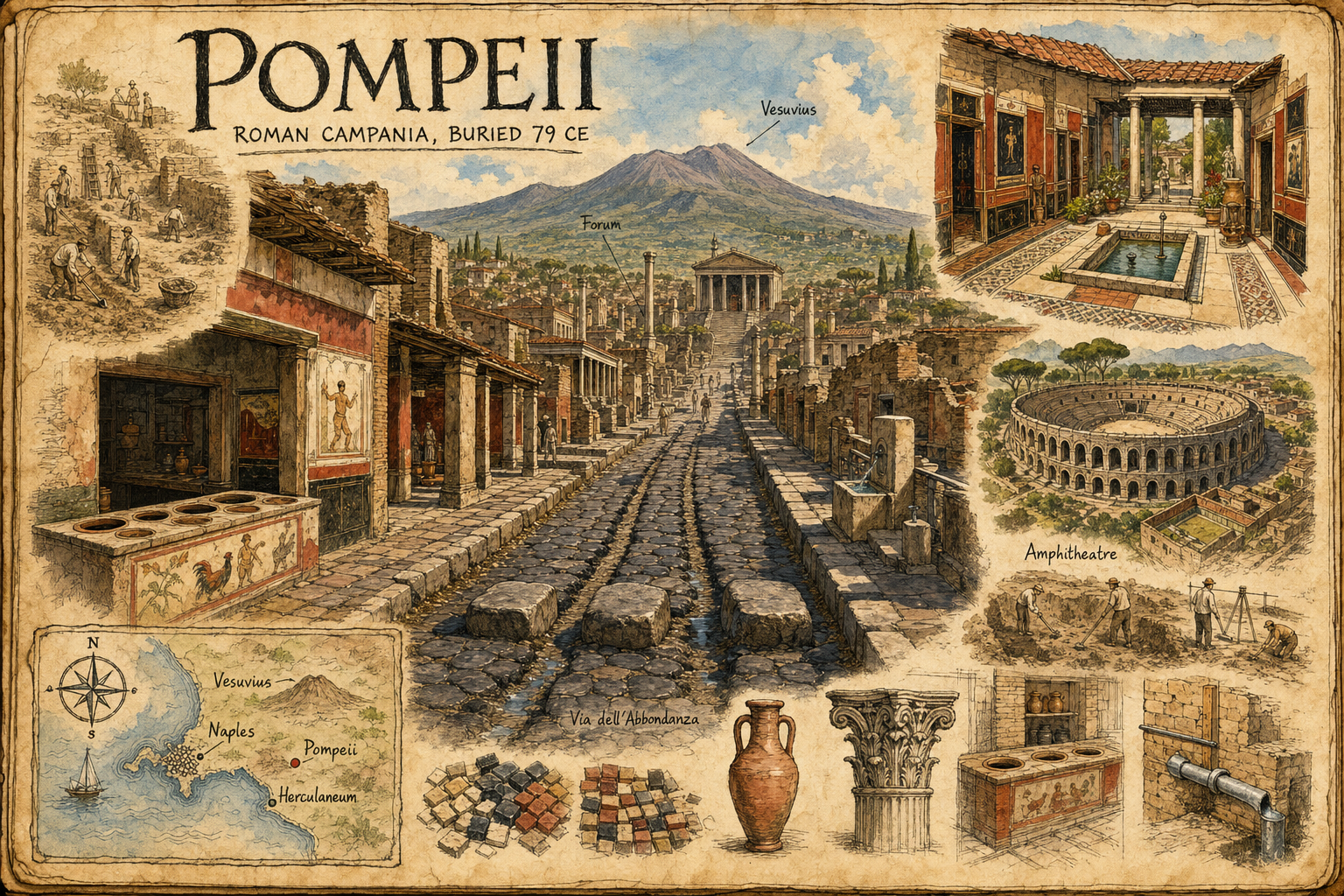
- The Forum and Temple of Jupiter aligned with Vesuvius establish Pompeii's civic center and volcanic setting.
- The amphitheatre and adjacent palaestra represent major public entertainment architecture and one of the city's most recognizable surviving complexes.
- Basalt streets with wheel ruts, raised sidewalks, and stepping stones make the everyday urban engineering instantly specific to Pompeii.
- A domestic atrium, impluvium, peristyle, mosaics, and red-and-black wall painting convey the preserved private houses for which the site is famous.
- A thermopolium counter with inset terracotta jars represents the city's abundant street-facing food businesses.
- Ash and lapilli banks beside generic eighteenth-century excavators communicate burial and rediscovery without depicting victims.
- A Bay of Naples map with Vesuvius, Pompeii, Herculaneum, and Naples grounds the journal page geographically.
Sources
- UNESCO World Heritage Centre: https://whc.unesco.org/en/list/829/
- Pompeii Archaeological Park, official site: https://pompeiisites.org/en/
- Pompeii Archaeological Park, open buildings and monuments: https://pompeiisites.org/en/houses/
- Pompeii Archaeological Park, Civil Forum: https://pompeiisites.org/en/excavations-plan-en/civil-forum/
- Pompeii Archaeological Park visitor guide PDF: https://pompeiisites.org/wp-content/uploads/Pompei-ING-LR-link.pdf
Final Prompt Used
Use case: illustration-story
Asset type: Lost Cities of Antiquity collection entry, 3:2 landscape PNG
Primary request: Create a polished cartoon-editorial archaeological sketchbook page of Pompeii as evocative excavated ruins, with majestic surviving Roman architecture and Mount Vesuvius.
Scene: an aged parchment journal spread dominated by an ink-and-watercolor view down a rutted basalt street with raised stepping stones toward the Forum, Temple of Jupiter, and Vesuvius. Roofless stucco-and-brick houses, shopfronts, fountains, and colonnades line the street.
Anchor details: Forum and temple; oval amphitheatre and palaestra; frescoed atrium house with impluvium, peristyle, mosaics, and tiled fragments; thermopolium counter with jars; fountain and water-pipe study; ash and lapilli; umbrella pines and vineyards.
Rediscovery: small generic eighteenth-century excavation figures and survey tools, no identifiable people or modern machinery.
Map: compass rose and Bay of Naples map marking Vesuvius, Pompeii, Herculaneum, Naples, and the coast. Margin accents: amphora, Corinthian capital, tesserae, thermopolium.
Text exactly: "POMPEII" and "ROMAN CAMPANIA, BURIED 79 CE". Optional labels: "Forum", "Vesuvius", "Amphitheatre", "Via dell'Abbondanza".
Style: polished magazine-quality cartoon editorial archaeology sketchbook, sepia ink, transparent watercolor, aged paper, warm expedition charm, never photorealistic. Wide 3:2 unified page with strong hierarchy.
Avoid: real-person likenesses, victims or body casts, active deadly eruption, gore, modern buildings or vehicles, logos, fake paragraphs, distorted text, clutter, generic fantasy ruins, watermark.
More from Image Collections

Internet Culture Timeline — 2025
2025-01-01

Music Yearbooks — 2025
2025-01-01

News & Culture — 2025
2025-01-01

NFL Super Bowls — 2025
2025-01-01

Science Breakthroughs — 2025
2025-01-01
Transportation & Mobility — 2025
2025-01-01

Video Game History — 2025
2025-01-01

Internet Culture Timeline — 2024
2024-01-01

Music Yearbooks — 2024
2024-01-01

News & Culture — 2024
2024-01-01

NFL Super Bowls — 2024
2024-01-01

Science Breakthroughs — 2024
2024-01-01