Video Game History — 2004
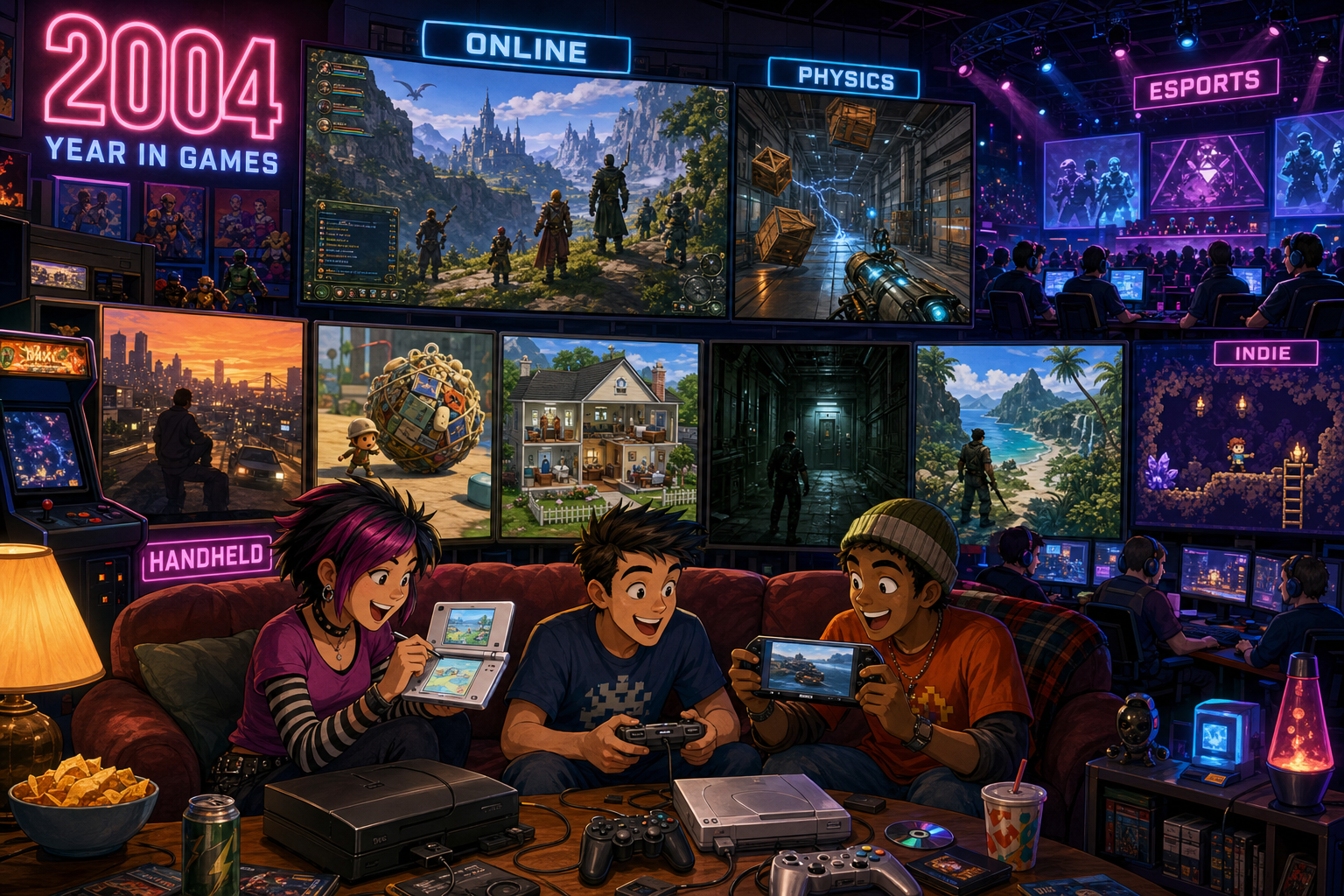
Nintendo DS and PlayStation Portable began a new handheld generation, represented by generic dual-screen touch and widescreen disc handhelds.
Video Game History: 2004
- Year: 2004
- Generation date: 2026-07-28
- Model: built-in gpt-image
- Saved image:
My-Library/Images/Collections/Video-Game-History/Images/Video-Game-History_2004.png
Selected moments
- Nintendo DS and PlayStation Portable began a new handheld generation, represented by generic dual-screen touch and widescreen disc handhelds.
- World of Warcraft launched and made the large persistent online fantasy world a defining gaming space.
- Half-Life 2 paired cinematic first-person storytelling with unusually prominent physics interaction.
- Halo 2 made console online multiplayer and Xbox Live culturally central, represented by an original armored team scene.
- Grand Theft Auto: San Andreas expanded the scale and ambition of the urban open-world sandbox.
- Katamari Damacy became a landmark of whimsical, experimental design, represented by a tiny original explorer rolling a ball of household objects.
- The Sims 2 advanced the life-simulation genre, represented by an original cutaway suburban household.
- Doom 3 and Far Cry showcased high-end lighting and expansive 3D environments, represented by invented horror and tropical action scenes.
- Cave Story became an influential independently developed release, represented by an original pixel-art cave adventure.
- Organized LAN and esports play continued to expand, represented by a generic arena and networked PC competitors.
These moments were selected to balance handheld hardware, landmark games across genres, online services, graphics and physics technology, independent development, and competitive play. Online fantasy worlds, the new handheld generation, and physics-rich PC games are the strongest visual anchors.
Sources
- Entertainment Software Association, 2004 video-game history timeline: https://www.theesa.com/timeline-entry/history-of-video-games-2004/
- Nintendo DS launch history and dates: https://en.wikipedia.org/wiki/Nintendo_DS
- Microsoft, contemporary Halo 2 launch announcement and online significance: https://news.microsoft.com/source/2004/10/19/halo-2-makes-entertainment-history-as-global-anticipation-builds/
- Valve, Half-Life 2 release page and physics-focused description: https://store.steampowered.com/app/220/halflife_2/
- GameSpot, contemporary announcement of the November 23 World of Warcraft launch: https://www.gamespot.com/articles/world-of-warcraft-to-open-its-gates-november-23/1100-6112401/
- BAFTA, awards recognizing Half-Life 2, Grand Theft Auto: San Andreas, Halo 2, Doom 3, and Burnout 3: https://www.bafta.org/awards/games/?award-year=2005
- NAVGTR, 2004 awards including Game of the Year for Half-Life 2: https://navgtr.org/2004-awards/
- 2004 release and industry chronology used as a cross-check: https://en.wikipedia.org/wiki/2004_in_video_games
Rights notes
The artwork uses original fictional characters, invented on-screen worlds, and generic consoles, controllers, cabinets, screens, and handhelds. It contains no official logos, exact copyrighted characters, real screenshots, trademark-accurate hardware designs, branded sports marks, or real-person likenesses. The historical references are communicated through broad genre cues and the short descriptive labels ONLINE, PHYSICS, HANDHELD, INDIE, and ESPORTS.
Final prompt used
Create a single cohesive polished cartoon-editorial gaming-magazine scene for 2004, visually matching the dense, high-finish arcade-and-living-room world of the existing Video Game History collection. At upper left, large perfectly readable glowing text “2004” with smaller “YEAR IN GAMES”. Foreground: three expressive generic friends on a couch around generic black and silver consoles and controllers; hands hold one generic dual-screen touch handheld and one generic widescreen disc handheld. Midground: a continuous curved wall of glowing monitors and arcade cabinets integrated naturally into the same room, with NO panel borders, NO numbering, NO checklist layout. Screens show original fictional worlds: a guild exploring a vast fantasy realm for the online-RPG boom; a physics-driven dystopian corridor with levitating crates; armored sci-fi teams playing online; a sunset urban sandbox; a quirky tiny explorer rolling a ball of household objects; a suburban life-simulation house; a shadowy technology-horror corridor; a tropical open-world action landscape; and a charming pixel-art cave adventure representing indie creation. Background: one small esports/LAN stage, crowd lights, and developers at networked PCs. Make online worlds, the handheld generation, and physics-rich PC games the largest anchors. Use only short readable signs “ONLINE”, “PHYSICS”, “HANDHELD”, “INDIE”, “ESPORTS”. Neon magenta and cyan screen light, deep blue and purple shadows, warm amber living-room light, varied colorful screens. ORIGINAL fictional characters and invented scenes only; generic hardware shapes only. STRICT: no numbered callouts, no separate comic panels, no sticker collage, no exact copyrighted characters, no official logos, no trademark-accurate hardware, no branded sports marks, no photorealistic real people, no gore, no fake paragraphs, no tiny garbled text, no borders, watermarks, or signatures.
More from Image Collections