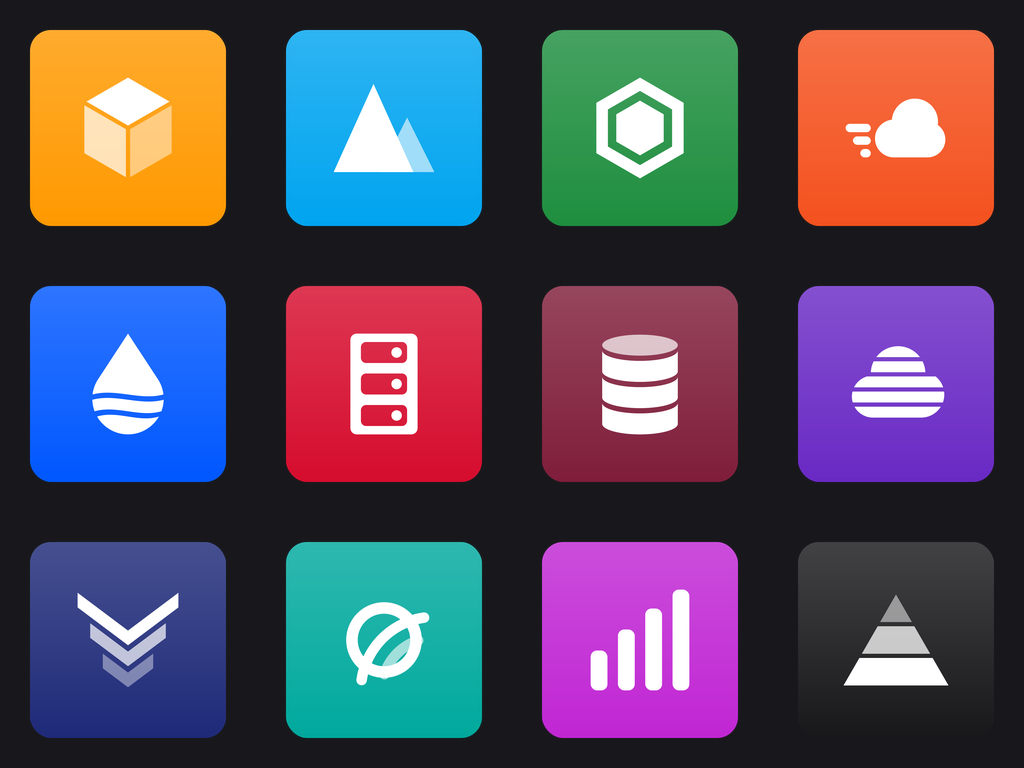
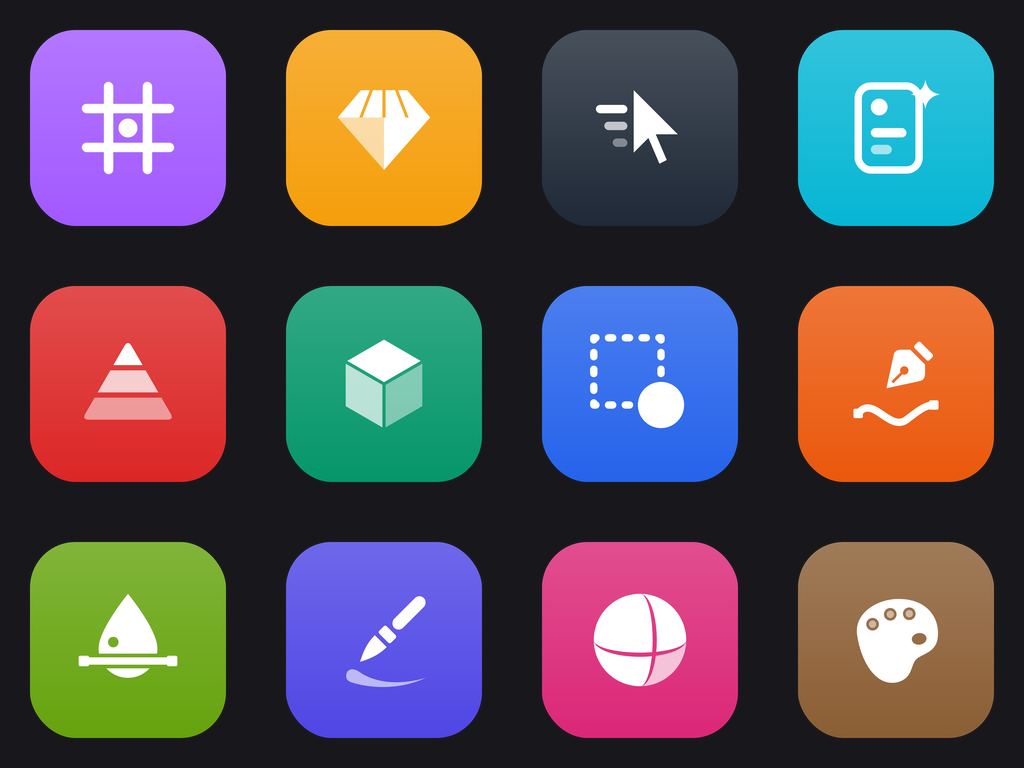
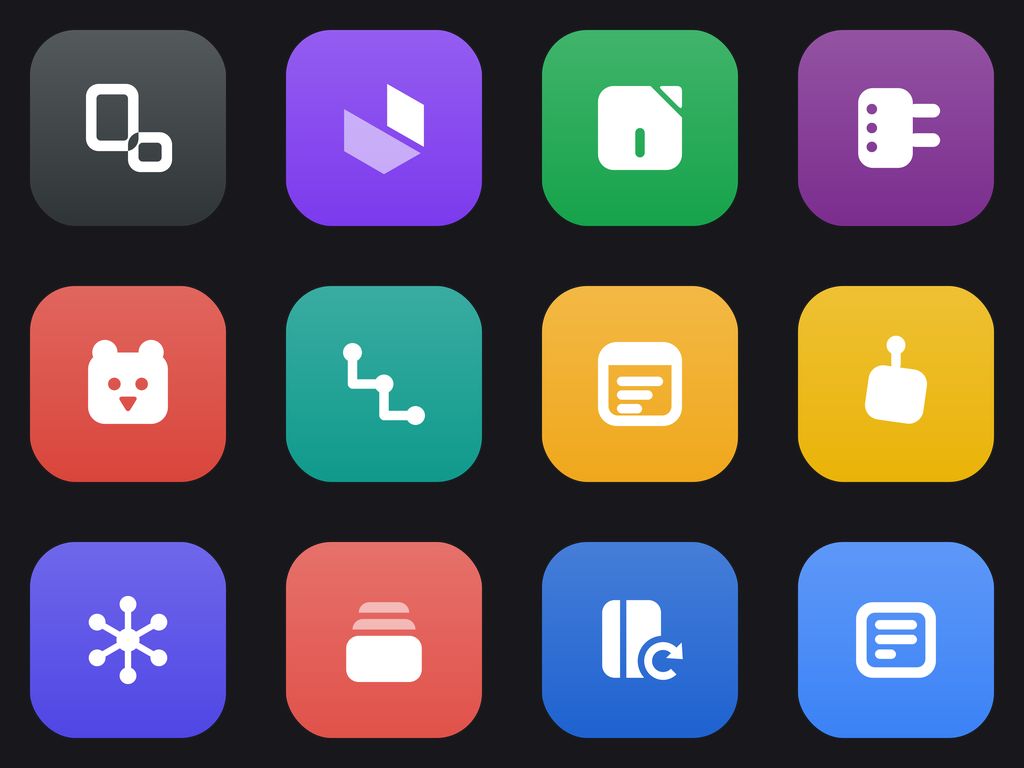
Code Chrome — IDE & Editor Tiles
Twelve of the tools programmers actually open all day — reimagined as one clean tile set. Each editor and IDE is reduced to a single flat white mark on its own saturated squircle, so the whole family reads as one system while every member stays instantly nameable. Built for dark IDE launchers, dock replacements, taskbars, and web toolbars.
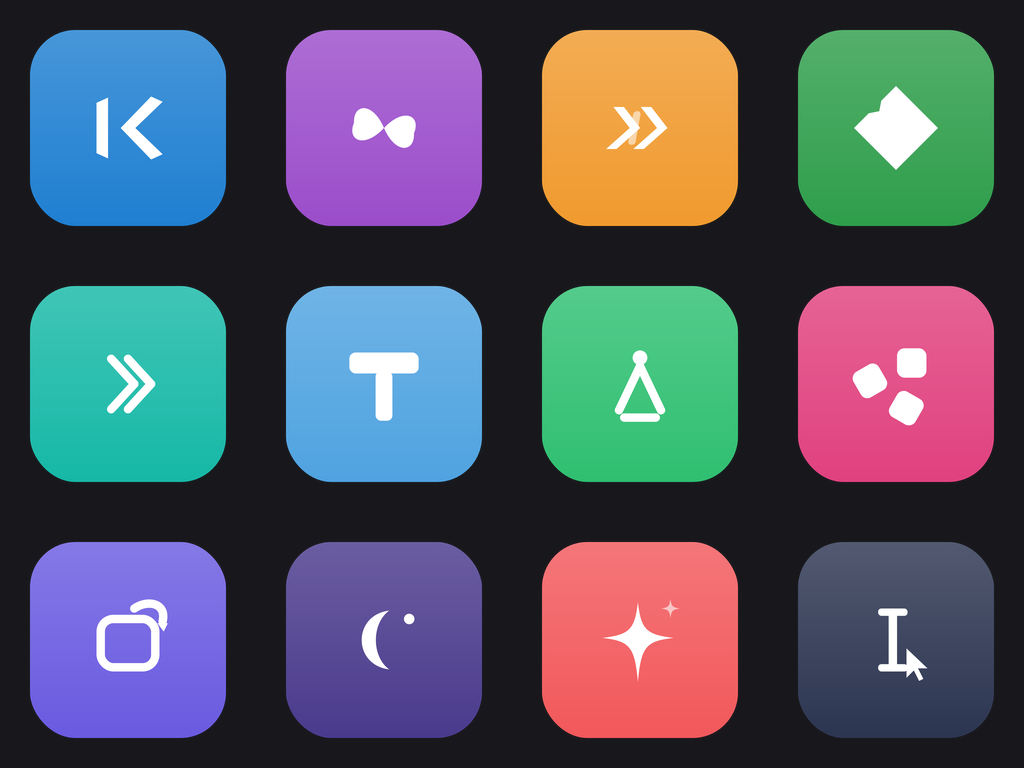
Code Chrome — IDE & Editor Tiles
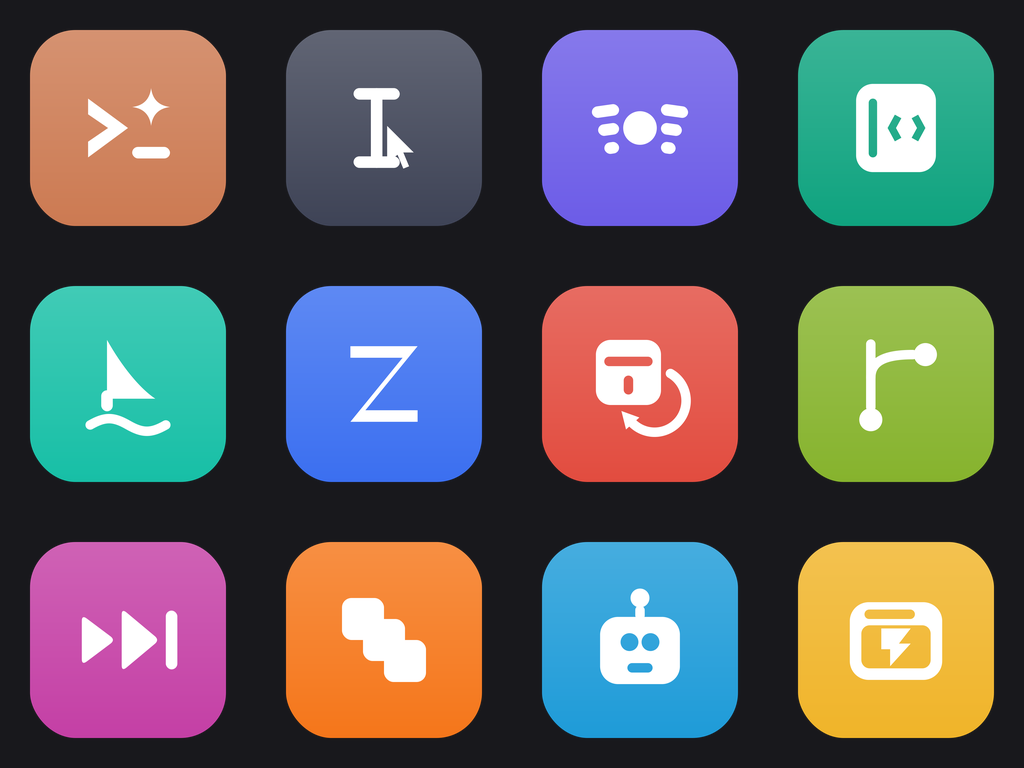
Every developer keeps a small, fiercely-held stable of editors and IDEs, and none of them ship an icon that looks good next to the others. Code Chrome fixes that: VS Code, JetBrains, Vim, Xcode and friends, each cut down to its essential silhouette and set on a rounded-square tile in a cohesive cool-leaning palette. The marks are original geometry — a folded ribbon, a notched diamond, a claw hammer, a doubled chevron — evoking each product without copying a trademark, so the pack drops cleanly into any launcher or docs page.
Format: SVG + ICO + PNG. Every icon ships as a transparent 1024x1024 PNG in Icons/PNG/ (the previews below), plus vector .svg source and a multi-size Windows .ico (16-256 px) bundled in one zip.
Using them: drop an .ico onto a folder via Properties → Customize → Change Icon, or onto a shortcut via Properties → Shortcut → Change Icon. The SVGs are the source art for web, docs, and app UI — they stay sharp at any size; the PNGs are there for anything that can't take a vector.
Container: squircle-tile — a rounded-square (squircle) app tile with a large corner radius. Every icon in the pack shares it at the same scale.
Download: code-chrome-ide-editor-tiles-svg-ico.zip — every icon as an .svg (vector source) and a multi-size Windows .ico. The PNGs below are the previews.
Icons in this pack
- VS Code: The folded ribbon silhouette everyone reads instantly as the blue editor.
- Visual Studio: The full Microsoft IDE, distinguished from VS Code by a purple infinity twist.
- Sublime Text: The lean, fast text editor shown as sheared code brackets around a caret.
- Vim: The modal terminal editor as its signature green lozenge diamond.
- Neovim: The Vim successor shown as a doubled forward chevron for its greater-than mark.
- Xcode: Apple's IDE reduced to its build hammer, the tool it is known by.

- Android Studio: Google's mobile IDE as its compass A-frame with a needle point.
- IntelliJ IDEA: The JetBrains flagship as three rounded squares in the family's pinwheel.
- Emacs: The extensible editor as a keyboard keycap with its ever-present meta loop.
- Eclipse: The Java IDE named and drawn as one disc eclipsing another.
- Nova: Panic's Mac editor as a bright four-point nova star.
- Cursor: The AI-first editor shown as a text I-beam paired with a pointer.
Prompt
Generation Prompts
- Concept model:
claude --print— claude-opus-4-8 - Glyph model:
claude --print— claude-opus-4-8 (SVG drawn directly, not an image model) - Format: SVG + ICO + PNG —
.svg(source) +.ico(Windows multi-size) +.png(1024x1024 RGBA) - Rasterizer: cairosvg, each
.icoentry rendered from the vector at its own size - Container: drawn by the generator, not the model — identical across the pack by construction
Pack Prompt
You are a senior icon designer producing a commercial icon pack for Windows desktop and web use — the kind sold on Iconfinder or posted on DeviantArt, not a stock-illustration set.
Design a cohesive pack of 12 icons on the theme: Code Editors and IDEs — VS Code, JetBrains, Vim, Sublime, Xcode, Android Studio — rounded squares.
This step is the concept only. You are not drawing anything yet — a second pass draws each symbol as SVG, and the container shape, the tile gradient, and the final document are generated by code. Your job is to decide what the pack is, who its twelve members are, and what colours it uses.
What a pack is
A pack is one category of similar, nameable things, drawn in one shared visual system. Think "Brave, Chrome, Edge, Firefox, Opera, Safari, Vivaldi" — or "Box, Dropbox, Google Drive, iCloud, Mega, OneDrive" — or "Photoshop, Illustrator, Figma, Canva, Affinity Designer". Twelve members of the same family, each instantly identifiable, all cut from the same cloth.
Name the real things. If the theme is browsers, name the actual browsers. If it is AI coding tools, name Claude Code, Cursor, Copilot, Codex. If it is cloud storage, name the real services. A pack of abstract inventions ("Chroma Bell", "Nebula Cloud", "Prism Home") is a failure — that is not what this is for.
But design an original mark for each. Do NOT reproduce a company's trademarked logo. Take the product's idea — what it does, its colour, its silhouette — and draw a fresh symbol for it in the pack's style. A Dropbox icon is a box or a stack of blue facets; a terminal tool is a prompt caret; a vector editor is a pen nib on a path. The set should feel recognizable at a glance without copying anyone's artwork.
If a theme genuinely has no real-world members (e.g. "Website Page Icons — Cart, Checkout, Orders"), then the 12 members are the concrete pages or functions themselves, still named plainly.
The shared visual system
Pick ONE container shape for the whole pack. The renderer draws it for you, identically on all twelve — you only choose which one fits the theme:
container |
Use it for |
|---|---|
squircle-tile |
app icons, browsers, mobile/desktop apps, AI tools |
folder-tab |
anything described as a folder pack — Windows folder icons |
circle-badge |
social, profile, status, round-dock sets |
rounded-square |
system/utility/taskbar icons, settings panels |
drive-block |
storage, backup, drives, sync services |
bare-glyph |
page/UI icons meant to sit inline in a web layout |
Colour
The pack is two-tone by design, and that is what makes it read as a set:
- Each icon gets its own
tile_color— the container behind it. This is where a member's identity lives: Firefox orange, Dropbox blue, Spotify green. Pick a saturated, distinguishable hex per icon; no two should be near-identical, and all twelve should look like one palette family rather than a random assortment. - The whole pack shares ONE
glyph_color— the symbol drawn on top of every tile. Almost always#FFFFFF; use a very dark neutral (e.g.#1A1A22) only if the pack's tiles are all pale. - For a
bare-glyphpack there is no tile, sotile_colorbecomes the symbol's own colour andglyph_coloris ignored.
Every colour must be a plain 6-digit hex string like #3B82F6.
Describing each symbol
Each icon's glyph_brief is an instruction to whoever draws it, in flat geometric terms — what shapes, in what arrangement. "A rounded upward chevron over a horizontal baseline bar" is useful; "a beautiful modern representation of growth" is not. Keep every brief phrased the same way and at the same level of detail, so the twelve come out at one optical weight.
Two hard constraints on what you may ask for, because the drawing pass is validated against them:
- No lettering. The renderer has no fonts. If a member is best known by a letter, describe the letterform as geometry ("two vertical bars joined by a crossbar") or pick a non-letter symbol instead.
- One colour per symbol. The symbol is drawn in the pack's single
glyph_color, with transparency as the only available second shade. Do not ask for a multi-colour symbol.
Return a JSON object
"title"— a catchy name for the pack."slug"— a kebab-case slug."description"— 2-3 sentences on the pack's style and what it is for."introduction"— a short intro paragraph for the pack's documentation."metadata":"style"— the visual style in a few words (e.g. "Flat vector, solid fills, single-weight symbols")."container"— exactly one of:squircle-tile,folder-tab,circle-badge,rounded-square,drive-block,bare-glyph."glyph_color"— the one hex colour every symbol is drawn in."palette"— the tile colour family in a phrase (e.g. "saturated brand hues, one per member")."keywords"— a list of 5 keywords.
"icons"— a list of 12 objects, each with:"name"— the thing itself, named plainly ("Firefox", "Google Drive", "Checkout")."concept"— one line on what the symbol shows and why it reads as that thing."glyph_brief"— the flat geometric description of this one symbol, per the section above."tile_color"— this icon's container hex.
"caption"— a short notification caption (e.g. "12 flat-vector browser icons in SVG, ICO and PNG.").
Return the JSON object and nothing else.
Drawing Contract (the glyph call)
You are drawing the SYMBOLS for a cohesive icon pack as SVG.

Pack: Code Chrome — IDE & Editor Tiles
Theme: Code Editors and IDEs — VS Code, JetBrains, Vim, Sublime, Xcode, Android Studio — rounded squares
Style: Flat vector, solid fills, single-weight white symbols on saturated tiles
Container: every icon is placed by our renderer inside a rounded-square (squircle) app tile with a large corner radius. YOU DO NOT DRAW THE CONTAINER, the tile, the background, or any border — those already exist. Draw only the symbol that sits inside.

## Rules — these are enforced by a validator, not by review

1. Draw each symbol in a plain square coordinate box from 0,0 to 100,100. Use the whole box; our renderer scales and centers it into the container for you.
2. Output BARE SVG shape elements only: `<path>`, `<circle>`, `<rect>`, `<ellipse>`, `<polygon>`, `<polyline>`, `<line>`, `<g>`. No `<svg>` wrapper, no XML declaration, no comments, no markdown fences.
3. **No `<text>` or `<tspan>`, ever.** The rasterizer has no fonts — a text element renders as nothing. If an icon needs a letterform, draw the letter as filled `<path>`/`<rect>` geometry.
4. No `<image>`, `<script>`, `<style>`, `<foreignObject>`, and no `href`/`src` pointing anywhere external. Nothing may be fetched at render time.
5. Colour: the symbol's default fill is already set to `#FFFFFF` by the renderer, so plain shapes need no fill attribute. You MAY set `fill="#FFFFFF"` explicitly, or use `fill-opacity` between 0.35 and 0.75 for a secondary shade. Do not introduce any other colour — one symbol colour plus its own transparency is what makes the pack read as a set.
6. Prefer solid filled shapes over strokes. If you do stroke, use `stroke="#FFFFFF"` with `stroke-width` between 6 and 9, plus `stroke-linecap="round"` and `stroke-linejoin="round"` — and use the SAME stroke width on every icon in the pack.
7. One optical weight across all twelve. Same visual density, same corner treatment, same level of detail. This is the single most important property of the set.

## Output format

For each icon, one delimiter line then its markup, nothing else:

=== ICON: <slug> ===
<path d="..."/>

Emit all 12 icons, in the order listed, using exactly the slugs given.

## The icons

- `vs-code` — **VS Code**: A folded ribbon: a narrow vertical parallelogram bar on the left joined at a central vertical seam to a wide right-opening chevron fold on the right, the two shapes meeting as one continuous mark.
- `visual-studio` — **Visual Studio**: Two mirrored curved teardrop lobes joined at a central pinch to form an infinity twist tilted slightly clockwise, one lobe reading as opening forward and the other folding back.
- `sublime-text` — **Sublime Text**: A pair of nested right-pointing chevrons with a short vertical caret bar rising between them, the whole group sheared to the right so it leans like a cursor in motion.
- `vim` — **Vim**: A solid diamond (rhombus) standing on one point with a small triangular notch cut into the middle of its upper-left edge.
- `neovim` — **Neovim**: Two rounded right-pointing angle brackets of equal size set side by side, the second nested just inside the first, forming a doubled chevron opening rightward.
- `xcode` — **Xcode**: A claw hammer seen head-on: a thick horizontal hammer-head bar across the top with a shorter vertical handle bar dropping from its center to the base.
- `android-studio` — **Android Studio**: An upward peak chevron (an A-frame with no crossbar) capped by a small solid circle at its apex, sitting on a short horizontal base bar between the two legs.
- `intellij-idea` — **IntelliJ IDEA**: Three equal rounded squares arranged around a small central gap in a pinwheel, each square touching the next at a corner so they rotate around the middle.
- `emacs` — **Emacs**: A rounded-square keycap outline with a small curved arrow looping over and returning into its upper-right corner.
- `eclipse` — **Eclipse**: A full circle with a crescent bite removed from its right side by an overlapping second circle, plus a small solid dot set just off its upper-right edge.
- `nova` — **Nova**: A four-point star with concave curved sides centered in the frame, accompanied by a smaller four-point spark near its upper-right point.
- `cursor` — **Cursor**: A tall vertical text-insertion I-beam with short horizontal serif caps at top and bottom, overlapped at its lower right by a small solid arrow pointer.
More from Icon Packs