Orb Fusion
Design brief
Drop glowing numbered orbs into columns — matching neighbors merge and double their value; reach 2048 to win.
Date: 2026-07-07 Genre: Merge Puzzle Platform: Mobile (portrait, touch-first) Status: Playable build
Concept
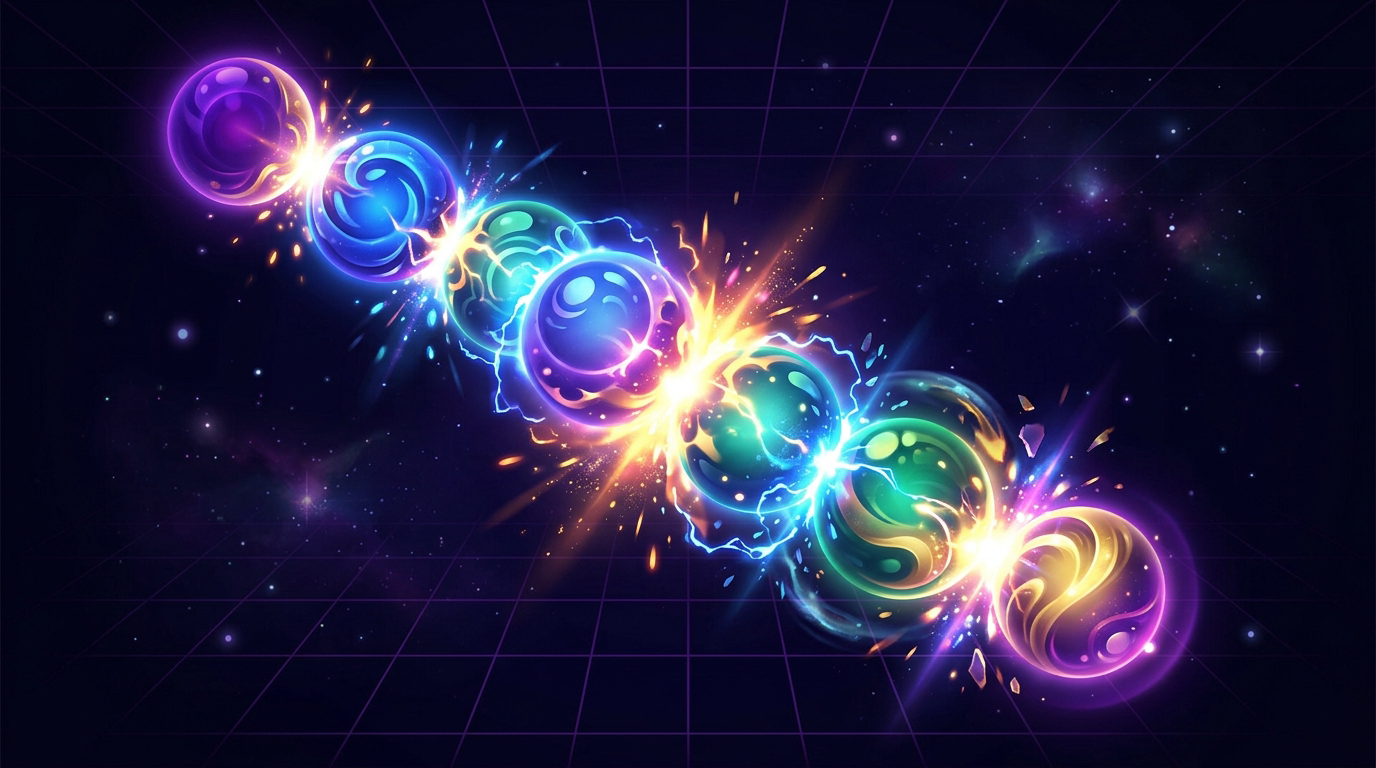
Orb Fusion is a portrait merge-puzzle where the player drops numbered orbs one at a time into a 6-column grid. When two adjacent orbs share the same value they fuse instantly into a doubled orb, which can then chain into further merges. The fantasy is satisfying cascade reactions — a single well-placed orb can trigger a chain that clears half the board and rockets the score.
How to play
Tap (or click) a column to drop the queued orb into it. The orb falls to the lowest empty cell. Any neighbor with the same number merges immediately, applies gravity, and the process repeats recursively. The next orb is previewed in the top-right corner. The game ends when every column is full, or you win by creating a 2048 orb. Desktop: press 1–6 to select a column, Space/Enter to drop, R to restart.
Core mechanics
- Column-drop placement — tap a column to send the active orb straight down.
- Adjacency merge — two orbs with the same value touching (horizontally or vertically) fuse into one doubled orb, scoring the new value.
- Gravity settle — after a merge removes an orb, all orbs above it fall to fill the gap, potentially enabling further merges.
- Recursive chain — the newly merged orb is re-evaluated for additional matches, letting cascades propagate.
- Weighted next-orb pool — the queue favors low values early, scaling up as the highest board orb grows (never producing an orb you can't use yet).
Progression & scoring
Each merge scores the doubled value (e.g. merging two 64s adds 128 to the score). Chain reactions multiply the benefit. Difficulty climbs naturally as the board fills: later drops must be placed more strategically to avoid blocking columns. The next-orb pool gradually introduces larger values as the board progresses. A "Keep Going" mode lets players continue past 2048.
Look & feel
Deep space dark palette — near-black background (#0a0018) with grid lines in translucent purple. Each orb tier has its own radial-gradient color pair (purple → blue → teal → green → gold → red → violet) with a glowing halo. Merge events trigger a brief scale-pop animation. All visuals are canvas-drawn — no image assets. WebAudio is not used; the visual feedback (glow, pop, highlight) provides the tactile satisfaction. The game renders inside a rounded phone bezel on a dark radial backdrop.
What makes it fun
- Chain dopamine — a well-placed orb can trigger 4–5 consecutive merges, each with a satisfying pop and score surge.
- Tighter than 2048 — the 6-column grid with adjacency (not just same-column) merging opens more spatial strategy than the original sliding game.
- Readable at a glance — each tier's distinct color makes board-state assessment instant, even when the grid is dense.
- One-tap depth — the interaction is a single tap per turn, but column choice has meaningful downstream consequences.