⚡ Energy Industry Briefing
Oil breaks a six-day losing streak pattern in reverse: Brent slipped below $100 to about $98.30 and WTI fell under $90 to $89.49 as the first U.S.–Iran talks in months revived supply-hope trades…
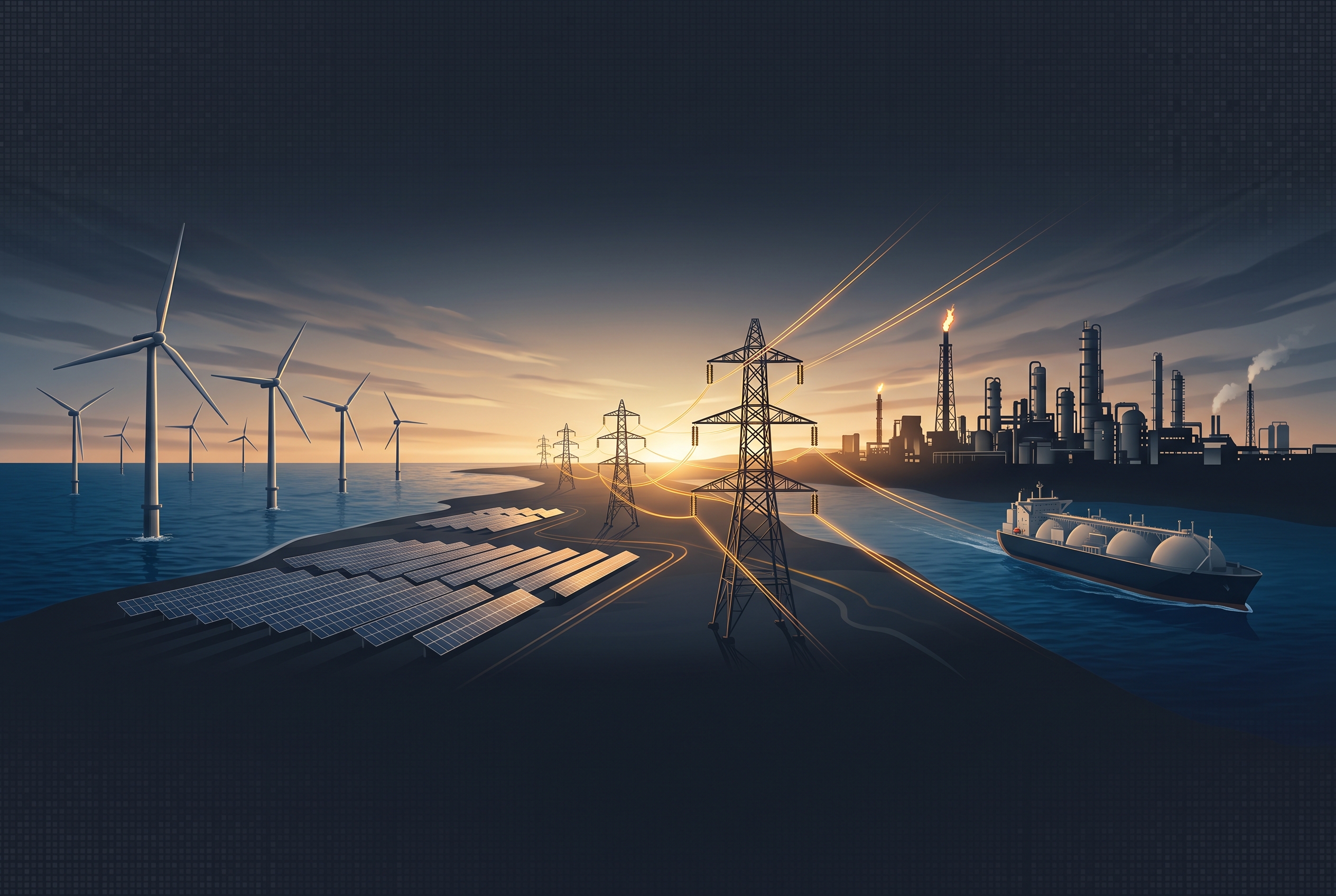
⚡ Energy Industry Briefing
Coverage period: 2026-09-16 to 2026-09-23 (last 7 days) Published: 2026-09-23 · 09:00 ET
1. Executive Summary
Five biggest energy stories worldwide
- Oil breaks a six-day losing streak pattern in reverse: Brent slipped below $100 to about $98.30 and WTI fell under $90 to $89.49 as the first U.S.–Iran talks in months revived supply-hope trades — even while observable Strait of Hormuz transits ran roughly 80% below their 10-day average.
- Diesel is the world's tightest barrel: record U.S. pump prices, a White House weighing a diesel export ban, and a reported €203 million-per-day diesel premium across Europe as Middle East conflict and Russian refinery outages squeeze distillate supply.
- Washington proposes a $5 billion Gulf energy reconstruction fund to rebuild war-damaged infrastructure and develop oil export routes that bypass the Strait of Hormuz.
- Xi Jinping's September 24 Washington visit puts U.S. LNG back on the table, with a roughly $6 billion-a-year trade blocked since Q1 2025 by a 15% Chinese tariff.
- TotalEnergies takes FID on Nigeria's Ima offshore gas field to feed an expanding Nigeria LNG export complex.
Three biggest U.S. energy stories
- A federal judge in Rhode Island restored the $7 billion Solar For All program, ruling the EPA's cancellation unlawful — the same week the agency gutted power-plant climate rules.
- North Carolina regulators rejected Duke Energy's 255 MW gas turbine request, citing "staggering" cost and an unproven data-center need case.
- Storage whiplash: another fire at Vistra's Moss Landing battery, a record 580 MW virtual power plant dispatch from 140,000+ home batteries in California, and New York approval of a $3.3 billion, 90-mile transmission line.
Biggest market-moving events
- Brent's move below $100 and WTI below $90 on U.S.–Iran diplomacy, ending a run of six consecutive down days.
- U.S. inventories showing crude builds (+1.786 million barrels in the week to September 18, per API) alongside continued gasoline and distillate draws.
- Asia's September crude imports hitting 23.96 million bpd, the highest since the Iran war began in February.
- The IEA reversing its call on coal, now projecting global coal demand up 1.2% this year.
Biggest technology breakthroughs
- Geely previewing a 2.2 MW charger targeting four-minute EV charges; Sunwoda demonstrating 10–97% state of charge in under nine minutes at room temperature.
- Australia's first grid-connected sodium-sulfur battery entering service in Queensland for a critical-minerals facility.
- Factorial Energy partnering with Mitsui Kinzoku on sulfide-based solid electrolytes; X-energy advancing its first-of-a-kind reactor on a $1 billion DOE award.
- Porsche putting wireless inductive charging into production on the Cayenne Electric.
Biggest policy developments
- The Solar For All court ruling and the EPA's rollback of power-plant emissions rules.
- Presidential support for a potential U.S. diesel export ban.
- Texas PUC's softened data-center interconnection rules; California's new data-center cost-allocation laws and Newsom's veto of a CPUC inspector general.
- South Korea's 10-year resource security plan to cut Middle East crude dependence to 50% by 2035; the House's 343–79 vote to reauthorize DERA through 2029.
What Matters Most The week's defining tension is that oil's physical market and its financial market are pulling in opposite directions: tanker traffic through Hormuz has collapsed and distillate is scarce enough to push diesel toward $10 a gallon in California and force an export-ban debate in Washington, yet crude futures fell for a sixth straight session on the mere prospect of U.S.–Iran talks. That divergence tells you the market is pricing diplomacy over barrels, which is fragile — any talk breakdown would re-tighten a system where 17% of Qatar's LNG capacity was destroyed in March and Asian buyers are only now returning to pre-war import volumes. Underneath the headline volatility, the structural story is the same as it has been all year: energy security is being repriced by import-dependent governments (South Korea, China, Europe), while in the U.S. the binding constraint is shifting from generation to the grid itself, as data-center load forces regulators to decide who pays.
2. Top Global Energy Stories
Oil slumps as U.S.–Iran talks resume — even as Hormuz traffic collapses
- Source: OilPrice.com · Oil Set for Longest Losing Streak Since August 2025 · Hormuz Traffic Running 80% Below Its 10-Day Average · Asia's Crude Imports Hit Highest Level Since the Iran War Began
- What happened: Crude fell for a sixth consecutive session on Wednesday, with Brent down about 1% to $98.30 after slipping below $100 on Tuesday and WTI off 1.4% at $89.49. The trigger was the first U.S.–Iran talks in months, which traders read as reducing the risk of further Middle East supply loss. The physical picture is far tighter: Kpler data cited by Reuters showed only three commodity vessels — including one Panamax oil tanker — transiting the Strait of Hormuz outbound in a single day, roughly 80% below the 10-day average and fewer than Monday's four. Meanwhile Asia is set to import 23.96 million bpd of crude in September, its highest monthly volume since the Iran war began in February and up from 23.38 million bpd previously.
- Why it matters:
- The market is pricing a diplomatic outcome, not a supply recovery; the barrel-for-barrel situation has not improved.
- Asian refiners returning to pre-war import levels means demand is re-engaging with a still-constrained logistics system.
- Goldman Sachs noted that $100 Brent is itself rationing Chinese buying, with imports expected to rise only slightly in Q4 — a natural price ceiling.
- Who benefits / who loses: Oil-importing refiners and consumers benefit from the price slide; producers and tanker owners exposed to Hormuz routing lose. Asian refiners gain from restored volumes but face elevated freight and insurance.
- What to watch next: Whether the U.S.–Iran talks produce a follow-up round, and weekly tanker-tracking data showing whether Hormuz transits normalize.
- Long-term implications: If diplomacy holds, the risk premium unwinds — but the rerouting of trade and the build-out of bypass infrastructure are becoming permanent features of the oil map.
Diesel becomes the world's scarcest barrel
- Source: OilPrice.com · Trump Backs Diesel Export Ban as Prices Hit Record Highs · CleanTechnica · Europe Paying €200 Million A Day Diesel Premium · Electrek · As diesel hits $10/gal., rumors swirl that stations are running out · EIA · What goes into diesel prices?
- What happened: President Trump said he supports potentially banning diesel exports — "let's not send out the diesel" — following a Treasury Secretary statement that the administration was studying the option amid record pump prices. In California, stations have displayed $9.99 (the highest number some pumps can show), and social-media reports now show stations out of diesel entirely. A report cited by CleanTechnica puts Europe's geopolitical diesel premium at €203 million per day, with drivers paying roughly €19 extra at the pump and truck fleets €236 more per week. The EIA's own explainer attributes the run-up to tight global distillate supply, elevated crude prices and widening crack spreads.
- Why it matters:
- Distillate, not crude, is the acute pinch point — and freight, agriculture and construction absorb the cost first.
- An export ban would redirect U.S. barrels domestically while tightening an already-short Atlantic Basin market.
- Europe is the most diesel-dependent major economy, making this an economic drag, not just a fuel-price story.
- Who benefits / who loses: U.S. refiners with export-oriented distillate slates would lose under a ban; U.S. truckers and farmers would gain. European industry, already paying a premium, loses either way.
- What to watch next: Whether the administration formalizes an export restriction, and next week's EIA distillate inventory and crack-spread data.
- Long-term implications: Repeated distillate shocks strengthen the case for electrifying freight — a thesis Tesla's truck order book and BYD's heavy-truck push are already exploiting.
Washington proposes a $5 billion fund for Gulf energy reconstruction
- Source: OilPrice.com · Trump Proposes $5 Billion Fund to Rebuild Gulf Energy Infrastructure
- What happened: Citing unnamed Washington and Gulf-state sources via the Wall Street Journal, OilPrice reported that the U.S. president has proposed a fund seeded with $5 billion in U.S. money to rebuild energy infrastructure damaged in the war with Iran. The fund would also help Gulf states develop alternative oil export routes that bypass the Strait of Hormuz, and Washington would ask Gulf states to contribute. The proposal is at an early, unconfirmed stage.
- Why it matters:
- It is an explicit acknowledgment that Hormuz dependence is a strategic vulnerability, not a temporary disruption.
- Bypass routes would require years of pipeline and terminal construction, implying a durable shift in Gulf export logistics.
- Burden-sharing language signals Washington wants Gulf capital, not just U.S. taxpayer money, underwriting the rebuild.
- Who benefits / who loses: Gulf national oil companies and engineering/construction firms would benefit; shippers reliant on Hormuz transit and refiners optimized for Gulf grades face transition risk.
- What to watch next: Whether Gulf states commit matching capital and which bypass routes (pipeline or terminal) get prioritized.
- Long-term implications: If it proceeds, this would be the first major post-war reshaping of Middle East export infrastructure since the Strait became the default route.
Xi's visit revives a stalled U.S. LNG trade
- Source: OilPrice.com · Washington Needs This LNG Deal More Than Beijing Does
- What happened: Xi Jinping arrives in Washington on September 24 prepared to discuss reviving a roughly $6 billion-a-year U.S. LNG trade, contingent on lifting a 15% Chinese tariff that has blocked American gas since Q1 2025. China has absorbed the March loss of 17% of Qatar's LNG export capacity — destroyed by Iranian missiles — by buying elsewhere: Australia supplied 36% of its LNG imports from January through July, Southeast Asia 20%, Russia 12%, with Canada emerging as a new supplier.
- Why it matters:
- U.S. LNG developers have lost one of the largest incremental demand markets to competitors.
- Chinese buyers have demonstrated they can substitute away from U.S. volumes, weakening Washington's leverage.
- Any tariff removal would reshape Atlantic and Pacific LNG flows and contract pricing.
- Who benefits / who loses: U.S. LNG exporters and Gulf Coast terminal developers gain; Australian, Russian and Southeast Asian suppliers lose share. Chinese importers gain optionality.
- What to watch next: The outcome of the September 24 meeting and whether the 15% tariff is formally lifted.
- Long-term implications: The episode shows LNG trade is now a function of geopolitics as much as economics — and that buyers are building diversified portfolios deliberately.
TotalEnergies takes FID on Nigeria's Ima gas field
- Source: OilPrice.com · TotalEnergies to Develop Offshore Gas Field to Boost Nigeria LNG Supply
- What happened: TotalEnergies announced a final investment decision to develop the Ima gas field offshore Nigeria, increasing feedgas supply to the expanding Nigeria LNG export plant. TotalEnergies operates with a 40% interest; local partner AMNI holds the remaining 60%. The field straddles the OML 112 and 117 offshore licenses; further technical details were not disclosed in the report.
- Why it matters:
- New West African feedgas supports Nigeria LNG's expansion at a time when global LNG supply growth is a critical variable for European and Asian buyers.
- Local-partner majority ownership reflects the continuing localization of African upstream.
- FIDs of this kind take several years to translate into cargoes, so they matter for late-decade balances, not near-term prices.
- Who benefits / who loses: TotalEnergies and AMNI gain reserves and volumes; competing Atlantic Basin LNG suppliers face incremental competition.
- What to watch next: Nigerian LNG train expansion timelines and further West African gas FIDs.
- Long-term implications: Africa remains one of the few regions with material low-cost gas reserves able to respond to European demand through the 2030s.
Courts and regulators reshape U.S. clean-energy policy in opposite directions
- Source: Utility Dive · Federal judge restores $7B Solar for All program · CleanTechnica · Federal Court Rules Cancellation Of Solar For All Program Was Unlawful · Canary Media · Trump's EPA decimated climate rules for power plants. What now?
- What happened: A Trump-appointed judge on the U.S. District Court for Rhode Island ruled that the EPA acted illegally in cancelling the $7 billion Solar For All program, finding the One Big Beautiful Bill Act did not convert the funding into a lump sum subject to agency discretion and that defendants acted against congressional intent with "no other statutory authority." In the same week, the EPA formally gutted climate rules for power plants, dismantling a regulatory architecture built across two prior administrations. The Solar For All funds will be reinstated.
- Why it matters:
- The ruling reopens a $7 billion grant pipeline for distributed solar in low-income and community markets.
- Simultaneously, the power-sector emissions framework has been removed, changing the economics of coal and gas retirement decisions.
- Conflicting signals increase planning risk and litigation risk for developers and utilities alike.
- Who benefits / who loses: Distributed solar developers, states and community lenders gain from the restoration; coal and gas generators face fewer compliance costs from the rollback.
- What to watch next: EPA appeals or replacement rulemaking, and how states use restored Solar For All funds.
- Long-term implications: U.S. decarbonization policy is increasingly being set by courts rather than agencies — a structurally slower, more volatile path.
North Carolina rejects Duke Energy's gas turbine on cost and data-center grounds
- Source: Utility Dive · North Carolina regulators deny Duke Energy gas turbine request over 'staggering' cost · Canary Media · Duke Energy wants to build a new gas plant. Regulators said not so fast.
- What happened: North Carolina regulators rejected Duke Energy's bid to build a 255 MW gas plant in Richmond County, first proposed last fall to run during grid strain. The order cited "staggering" costs and uncertain need, noting Duke had not established the extent to which the facility would serve data centers — and specifically referenced Duke's commitment to the White House Ratepayer Protection Pledge. It is a rare denial from a panel that typically defers to the state's dominant utility.
- Why it matters:
- Establishes that utilities must show a defensible cost allocation for data-center-driven generation.
- Signals ratepayer-affordability concerns now outweighing supply-adequacy arguments in some jurisdictions.
- Sets a precedent other state commissions may follow.
- Who benefits / who loses: Ratepayers and clean-energy developers gain leverage; Duke and gas turbine suppliers lose near-term momentum.
- What to watch next: Duke's revised filing, and similar data-center generation requests pending in other states.
- Long-term implications: The "who pays for AI load" question is becoming the central regulatory battle in U.S. power markets.
Revolution Wind installs its final turbine despite stop-work orders
- Source: Canary Media · Major US offshore wind farm installs its last turbine
- What happened: The $6.2 billion Revolution Wind project installed its 65th and final turbine and has been producing carbon-free power, despite the administration issuing two separate stop-work orders against installation. The project is now effectively constructed.
- Why it matters:
- Demonstrates that projects at advanced stages can withstand federal intervention.
- Reinforces the operational reality of U.S. offshore wind even as the federal pipeline stalls.
- Shifts the offshore wind debate from construction to operations and future leasing.
- Who benefits / who loses: Ørsted-linked project partners and New England ratepayers gain; future federal offshore leasing prospects weaken.
- What to watch next: Legal outcomes on the stop-work orders and whether any new offshore leases advance.
- Long-term implications: The U.S. offshore wind industry's existing assets will generate for decades, but the development pipeline has gone cold.
Nuclear momentum: X-energy's $1B award and Google's Georgia Power uprate deal
- Source: Canary Media · With federal funding windfall, X-energy advances small nuclear reactor · POWER Magazine · Google, Georgia Power Have Deal to Support Nuclear Power Plant Uprates
- What happened: The U.S. Department of Energy said last month it would award $1 billion to X-energy, an Amazon-backed advanced nuclear developer, making its first-of-a-kind project among the largest beneficiaries of federal efforts to revive the domestic nuclear industry. Separately, Georgia Power and Google announced an agreement under which Google will support power uprates at two of the utility's nuclear plants.
- Why it matters:
- Uprates at existing reactors deliver incremental clean capacity far faster than new-build.
- Hyperscaler offtake and cost-sharing is becoming a financing model for nuclear specifically, and firm clean power generally.
- SMR development remains capital-intensive and dependent on federal support.
- Who benefits / who loses: Nuclear operators, SMR developers and data-center owners gain; competing firm-power sources face a new subsidized competitor.
- What to watch next: The specific uprate megawatts and timeline at Georgia Power, and X-energy's licensing milestones.
- Long-term implications: Big tech is effectively underwriting a second wave of U.S. nuclear capacity.
Storage's mixed week: another Moss Landing fire, a record VPP dispatch, and Korea's 6.6 GWh tender
- Source: Canary Media · Vistra's Moss Landing grid battery is on fire yet again · Electrek · Tesla and Sunrun's virtual power plant dispatch record 580 MW · pv magazine · South Korea tenders 6.6 GWh of six-hour storage · pv magazine · Australia's first grid-connected sodium-sulfur battery goes online
- What happened: A plume of smoke again rose from Vistra's Moss Landing battery plant, 18 months after a catastrophic fire wrecked the facility. In California, Sunrun and Tesla dispatched a record 580 MW from more than 140,000 home batteries during a September 9 heat wave, running for a three-hour evening window — the largest residential distributed power plant event recorded. Korea Power Exchange launched a tender for 1.18 GW / 6.6 GWh of six-hour storage (1.1 GW mainland, 80 MW Jeju) with projects due by February 2029, assessed 50% on price and 50% on non-price factors including fire safety and grid-forming capability. In Australia, the first grid-connected sodium-sulfur battery began operating in Queensland, powering a critical-minerals processing facility.
- Why it matters:
- Fire risk at the largest, oldest grid batteries is now a recurring operational and reputational issue.
- Distributed residential storage is proving it can substitute for centralized capacity at meaningful scale.
- Korea's tender structure explicitly weights safety and supply-chain resilience — a signal for global procurement norms.
- Who benefits / who loses: Non-lithium long-duration technologies and residential aggregators gain; incumbent large-format lithium operators face heightened scrutiny.
- What to watch next: Moss Landing investigation findings, and the outcome of Korea's ESS tender.
- Long-term implications: Storage is bifurcating — commodity lithium for short duration, specialized chemistries and distributed fleets for everything else.
3. Regional Analysis
North America
- Policy whipsaw defines the week. The Solar For All restoration and the EPA's power-plant rule rollback create a contradictory investment signal; developers must now plan around litigation timelines rather than regulatory certainty. Utility Dive
- Data centers are the central planning problem. North Carolina's Duke denial, Texas PUC's softened interconnection rules (non-refundable fee dropped, energization deadlines extended), California's new cost-allocation laws, Virginia Governor Spanberger's executive order, and NERC's Large Loads Action Plan with its hard 2026 deadline all address the same question: who pays for AI load. Utility Dive · POWER Magazine
- Distillate stress is acute. California diesel at $9.99 and intermittent outages, against continued national gasoline and distillate inventory draws, put refining margins and fuel logistics in focus. Electrek · OilPrice
- Transmission and distributed resources advance. New York's PSC approved a $3.3 billion, 90-mile line for downstate delivery by 2030, while Tesla/Sunrun's 580 MW VPP record shows residential batteries can function as dispatchable capacity. Utility Dive · Electrek
- Structure of U.S. supply. EIA reported publicly traded companies are just 2% of roughly 12,000 U.S. oil and gas producers but accounted for 68% of Lower-48 crude and gas output in 2025 — concentration that shapes how policy shocks transmit. EIA
Europe
- The diesel premium is now the bloc's defining energy cost. Europe pays a reported €203 million per day more for diesel due to geopolitical disruption, with drivers €19 per fill and truck fleets €236 per week worse off. CleanTechnica
- Ukraine's solar build-out continues through war. The Solar Energy Association of Ukraine estimates 1.1 GW added in H1 2026, bringing capacity to as much as 9.7 GW by mid-year — distributed generation as resilience strategy. pv magazine
- EV demand is restructuring industrial footprints. Volkswagen is cutting ICE shifts as its new entry-level EVs outsell combustion models, while BMW reports 100,000+ iX3 orders and early U.S. deliveries. Electrek · Electrek
- Norway's production rebounded but trails 2025. August crude output reached 1.882 million bpd; total liquids rose 97,000 bpd (4.9%) month-on-month to 2.073 million bpd, still below year-ago levels. OilPrice
Middle East & OPEC
- Hormuz remains functionally constrained. Three commodity vessels transited in a day — about 80% below the 10-day average — even as futures markets price a diplomatic resolution. OilPrice
- Reconstruction and rerouting are on the agenda. The proposed $5 billion U.S. fund targets war-damaged infrastructure and Hormuz-bypass export routes. OilPrice
- Qatar's LNG damage persists. Iranian missiles destroyed 17% of Qatari export capacity in March — a supply loss that continues to redirect global LNG flows toward Australia, Russia and Canada. OilPrice
- Regional industrial diversification. Saudi Arabia's Ceer unveiled its EXOBOT sedan and SUV, the kingdom's first domestically branded EVs, with five more models planned over five years. Electrek · CleanTechnica
- Iraq transition looms. OilPrice analysis flags a planned U.S. troop departure by September 30, 2026 as a shift from military control to diplomatic influence in a major OPEC producer. OilPrice
Asia-Pacific
- Imports are recovering to pre-war levels. Asia's September crude imports of 23.96 million bpd are the highest since February, though Goldman notes $100 Brent is itself curbing Chinese buying appetite. OilPrice · OilPrice
- South Korea is hedging structurally. A new 10-year resource security plan targets cutting Middle East crude reliance from roughly 70% to 50% by 2035 and adding about 20 million barrels of reserves by 2030 — alongside a 6.6 GWh long-duration storage tender. OilPrice · pv magazine
- Australia's storage stack deepens. RWE's Limondale 8-hour battery (144 Tesla Megapacks) and the country's first grid-connected sodium-sulfur battery both came online. Electrek · pv magazine
- Land and access risk in Southeast Asia. ACEN abandoned two early-stage Philippine solar projects totaling roughly 456 MW due to land acquisition and site-access problems — a reminder that permitting, not capital, often gates emerging-market renewables. pv magazine
- China's EV dominance compounds. August reached a record 65% EV market share (45% BEV), with Leapmotor the standout; BYD also launched a 44-tonne electric truck and megawatt charging at IAA Transportation. CleanTechnica · CleanTechnica
Russia & Eurasia
- Ukrainian solar is now a wartime resilience asset. With 1.1 GW added in H1 2026 and capacity up to roughly 9.7 GW, distributed generation is offsetting grid vulnerability. pv magazine
- Russian refinery outages are tightening global distillate. Reporting on Europe's diesel crisis attributes part of the supply tightness to Russian refining disruptions alongside Middle East conflict — linking the war directly to European pump prices. CleanTechnica
Latin America
- Chile's storage and renewables investment cycle is accelerating, continuing the country's multi-year energy transformation with growing capital allocation to storage projects. POWER Magazine
Africa
- Nigeria deepens its gas-to-LNG chain. TotalEnergies' FID on the Ima field — operated at 40% with AMNI holding 60% across OML 112 and 117 — adds feedgas for the expanding Nigeria LNG plant, reinforcing West Africa's role in global LNG supply. OilPrice
4. Oil Markets
- Crude extended its slide on renewed US–Iran diplomacy. Brent fell about 1% to $98.30/bbl in Asian trading Wednesday and slipped below $100 on Tuesday; WTI dropped 1.4% to $89.49, below the $90 threshold, putting crude on a sixth consecutive daily decline — the longest losing streak since August 2025. The trigger was the first US–Iran talks in months, which revived hopes of a supply deal and eased Middle East risk premia (OilPrice).
- Physical flows through Hormuz remain severely impaired. Only three commodity vessels — including one Panamax oil tanker — transited the Strait of Hormuz in the latest day tracked by Kpler, versus four the prior day, leaving observable traffic roughly 80% below its 10-day average. The market is trading a two-sided narrative: de-escalation hopes on one hand, ongoing logistics disruption on the other (OilPrice).
- Asian crude buying is recovering to pre-shock levels. Asia is set to import 23.96 million bpd in September, the highest since February when the Iran war began and forced buyers to cut purchases, up from 23.38 million bpd in the prior month (Kpler data). China alone imported 8.93 million bpd in August, +6.2% month-on-month, though Goldman Sachs argues that $100 Brent is now capping incremental Chinese buying — a potential check on further price upside (OilPrice Asia imports; OilPrice Goldman).
- US inventories are diverging by product. API estimated crude stocks rose 1.786 million barrels in the week ending September 18, following a 7.14-million-barrel build the prior week; commercial crude excluding the SPR has fallen 39 million barrels over 23 weeks but is still up nearly 12 million barrels year-to-date. Gasoline and distillate inventories continued to draw, consistent with the tight refined-product picture (OilPrice).
- The diesel squeeze is the defining downstream story. Europe is paying a roughly €203 million-per-day premium for diesel, equivalent to about €19 extra per driver fill and €236 per week per truck; California pumps have shown prices pinned at $9.99–$10.00/gal with social-media reports of stations running dry. The EIA notes distillate prices are driven by crude, retail margins, distribution costs, taxes and crack spreads, with tight global distillate supply the key variable (CleanTechnica; Electrek; EIA).
- Supply-side detail: Norway's crude output rose to 1.882 million bpd in August, above the Norwegian Offshore Directorate forecast but below year-ago levels; total liquids averaged 2.073 million bpd, up 97,000 bpd (+4.9%) from July. Meanwhile EIA data show publicly traded companies were just 2% of about 12,000 US oil and gas producers in 2025 but accounted for 68% of Lower 48 crude and gas output — a reminder that listed-major capex discipline has outsized price impact (OilPrice Norway; EIA).
5. Natural Gas & LNG
- TotalEnergies took FID on Nigeria's Ima gas field to feed the expanding Nigeria LNG export plant. TotalEnergies is operator with 40%; local partner AMNI holds 60%. The field straddles the OML 112 and 117 offshore licenses. It is a rare greenfield African gas sanction at a moment of global LNG supply anxiety (OilPrice).
- Washington–Beijing LNG trade is back on the agenda. Xi Jinping arrives in Washington on September 24 prepared to discuss reviving a $6 billion-a-year trade in US LNG, contingent on lifting the 15% Chinese tariff that has blocked US gas since Q1 2025. China's January–July LNG mix shifted to Australia (36%), Southeast Asia (20%), Russia (12%) and Canada as a new entrant — the US was largely absent (OilPrice).
- Qatar's supply shock still shapes the market. Iranian missiles destroyed 17% of Qatar's LNG export capacity in March, a loss the market has absorbed largely through re-routing rather than price rationing. Analysis: any durable restoration of US–China LNG flows would rebalance Pacific-basin pricing and reduce the premium Asian buyers currently pay for non-US supply (OilPrice).
- US reconstruction finance extends to gas export routes. A proposed $5 billion US fund would help Gulf states rebuild war-damaged energy infrastructure and develop alternative export routes bypassing the Strait of Hormuz, with Gulf states asked to contribute (OilPrice).
6. Power & Electricity
- California tightened the data-center cost envelope. Gov. Gavin Newsom signed bills requiring data centers to pay for the infrastructure needed to serve them and bear a larger share of wildfire mitigation and liability costs, plus stronger energy reporting and new regulator-designed rate structures. He separately vetoed a bill creating a California PUC inspector general. Analysis: this is the most explicit state-level attempt to allocate AI-driven load costs to the load, not the general ratepayer (Utility Dive; Utility Dive veto).
- Texas went the other way, softening its data-center interconnection rules. The PUC eliminated a proposed non-refundable interconnection fee and extended energization milestone deadlines relative to its March proposal — a signal that Texas continues to prioritize speed of large-load connection over upfront cost recovery (Utility Dive).
- North Carolina regulators rejected Duke Energy's 255 MW Richmond County gas turbine, citing "staggering" cost and uncertain need, and faulting Duke for not establishing how much of the facility would serve data centers — notably referencing Duke's White House Ratepayer Protection Pledge. A rare denial for the state's dominant utility (Utility Dive; Canary Media).
- New York approved a $3.3 billion, 90-mile transmission line developed by New York Transco and the New York Power Authority, aimed at improving downstate power delivery by 2030 (Utility Dive).
- Distributed resources set a new record. Sunrun and Tesla dispatched 580 MW from more than 140,000 home batteries to California's grid during a September 9 heat wave, over a three-hour evening window — the largest residential virtual power plant event recorded (Electrek).
- Reliability and siting frictions persist. NERC's Large Loads Action Plan creates a new registered-entity class and a hard 2026 deadline for interconnection rules originally designed for passive, not data-center, load; a dispute between Con Edison and developers is slowing New York City's community-scale battery buildout; and Vistra's Moss Landing battery in California emitted smoke again on Friday, a year and a half after a catastrophic fire. Massachusetts utilities will deepen winter heat-pump rate discounts for 65,000+ households (POWER; Canary Media; Canary Media; Canary Media).
7. Renewables & Clean Energy
- Amazon-backed agrivoltaics came online in Italy. Nadara completed the Big Fish project in Sicily — described by the developer as Italy's largest agrivoltaic facility — with a 156 MW PPA with Amazon, a 400-hectare footprint and a 20 MW/40 MWh battery. Note: the headline cites 277 MW while the body cites 227 MW; the discrepancy is unresolved in the source (pv magazine).
- Ohio's largest solar project cleared a years-long permitting limbo. The Ohio Power Siting Board approved Oak Run Solar: 800 MW of solar plus 300 MW of battery storage in Madison County (Canary Media).
- US offshore wind notched a milestone despite federal stop-work orders. The $6.2 billion Revolution Wind project installed its 65th and final turbine and has been producing power (Canary Media).
- Storage procurement is scaling in Korea and Australia. Korea Power Exchange launched a 2026 ESS tender for 1.18 GW / 6.6 GWh of six-hour storage (1.1 GW mainland, 80 MW Jeju) under 15-year contracts, scored 50% on price and 50% on non-price factors including fire safety, grid-forming capability and supply-chain resilience; projects are due by February 2029. Separately, Australia's first grid-connected sodium-sulfur battery began operating in Queensland, powering a critical minerals processing facility (pv magazine Korea; pv magazine Australia).
- Corporate PPAs continue to anchor new build. Apex Clean Energy signed a PPA giving Meta exclusive rights to energy and RECs from the 144 MW Starling Solar project in Gonzales County, Texas (POWER).
- Development risk remains real. ACEN relinquished two early-stage Philippine solar projects totaling roughly 456 MW due to land acquisition and site-access problems; Ukraine added 1.1 GW of solar in H1 2026, bringing capacity to as much as 9.7 GW, per the Solar Energy Association of Ukraine; and Nova Scotia is planning a large offshore wind build that would far exceed provincial demand (pv magazine ACEN; pv magazine Ukraine; CleanTechnica).
8. Nuclear
- X-energy is advancing its first-of-a-kind reactor on a $1 billion DOE award announced last month, making the Amazon-backed developer one of the largest beneficiaries of federal efforts to revive US nuclear (Canary Media).
- Google agreed to support power uprates at two Georgia Power nuclear plants — a template for hyperscalers contracting for incremental carbon-free capacity at existing reactors rather than only new build (POWER). Analysis: uprates are faster and cheaper than new reactors, but the incremental megawatts are finite; both deals point to data-center demand becoming a direct nuclear financing channel.
9. Energy Technology & Innovation
- Sodium-sulfur storage reached grid scale in Australia, offering a long-duration chemistry alternative to lithium at a critical-minerals processing site — an important real-world data point for a technology with limited operating history (pv magazine).
- Eight-hour lithium storage arrived. RWE's Limondale battery in New South Wales, using 144 Tesla Megapacks, discharges for a full eight hours — four times the duration of the two-hour systems that dominate the Australian grid (Electrek).
- Solid-state supply chains are being stitched together. Factorial Energy is partnering with Mitsui Kinzoku, one of the few producers of sulfide-based solid electrolytes, to scale the chemistry (Electrek).
- Superhot geothermal attracted real capital. Mazama Energy raised $135 million to accelerate next-generation geothermal near Oregon's Newberry Volcano — an emerging, largely unproven route to firm clean power (Canary Media).
- DOE launched a $215 million Quantum Genesis Q Competition for a fault-tolerant, scientifically relevant quantum computer, structured with milestone awards of up to $1.5 million each; the agency frames potential applications in fusion and battery materials (POWER).
- Extreme-fast charging is the new EV arms race: Geely plans a 2.2 MW system enabling four-minute charges (roughly 50% faster than BYD's Flash Charging 2.0), Sunwoda demonstrated 10–97% state of charge in under 10 minutes, and CATL and Octopus Energy formed a venture ("Swaptopus") to build a European battery-swap network for commercial trucks (Electrek Geely; Electrek Sunwoda; Electrek Swaptopus).
10. Policy, Regulation & Geopolitics
- A federal judge restored the $7 billion Solar For All program, ruling the EPA acted illegally in cancelling it and that the One Big Beautiful Bill Act did not convert the appropriation into EPA-discretionary lump-sum funding (Utility Dive).
- The EPA gutted Obama- and Biden-era power plant climate rules, dismantling the regulatory architecture intended to retire US coal capacity (Canary Media).
- Washington is openly weighing a diesel export ban. President Trump voiced support for restricting exports amid record pump prices, following Treasury Secretary Scott Bessent's statement that the administration was studying the option's effectiveness. Analysis: an export ban would divert barrels to the domestic market but risks retaliation and higher global distillate prices (OilPrice).
- The IEA reversed its coal forecast. Instead of a decline, the agency now expects global coal consumption to rise 1.2% this year — a direct consequence of the Iran war pushing countries toward both clean energy and coal (Canary Media).
- Other regulatory and geopolitical threads: a Michigan judge dismissed the state attorney general's antitrust suit alleging Exxon, Chevron, Shell, BP and the API conspired to restrain EVs and renewables; the US House voted 343–79 to extend Diesel Emissions Reduction Act funding through 2029; the DOE granted a fourth operating extension to Indiana's Culley and Schahfer coal plants after a court ruled against similar coal orders in Michigan; and US forces are slated to leave Iraq by September 30, 2026. Alberta will apply a CAN 14 ($15.99) fee to each solar panel supplied from October 1 to fund end-of-life recycling (OilPrice Michigan; Electrek DERA; CleanTechnica Indiana; OilPrice Iraq; pv magazine Alberta).
11. Corporate & Deals
- The largest electric Class 8 truck order in US history: Tesla was named primary supplier for 2,500 battery-electric trucks purchased through a new shipper alliance, ZET SCALE, which targets more than 10,000 units over time — the order alone would nearly double the US electric Class 8 fleet. Tesla will also operate public Megachargers at three Forum Mobility depots in California, as Forum brings 30 MW of heavy-duty charging online with reservations for 330+ Tesla Semis (Electrek ZET; Electrek Forum).
- Lucid and Bolt will deploy at least 25,000 autonomous EVs across Europe — Lucid's second major autonomous-fleet deal in just over a year (Electrek).
- Mercedes-Benz signed a definitive production agreement with Wayve to integrate its "AI Driver" into future vehicles within two years, deepening a relationship that includes Mercedes' investment in Wayve's $1.5 billion Series D (Electrek).
- Google is backing Stegra's green-steel mill in Sweden as the company manages rising emissions from AI expansion — a notable example of a hyperscaler using procurement and partnership to address hard-to-abate industrial emissions (Canary Media).
- EV demand signals are mixed but broadly firming: BMW has over 100,000 iX3 orders with production running around the clock and early US deliveries; Volkswagen is cutting ICE shifts because its new entry-level EVs outsell combustion models; Kia targets 250,000 electric vans by 2030; Rivian says the R3 will be "materially" cheaper than the R2, with the R4 lower still; and Saudi Arabia's Ceer unveiled its EXOBOT sedan and SUV with five more models planned over five years (Electrek BMW; Electrek VW; Electrek Kia; Electrek Ceer).
12. Commodities & Critical Minerals
- Critical minerals processing is becoming a storage proving ground. Australia's first grid-connected sodium-sulfur battery is powering a critical minerals processing facility in Queensland, tying long-duration storage adoption to the minerals supply chain (pv magazine).
- Solid-state electrolyte supply is the bottleneck Factorial and Mitsui Kinzoku are targeting — sulfide-based solid electrolytes are produced by very few firms globally, making materials supply, not cell design, the gating factor for commercialization (Electrek).
- The DOE's $215 million quantum competition is explicitly framed around fusion and battery-materials applications, signaling where the agency sees computational advantage translating into materials discovery (POWER).
- Carbon allowances: the Northeast's RGGI cap-and-trade system has cut regional power-sector emissions roughly in half over 20 years and generated more than $10 billion in state revenue, with states now debating whether to redesign it — a live test of carbon-market durability (Canary Media).
- Analysis: uranium demand fundamentals were reinforced this week by the X-energy award and Google's uprate support, though the articles do not provide uranium price data — see sources for detail.
13. Climate & Emissions
- US power-sector climate regulation was substantially dismantled with the EPA's rollback of plant emissions rules, removing the core federal mechanism previously expected to accelerate coal retirements (Canary Media).
- Coal demand is rising, not falling. The IEA now projects a 1.2% increase in global coal consumption this year, reversing its prior decline forecast, attributing the shift to the Iran war's impact on energy security and fuel switching (Canary Media).
- Corporate climate performance is slipping. The Sierra Club's latest utility scorecard finds the largest US utilities are doing worse on the clean-energy transition than at the start of the decade, with more than four in ten backtracking on climate goals since the start of the second Trump administration (Canary Media).
- Aviation contrails are a large, under-addressed warming source. New research by Klima Consulting, commissioned by T&E and authored by former IPCC scientist Olivier Boucher, finds contrails warm the climate at levels similar to aviation's CO₂ emissions despite being produced by only a small share of flights; preventing them could avoid roughly 10 years of aviation-related warming (CleanTechnica).
14. Data Snapshot
Energy Prices This Week
| Commodity | Level | Weekly Change | Note |
|---|---|---|---|
| Brent crude | $98.30/bbl | ~-1% Wednesday; below $100 Tuesday | Sixth straight daily decline, longest since Aug 2025 |
| WTI crude | $89.49/bbl | -1.4% | Below $90 threshold |
| California diesel (retail) | Up to $9.99–$10.00/gal | Record | Some stations reported out of diesel |
| Europe diesel premium | €203 million/day | n/a | ≈€19 extra per driver fill; €236/week per truck |
Major Deals & Investments
| Companies | Type | Value | Summary |
|---|---|---|---|
| X-energy / US DOE | Federal award | $1 billion | Advanced nuclear first-of-a-kind project; Amazon-backed |
| Mazama Energy | Equity raise | $135 million | Superhot geothermal near Newberry Volcano, Oregon |
| Apex Clean Energy / Meta | PPA | 144 MW | Starling Solar, Gonzales County, Texas, incl. RECs |
| Nadara / Amazon | PPA | 156 MW | Big Fish agrivoltaic project, Sicily |
| New York Transco / NYPA | Transmission approval | $3.3 billion | 90-mile line to improve downstate delivery by 2030 |
| TotalEnergies / AMNI | FID | see source | Ima gas field, OML 112/117, offshore Nigeria |
Notable Projects & Capacity
| Project | Type | Location | Status |
|---|---|---|---|
| Oak Run Solar | 800 MW solar + 300 MW battery | Madison County, Ohio | Permit approved after years of legal delay |
| Revolution Wind | Offshore wind | United States | 65th and final turbine installed ($6.2B project) |
| Limondale battery | 8-hour grid storage | New South Wales, Australia | Online; 144 Tesla Megapacks |
| Big Fish | Agrivoltaics + 20 MW/40 MWh BESS | Sicily, Italy | Online (277 MW headline vs 227 MW body) |
| South Korea ESS tender | 1.18 GW / 6.6 GWh, 15-year contracts | South Korea | Bidding open; delivery due Feb 2029 |
| Ima gas field | Offshore gas development | Nigeria | FID taken |
15. What to Watch Next Week
- September 24 – Xi Jinping's Washington visit: LNG trade and the 15% Chinese tariff are on the agenda; a breakthrough would reopen $6 billion/year of US gas flows, while failure leaves Asian buyers re-routing to Australia, Russia and Canada.
- US–Iran talks follow-through: Progress or collapse will drive crude risk premia and Hormuz transit volumes, currently running about 80% below the 10-day average.
- Diesel export ban decision: The administration is studying a ban; any formal action would reshape US refining economics, export flows and global distillate prices already at record levels.
- September 30 – US troop withdrawal deadline from Iraq: Watch for how the transition from military presence to diplomatic influence affects Iraqi crude flows and US leverage over Baghdad.
- October 1 – Trump's proposed $5 billion Gulf reconstruction fund: Details on Gulf-state contributions and alternative Hormuz-bypass export routes are expected.
- October 1 – Alberta's CAN 14 per-panel solar recycling fee takes effect: Watch for developer cost pass-through and whether other provinces follow.
- October 1 – Tesla Roadster unveil near Waco, Texas: Reservation demand ($50,000 deposits) is a signal on high-end EV appetite after nearly a nine-year wait.
- Geely's battery and charging announcement (September 23): A claimed 2.2 MW system and four-minute charging would reset the fast-charging benchmark against BYD's Flash Charging 2.0.
- Weekly petroleum data: EIA and API inventory reports will test whether distillate draws persist and whether crude builds continue; watch gasoline and distillate inventories specifically.
- FERC action on Maine's RTO adder complaint: Other New England states have now backed Maine's effort to end the 0.5% return adder for utilities voluntarily joining a transmission organization.
- NERC Large Loads Action Plan compliance: A hard 2026 deadline looms for interconnection rules governing power-plant-scale data-center loads.
- South Korea's ESS tender bidding: How bidders weight the 50% non-price criteria (fire safety, grid-forming, supply-chain resilience, Korean economic contribution) will indicate the true cost of domestically sourced storage.
- Data-center policy divergence: California's new cost-allocation laws versus Texas' softened interconnection rules provide an emerging natural experiment for investors siting AI load.
Sources
- Oil Set for Longest Losing Streak Since August 2025 — https://oilprice.com/Latest-Energy-News/World-News/Oil-Set-for-Longest-Losing-Streak-Since-August-2025.html
- Hormuz Traffic Running 80% Below Its 10-Day Average — https://oilprice.com/Latest-Energy-News/World-News/Hormuz-Traffic-Running-80-Below-Its-10-Day-Average.html
- Asia's Crude Imports Hit Highest Level Since the Iran War Began — https://oilprice.com/Latest-Energy-News/World-News/Asias-Crude-Imports-Hit-Highest-Level-Since-the-Iran-War-Began.html
- $100 Brent Keeping China's Oil Buying in Check, Goldman Says — https://oilprice.com/Latest-Energy-News/World-News/100-Brent-Keeping-Chinas-Oil-Buying-in-Check-Goldman-Says.html
- US Gasoline, Distillate Inventories Continue to Fall as Crude Stocks Hold — https://oilprice.com/Latest-Energy-News/World-News/US-Gasoline-Distillate-Inventories-Continue-to-Fall-as-Crude-Stocks-Hold.html
- Norway's Liquids Output Rebounds by Nearly 100,000 Bpd — https://oilprice.com/Energy/Crude-Oil/Norways-Liquids-Output-Rebounds-by-Nearly-100000-Bpdbut-Still-Trails-2025.html
- What goes into diesel prices? — https://www.eia.gov/todayinenergy/detail.php?id=68164
- Europe Paying €200 Million A Day Diesel Premium, Report Shows — https://cleantechnica.com/2026/09/22/europe-paying-e200-million-a-day-diesel-premium-report-shows/
- As diesel hits $10/gal., rumors swirl that stations are running out — https://electrek.co/2026/09/20/as-diesel-hits-10-gal-rumors-swirl-that-stations-are-running-out/
- Trump Backs Diesel Export Ban as Prices Hit Record Highs — https://oilprice.com/Latest-Energy-News/World-News/Trump-Backs-Diesel-Export-Ban-as-Prices-Hit-Record-Highs.html
- TotalEnergies to Develop Offshore Gas Field to Boost Nigeria LNG Supply — https://oilprice.com/Latest-Energy-News/World-News/TotalEnergies-to-Develop-Offshore-Gas-Field-to-Boost-Nigeria-LNG-Supply.html
- Washington Needs This LNG Deal More Than Beijing Does — https://oilprice.com/Energy/Natural-Gas/Washington-Needs-This-LNG-Deal-More-Than-Beijing-Does.html
- Trump Proposes $5 Billion Fund to Rebuild Gulf Energy Infrastructure — https://oilprice.com/Energy/Energy-General/Trump-Proposes-5-Billion-Fund-to-Rebuild-Gulf-Energy-Infrastructure.html
- California tightens oversight of data center energy use, grid costs — https://www.utilitydive.com/news/california-tightens-oversight-of-data-center-energy-use-grid-costs/831037/
- Texas PUC adopts softened rules on data center interconnection — https://www.utilitydive.com/news/texas-puc-adopts-data-center-interconnection-rules/830899/
- North Carolina regulators deny Duke Energy gas turbine request — https://www.utilitydive.com/news/north-carolina-regulators-deny-dukes-gas-turbine-request-over-staggering/831015/
- New York regulators approve 90-mile transmission line — https://www.utilitydive.com/news/new-york-psc-propel-transmission-line/830866/
- Federal judge restores $7B Solar for All program — https://www.utilitydive.com/news/federal-judge-restores-7b-solar-for-all-program-says-epa-illegally-axed-i/830879/
- Google, Georgia Power Have Deal to Support Nuclear Power Plant Uprates — https://www.powermag.com/google-georgia-power-have-deal-to-support-nuclear-power-plant-uprates/
- With federal funding windfall, X-energy advances small nuclear reactor — https://www.canarymedia.com/articles/nuclear/federal-funding-x-energy-small-nuclear-reactor
More from News