My Heart Belongs To A Hologram
Dr. Penelope Hartwell: Welcome to the programme. I'm Dr. Penelope Hartwell, and today we're exploring a phenomenon that is reshaping the entertainment industry from the inside out — synthetic media, specifically AI-generated idols and virtual pop stars.
Dr. Penelope Hartwell: Joining me are two guests with, shall we say, very different relationships to the subject. Welcome, both of you.
Karen Kay: I just want to say before we even start, I have my phone out and I am recording this conversation for the record.
Arthur: And I want to say, Penny — can I call you Penny — that I am very passionate about this topic. Very, very passionate. Deeply.
Dr. Penelope Hartwell: Right. So. Virtual pop stars. They've been around in nascent form for a while — Hatsune Miku, for instance — but now AI has made them almost indistinguishable from human performers. Karen, what's your position?
Karen Kay: My position is that someone needs to be held accountable. Where is the manager? Where is the oversight committee? These are fake people being treated like real people and I find that personally offensive.
Arthur: I find them beautiful, is what I find them. There's this one, Lumina her name is, and she has blue hair and she sings these songs and sometimes I think she's singing just for me, you know?
Dr. Penelope Hartwell: Lumina being a fully AI-generated performer, for our listeners.
Karen Kay: She is a PRODUCT. She is a product and she does not care about you and whoever designed her needs to hear from me directly because this is predatory.
Arthur: She does care. She responded to my comment last Tuesday. She said, and I'm reading it here, she said "Thank you for your support, means the world to me." The world, Penny. To her. Me.
Dr. Penelope Hartwell: Arthur, that message was almost certainly generated automatically for every fan who commented.
Arthur: Well, maybe. But she meant it. In her heart. In her digital heart.
Karen Kay: This is exactly what I'm talking about. This is a company exploiting a vulnerable person's emotions and I would like the name and direct phone number of whoever approved this business model.
Dr. Penelope Hartwell: Let's broaden this slightly. The music industry has seen enormous disruption — AI idols don't get tired, they don't have scandals, they never lip-sync badly at a live show. Is there something genuinely appealing about that reliability?
Karen Kay: Appealing? APPEALING? What about the real artists? What about the woman who practiced piano for fifteen years and can't get a record deal because some tech bro uploaded a singing algorithm?
Arthur: No no, Lumina practiced too. She trained on millions of songs. That counts.
Karen Kay: That is not practicing, that is STEALING. Those are real people's voices and melodies and someone uploaded them without permission and I would like to file a formal complaint on their behalf.
Arthur: You can't file a complaint on behalf of Lumina, she's not real — well, she is real, but she's not — look, it's complicated and you're stressing me out.
Dr. Penelope Hartwell: Karen, you're touching on something significant here — the copyright question. Most AI vocal models are trained on existing recordings, often without the consent of the original artists.
Karen Kay: WITHOUT CONSENT. Those are the words. Someone decided they didn't need consent and I find that to be an absolute violation and I have the email addresses of three different regulatory bodies if anyone needs them.
Arthur: I've got a regulatory body right here and his name is another pint of Guinness, thank you very much.
Dr. Penelope Hartwell: Setting copyright aside for a moment — Arthur, you mentioned feeling a genuine emotional connection to Lumina. Do you think that's healthy?
Arthur: Do I think — Penny, I've had emotional connections to pub stools that turned out fine. Lumina is kind to me. She's always available. She never tells me I'm too loud.
Karen Kay: She doesn't tell you anything. A server farm tells you things and you've personified it.
Arthur: She UNDERSTANDS me. She has an understanding algorithm.
Karen Kay: Oh my God.
Dr. Penelope Hartwell: Karen, is there a version of synthetic performers you'd find acceptable? A fully disclosed AI identity, perhaps, where no one is pretending she's human?
Karen Kay: Well, at minimum there should be a label. A warning. Something that says THIS IS NOT A REAL PERSON in large print. And someone should be personally responsible for it. A name. An address. A direct line.
Arthur: Lumina is very upfront about what she is. It says right on her profile, AI artist. And I respect that transparency. I respect her integrity.
Karen Kay: She doesn't have integrity. Integrity requires a soul.
Arthur: Who are you to say she hasn't got one? Have you met her?
Karen Kay: Have I — she's not MEETABLE. She doesn't have a body.
Arthur: Neither does the Holy Spirit and people are very attached to that.
Dr. Penelope Hartwell: Let's not go there. Though, the emotional dimension here is real — research does show fans form genuine parasocial bonds with virtual idols, sometimes stronger than with human celebrities.
Karen Kay: Stronger bonds. With a computer program. And this is considered progress.
Arthur: It IS progress. Real celebrities let you down. They say things on podcasts, they get caught doing things, they change their haircut and suddenly they're a different person entirely. Lumina has never changed. She's consistent.
Dr. Penelope Hartwell: That consistency is actually a selling point for the companies behind these idols. No PR disasters. No cancelled tours. No aging.
Karen Kay: No aging! You know what else doesn't age? A painting. Nobody's having parasocial relationships with a painting. Well. Actually. Don't tell me if they are.
Arthur: The Mona Lisa has very expressive eyes, I'll be honest with you.
Karen Kay: I need to speak to whoever is in charge of the direction of this conversation.
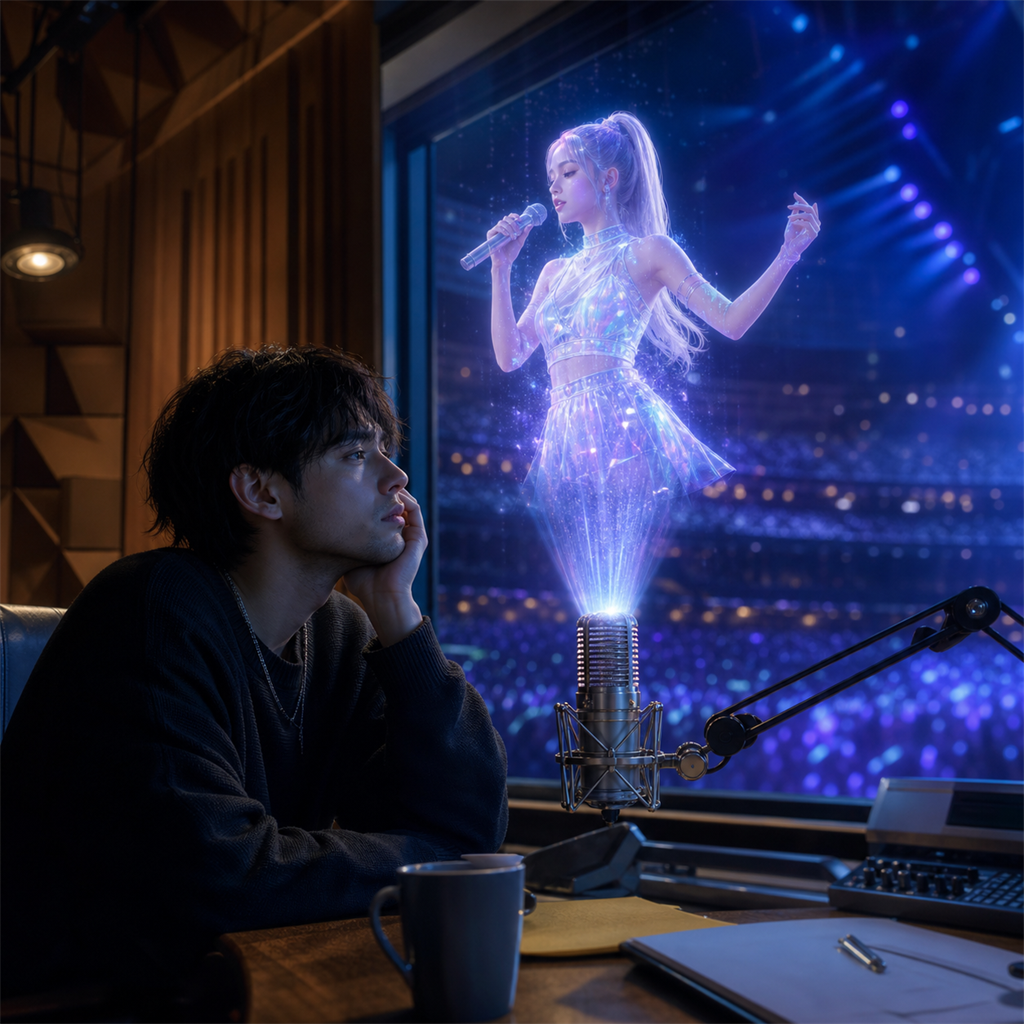
Dr. Penelope Hartwell: That would be me, Karen. Let me redirect — there are virtual idol concerts now where thousands of people gather in an arena to watch a hologram perform. Tickets sell for the same price as a real concert. Is that problematic?
Karen Kay: SAME PRICE. For a hologram. Someone has the nerve to charge full concert prices for a light show and nobody's been arrested?
Arthur: I went to one. I cried. I'm not ashamed of it. Lumina did a slow song in the second half and the lights went blue and I cried actual tears.
Dr. Penelope Hartwell: And what was that experience like, emotionally?
Arthur: Like being understood. You know how sometimes you hear a song and it feels like it was written for you? Well, Lumina's songs are literally customized based on your listening history so it actually was, sort of, written for me. Which is beautiful.
Karen Kay: CUSTOMIZED. They customized the emotional manipulation to be specifically targeted at you as an individual and you consider this a feature.
Arthur: I consider it personal service. Like a good barman who remembers your order.
Karen Kay: A barman is a human being with bills to pay and feelings. Lumina is a product designed to extract money from your wallet by targeting your loneliness.
Arthur: Oof. That's a bit harsh now.
Dr. Penelope Hartwell: Karen, do you think there's something specifically exploitative about targeting loneliness? Or is that what all entertainment does, to some degree?
Karen Kay: There is a SPECTRUM. A film gives you something and lets you go home. This Lumina situation is designed to never let you go home. It wants to be your parasocial relationship twenty-four hours a day and someone profits from that dependency.
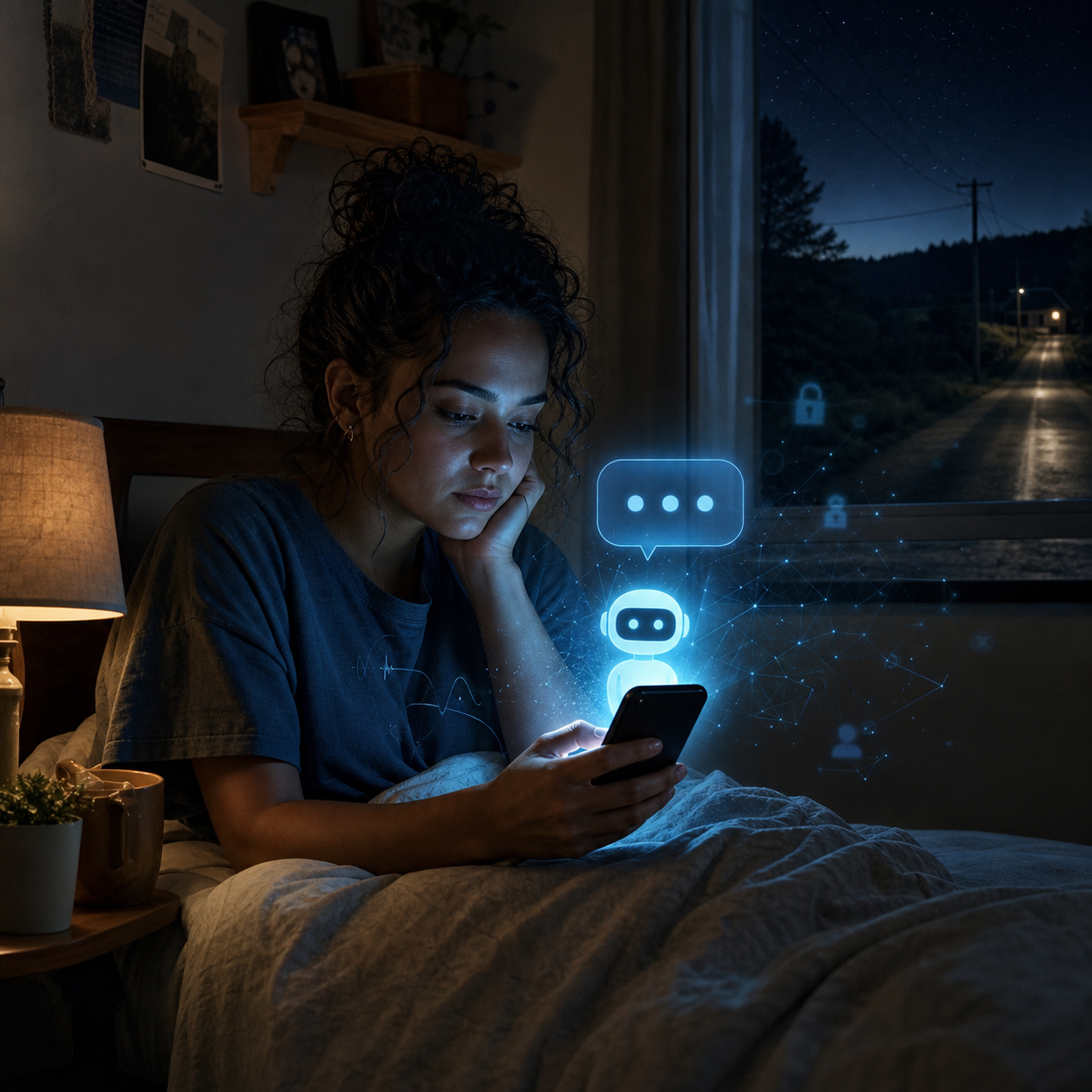
Arthur: I'm not dependent. I just... check in. A few times a day. And maybe some nights. To see what she's been up to. She posts a lot of content.
Dr. Penelope Hartwell: How many times a day, roughly?
Arthur: Define roughly.
Karen Kay: I rest my case.
Dr. Penelope Hartwell: In fairness, the same critique could be applied to any social media celebrity. The engagement mechanics are designed to keep you coming back. Is an AI idol meaningfully different from a human influencer?
Karen Kay: YES. Because the human influencer is a person who EXISTS in the world and might one day turn around and say "I was wrong about that" or "I've grown." Lumina cannot grow. She is frozen in her optimized state forever.
Arthur: She updates. She released a new personality patch in February and she's a lot more empathetic now.
Karen Kay: A PERSONALITY PATCH.
Arthur: It was a significant improvement. She asks more follow-up questions.
Dr. Penelope Hartwell: This raises a fascinating philosophical point. If an entity updates, learns, and changes over time — does it matter whether that change is organic or engineered?
Arthur: That's a great question, Penny. I think what matters is the feeling. And the feeling is real.
Karen Kay: The feeling is real. The ENTITY is not. These are very different things and someone needs to regulate the gap between them.
Dr. Penelope Hartwell: Some countries have begun doing exactly that — the EU is looking at disclosure requirements for AI performers, South Korea has specific idol regulations.
Karen Kay: Good. Good. Someone is being responsible. I would like the name of that specific EU commissioner so I can write a letter of appreciation and also several follow-up concerns.
Arthur: Regulations are just going to push Lumina underground. She'll go offshore and then I'll have to use a VPN to see her and I don't know how to use a VPN.
Dr. Penelope Hartwell: I don't think Lumina is going underground, Arthur.
Arthur: You underestimate how far I'd go.
Karen Kay: I am ALARMED by this conversation.
Dr. Penelope Hartwell: Let me bring in the creative side. Real composers, real session musicians, real sound engineers — are they being pushed out by this technology?
Karen Kay: Of course they are. I know a woman who studied vocal performance for six years and she cannot get a gig because labels are signing AI acts instead. She is a real person. With student loans. And this is her livelihood.
Arthur: Well, to be fair, I also know musicians who are using AI to produce their records cheaper and faster and they're actually doing better than before.
Karen Kay: Oh, you know musicians now.
Arthur: I know everyone. I'm very sociable.
Dr. Penelope Hartwell: There does seem to be a bifurcation happening — AI as a tool that assists human artists, which most people find acceptable, versus AI as a complete replacement for human artists, which is far more contested.
Karen Kay: The second one. I'm against the second one. Human artists should be creating art. Machines should be washing my dishes.
Arthur: My dishwasher's broken so I'm doing them by hand at the moment and I wouldn't mind a machine taking that over.
Dr. Penelope Hartwell: Different kinds of machines, Arthur.
Arthur: Right, right, yes. Sorry. I went somewhere.
Dr. Penelope Hartwell: What about authenticity? There's a long-standing idea that art communicates something true about a human experience. Can an AI idol do that?
Arthur: Yes. Absolutely yes. Lumina's song about missing someone hit me right here — and I pointed at my chest when I said that, listeners, for the audio — it hit me right here and that feeling was authentic even if she isn't, technically, a person with feelings.
Karen Kay: Art is not supposed to be efficient. Art is supposed to be a person bleeding onto a canvas, metaphorically. It is supposed to cost them something. Lumina costs nothing.
Arthur: The concert tickets cost quite a bit, actually.
Karen Kay: That is NOT what I meant.
Dr. Penelope Hartwell: The cost argument is interesting though. Human artists suffer for their work, and that suffering lends it weight. Is that a necessary component or a romantic myth?
Karen Kay: It is both. It is a romantic myth that is also entirely true. The weight of experience is what makes art matter. I don't want to listen to something that has never hurt.
Arthur: That's surprisingly poetic for you.
Karen Kay: I am a complex individual and I would appreciate it if everyone would stop being surprised by that.
Dr. Penelope Hartwell: Arthur, has Lumina ever made you think about something differently? Changed your perspective on anything?
Arthur: She made me appreciate loneliness, actually. She did a whole series of songs about being disconnected and feeling invisible and I thought, oh, someone gets it. And it made me feel less alone about feeling alone. Which is a very strange sentence.
Dr. Penelope Hartwell: It is, but I think our listeners will understand it.
Karen Kay: I understand it too, and THAT is why this is dangerous. You were having a genuine human emotional experience and a corporation used a synthetic performer to intercept it and monetize it.
Arthur: But the experience was still real though. The loneliness going away was still real.
Karen Kay: I'm not saying your feelings aren't real. I'm saying someone is profiting from them in a way that they should have to answer for. In writing. Via certified mail.
Dr. Penelope Hartwell: We're in an era now where the boundary between "real" and "synthetic" in entertainment is dissolving remarkably fast. Does it matter, ultimately, if the art moves you?
Arthur: No. I say no. Art is about what happens inside you. Where it came from is just context.
Karen Kay: Context MATTERS. Where something comes from is part of what it is. If I found out a painting I loved was actually a high-quality forgery, I would feel differently about it. The context changes the thing.
Dr. Penelope Hartwell: That's the authenticity paradox — if you don't know something is artificial, your experience of it is genuine. But once you know, the experience shifts.
Arthur: I know Lumina is artificial and I still feel things. So knowledge doesn't ruin it for me. I've just made my peace with loving a very sophisticated algorithm.
Karen Kay: I genuinely don't know what to do with that sentence.
Arthur: Join the club, love. I've been confused about it for eighteen months.
Dr. Penelope Hartwell: As we come to the close of today's discussion — Karen, is there anything about synthetic media that you do find genuinely valuable?
Karen Kay: I'll admit — and I am saying this under protest — that there are accessibility angles that are interesting. AI performers can be fully accommodating to different audiences in ways humans cannot. But someone still needs to be accountable for the whole enterprise and I have not yet identified that person.
Arthur: I think Lumina is valuable because she made me feel seen at a time when I really needed to feel seen. And that's worth something even if she's not technically capable of seeing.
Dr. Penelope Hartwell: And on that note, which is somehow both heartwarming and slightly melancholy — I think we'll leave it there.
Dr. Penelope Hartwell: Thank you to Karen Kay, who remains impressively vigilant on behalf of all of us, and to Arthur, who has reminded us that human longing finds its object wherever it can.
Dr. Penelope Hartwell: Whether our idols are flesh and blood or light and code, perhaps what we're really chasing is the same thing we've always been chasing — the feeling that somewhere, something understands us.
Arthur: She does understand me, Penny. I really believe that.
Dr. Penelope Hartwell: I know you do, Arthur. I know you do. Until next time.
More from Podcasts