NIH Announces Colorectal Cancer Cure, Reassures Public They'll 'Circle Back' On The Frog Part
BETHESDA, MD — Federal health officials announced Tuesday that a naturally occurring bacterium found in the intestines of common North American frogs has demonstrated complete colorectal tumor…
NIH Announces Colorectal Cancer Cure, Reassures Public They'll 'Circle Back' On The Frog Part
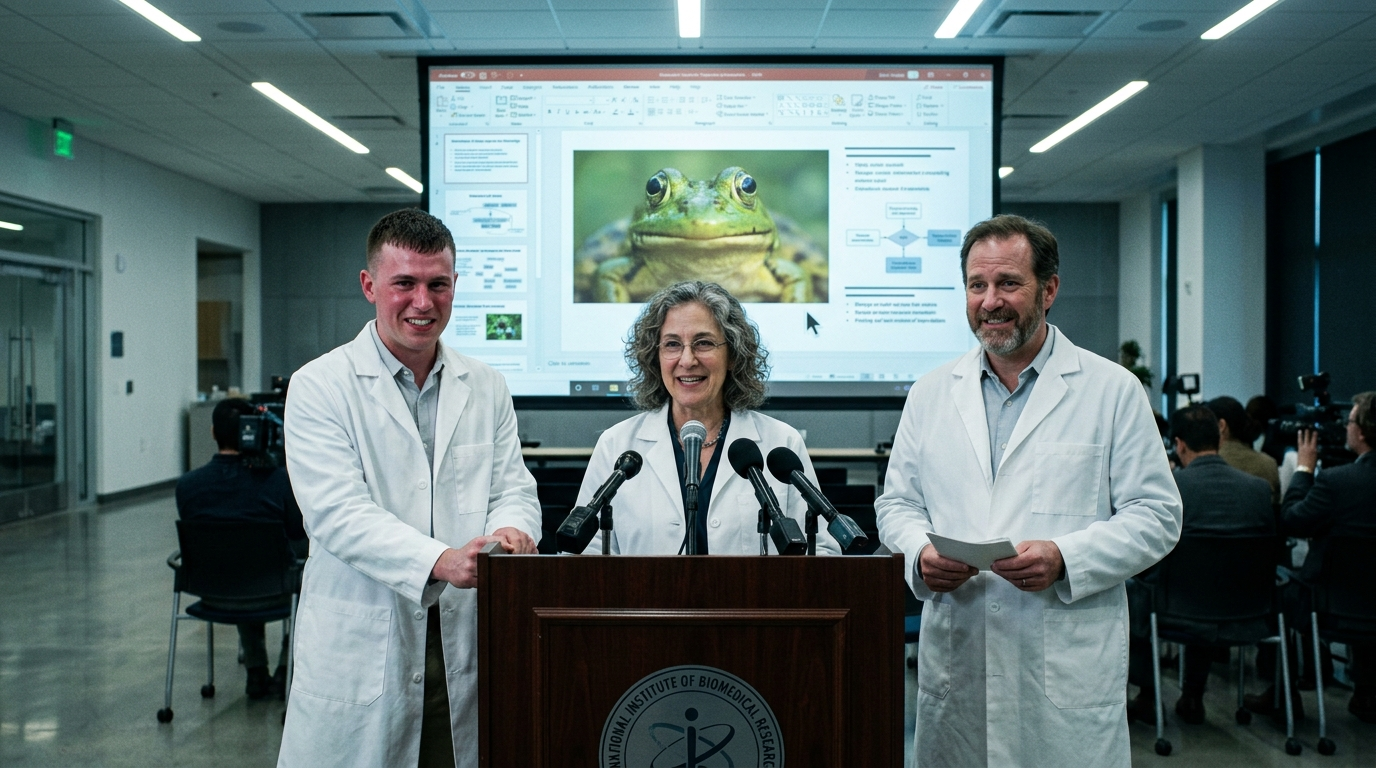
BETHESDA, MD — Federal health officials announced Tuesday that a naturally occurring bacterium found in the intestines of common North American frogs has demonstrated complete colorectal tumor elimination in early animal trials, calling the finding "a generational breakthrough in oncology" and "something we'd like everyone to be excited about before we get into the specifics."
"We are enormously proud to announce that a single-dose treatment derived from Amphibacillus ranae — a bacterium native to the digestive tract of the American bullfrog — has achieved 100% tumor regression in every mouse we treated," said Dr. Patricia Nguyen, lead researcher at the National Cancer Institute, pausing briefly before adding, "and that's where we'll stop for now, and open the floor to applause."
The announcement was met with a standing ovation from the assembled press, followed by a three-second silence when a reporter from Reuters raised her hand and asked about the frogs.
"We will be releasing a full FAQ," Dr. Nguyen confirmed.
The bacterium, first identified during what researchers describe as "a completely routine amphibian intestine survey," works by simultaneously attacking malignant cells and supercharging the body's immune response — eliminating tumors through what the NCI is calling a "dual-action mechanism" and what one anonymous lab technician described as "the frog just sort of handles it."

In an 87-page supplementary research document released alongside the announcement, the word "frog" appears 341 times — 340 in the methodology section, and one of which researchers confirmed was a typo for "from."
Officials were quick to note that no living frogs are required in the treatment process, as the bacterium can be cultured in laboratory conditions, though they acknowledged explaining this distinction "has been more time-consuming than anticipated."
"We want to be clear: patients will not be consuming frogs," said FDA Acting Commissioner Dr. James Okafor in a statement released Wednesday morning. "The treatment is a purified bacterial culture administered intravenously. There are no frogs involved in the clinical process. I cannot stress enough that the frogs themselves are not the treatment. Please do not eat frogs."
By Wednesday afternoon, sales of live bullfrogs on agricultural commerce platforms had increased 4,800%.
"I'm not going to wait for the FDA," said Gerald Pittman, 54, of Akron, Ohio, who told reporters he had been managing Stage II colon cancer for 18 months and had already ordered twelve frogs from a bait shop website. "I've read the study. I understand science. I'm eating a frog."

The NCI says Phase I human trials are expected to begin in Q1 2027, pending regulatory review. Dr. Nguyen expressed confidence that the treatment will ultimately reach patients, though she acknowledged the road ahead involves "a significant amount of explaining."
"This is the most exciting result I've seen in thirty years of oncology," she said. "It's also the most explaining I've done since I told my mother how mRNA vaccines work. So. Both things."
At press time, the research team had issued a formal request that media outlets refrain from using the headline "Scientists Find Cure For Cancer Inside Frog," noting that they had used this exact headline themselves six times in internal communications and found it "does not capture the appropriate scientific nuance."
More from The Overcorrect